
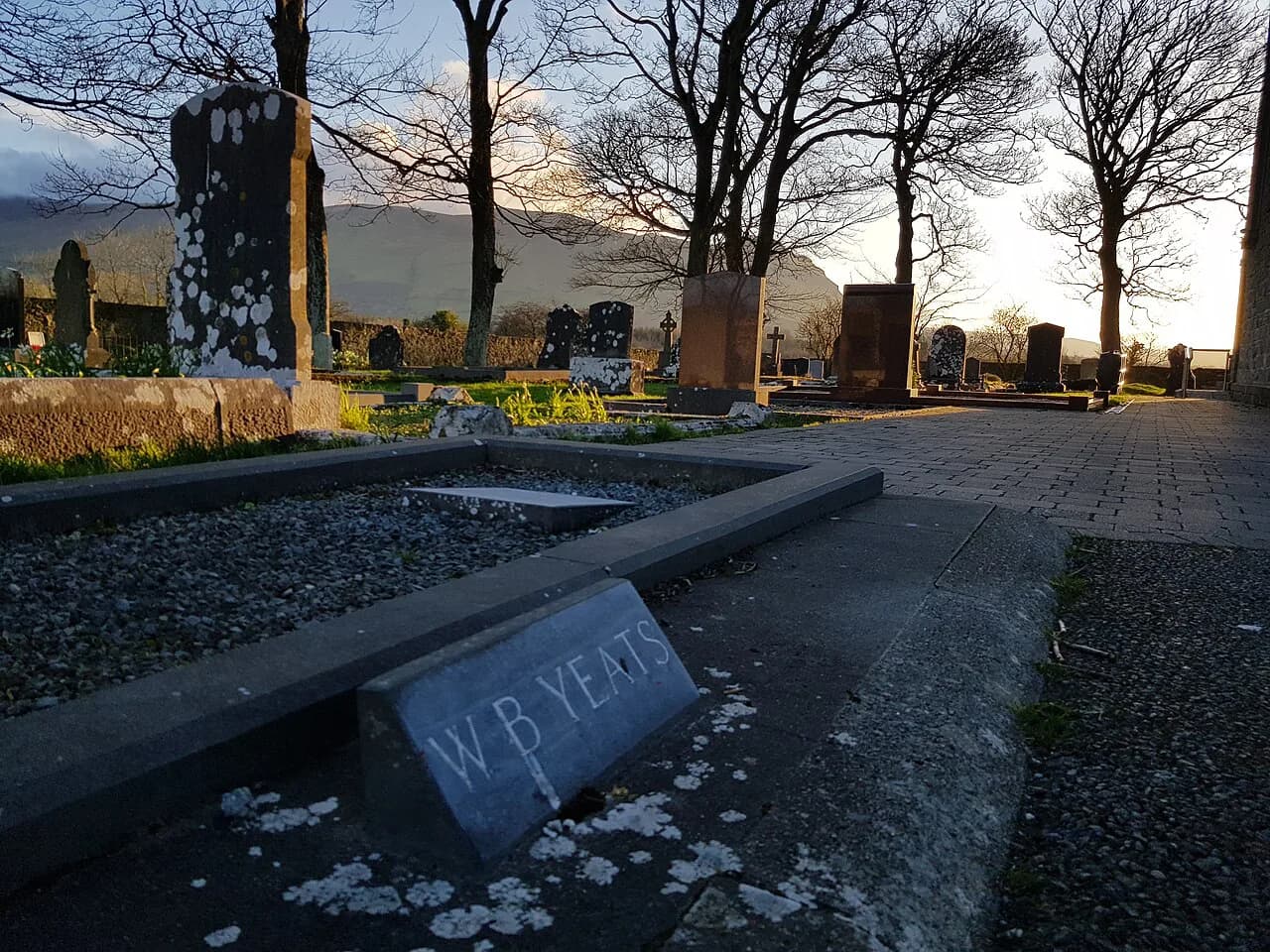
WB Yeats Grave at Drumcliffe: The Headstone and the Burial Puzzle
The WB Yeats grave at Drumcliffe draws visitors for its epitaph and Ben Bulben setting. Behind the headstone lies a documented burial puzzle worth understanding.
On this page
The WB Yeats grave is the headstone in the churchyard at Drumcliffe, County Sligo, associated with the poet and framed by the mountain of Ben Bulben. It draws visitors not because the site settles anything about the poet's remains, but because it concentrates his epitaph, his landscape and an unresolved historical question in one place. Read it as a literary memorial first and a forensic puzzle second, and the visit makes more sense.
The puzzle is real and documented rather than folk invention. Reporting in The Irish Times on French diplomatic papers describes how the coffin sent to Sligo for reburial in September 1948 was assembled from bones that could not be individually identified. That account does not settle whose remains lie under the stone, and it should not be read as a flat declaration that no part of Yeats is present.
What Visitors Come to See at Drumcliffe
The gravesite's public profile rests on the stone and its setting rather than on any confirmed identification of the remains. InsideHook reports that the grave in Drumcliffe continues to attract thousands of visitors each year, a measure of literary reputation rather than of archaeological certainty. That distinction is the key to reading the place honestly.
According to The Irish Times, Yeats wrote Under Ben Bulben, the poem that carries the epitaph, in the last month of his life. The epitaph's address to the passer-by places the grave in an old funerary tradition of stones that ask the traveller to stop and reflect, a point the paper attributes to Professor Warwick Gould of the Institute of English Studies. Knowing that, the marker reads as an invitation to pause rather than a biography panel.
Current visiting arrangements at the churchyard can change with the season, so confirm them with the site's own published information before you travel and treat secondhand planning detail as provisional. What the sources do support is the reason to go: a compact, legible memorial where the words, the stone and the mountain do most of the interpretive work.
The Documented Chronology: 1939 to 1948
The firm facts are few and worth keeping straight. Yeats died on 28 January 1939 at Roquebrune-Cap-Martin on the French Riviera, and the Second World War prevented his widow George from moving the body as he had asked. The Irish Times reports that in 1946 his remains were disinterred in France and mixed with other bones in the cemetery ossuary, which is where the identity doubt begins.
In January 1948 The Times announced that George Yeats intended to repatriate the poet's remains, and the exhumation in the Roquebrune ossuary followed on 20 March 1948. The reburial at Drumcliffe took place in September 1948. Those dates, rather than any later claim, anchor the story.
The interval matters to interpretation. Because the mixing had happened two years before the March 1948 exhumation, the people arranging the return were already working with material that could not be cleanly separated. That is why the reporting centres on what French officials wrote at the time rather than on anything discovered later, and it is why the grave reads as a memorial shaped by wartime delay rather than a planned reburial.
What the French Records Reported
The Irish Times bases its account on papers reportedly found among the effects of the French diplomat Jacques Camille Paris. They include a report by Bernard Cailloux, sent to Roquebrune in early 1948, stating that it was impossible to return the poet's full and authentic remains. Cailloux proposed that the local sworn pathologist reconstruct a skeleton showing the characteristics of the deceased.
One detail resists a tidy conclusion. Cailloux wrote that it might be possible to recover a skull along with other items, and Yeats was noted for an unusually large skull, so the paper describes it as conceivable that his skull was among the remains sent to Ireland. That is a possibility reported in the coverage, not a finding, and readers should not turn it into either a confirmation or a dismissal.
The records suggest the coffin held bones selected by size from piles sorted by type, and diplomatic correspondence implies Cailloux's recommendation was followed. The phrase used in the coverage is that the material was a haphazard assemblage. It is a careful way of saying the identity question cannot be closed by the paperwork that survives, however closely it is read.
The 1948 Ceremony and the Silence Around It
Doubt was present before the coffin reached Sligo. Friends of the poet tried to dissuade George Yeats from the repatriation, and at the ceremony the poet Louis MacNeice protested that the new coffin was more likely to hold a Frenchman than Yeats. The Irish Times records the remark as part of the public awkwardness of the occasion.
French officials handled the transfer with deliberate discretion. Correspondence quoted in the reporting shows concern that no inconvenient explanation be given to those present in Ireland, and the poet's son was informed only that his father's remains had been collected. That administrative quietness helps explain why the identity question stayed largely out of public view for decades.
When approached about the papers, Yeats's granddaughter declined to comment and pointed to a 1988 letter to the editor by the poet's children. Treat that reticence as part of the record: the family has chosen not to litigate the question publicly, and visitors should not expect the site to resolve it for them.
Stones Versus Bones: Why the Grave Still Works
Gould's framing, quoted in the coverage, is that shrines are about stones rather than bones, and that their symbolic force is designed to outlast human remains. That is not a dodge; it describes how literary memorials actually function. The visitor who knows the history can still find the place meaningful precisely because it asks for reflection rather than certainty.
Some readers look elsewhere for a sense of the poet's presence. The Yeats scholar Joseph Hassett told The Irish Times that he feels Yeats's soul is in Thoor Ballylee, the poet's former home in County Galway, and that the location of the body matters less. For travellers building a wider itinerary, that is a useful counterweight to treating Drumcliffe as the only Yeats site worth the journey. You can widen the trip with a separate stop at Coole Park, and browse the Literary Ireland guide for related literary places. If your route swings through the city itself, the museums in Galway make an easy add-on to the same western loop.
Brenda Maddox suggested in her 2000 biography that DNA analysis of the Drumcliffe remains would settle the matter, but the reporting makes clear no such testing has resolved it, and Irish officials are described as reluctant. Visitors should therefore expect an open question at the site, not a verdict.
Reading the Grave Without Overselling It
The most useful approach is to separate three things: the documented dates, the reported contents of the French files, and the meaning the stone carries for readers. The dates are firm, the file contents are reported by a serious newspaper from primary documents, and the meaning is cultural rather than forensic. Keeping those layers apart protects you from both credulous legend and cheap debunking.
If your interest runs to Ireland's literary landscapes more broadly, this grave sits within a wider set of places associated with writers and their worlds, including the Blasket Centre (Ionad an Bhlascaoid) in Dún Chaoin, where the island writers' world is interpreted. Use the Literary Ireland guide to place Drumcliffe in that company, and let the burial question remain a feature of the site rather than the whole reason for going.
Wider Trails for a Yeats-Focused Trip
Travellers who want to follow the poet's afterlife beyond Sligo have several distinct options rather than one circuit. The Patrick Kavanagh Centre in Inniskeen, a separate Irish poet's home place, makes a useful comparison for how a landscape and a body of work are presented together. Neither site substitutes for the other, and visiting both sharpens what is specific to Drumcliffe.
For a broader sense of how Ireland's writers drew on older traditions, the material culture of Irish storytelling offers context that a single grave cannot. You can read about ancient sites in Ireland for background on the older monuments of the wider landscape. Keep the connections loose: the grave is a modern literary marker, not an archaeological monument, and treating it as both blurs what each actually is.
Travellers who want to extend a western itinerary can pair this literary stop with other built heritage: the Glebe Gallery and Garden and the castles in county Galway are separate threads with their own arrangements. These are companions on an itinerary, not rival versions of the Drumcliffe experience. Plan them as separate stops and check each site's own opening details directly.
Reading the WB Yeats Grave Honestly
The WB Yeats grave at Drumcliffe is best understood as a literary shrine with a documented historical problem attached. Its power comes from the epitaph, the Ben Bulben setting and the fact that a major poet chose to be remembered there. The reporting on the 1948 reburial adds a layer of genuine uncertainty that deepens rather than erases that meaning.
Before you travel, confirm current access arrangements with the site's own published information, since no reliable opening or admission detail can be assumed from the sources here. Arrive prepared to read the stone slowly, to note the mountain behind it, and to hold the identity question as an open one. That is the most honest way to visit, and it is also the most rewarding.
Explore more Ireland guides
Frequently Asked Questions
Where is the WB Yeats grave?
The headstone associated with the poet stands in the churchyard at Drumcliffe in County Sligo, with Ben Bulben rising behind it. It is a literary memorial site that attracts visitors, not a museum display with an identification record attached. Check the churchyard's own notices for current visiting arrangements before you go.
Is Yeats actually buried at Drumcliffe?
The honest answer is that it is unresolved. Reporting in The Irish Times on French diplomatic papers describes a 1948 coffin assembled from bones that could not be individually identified, after the poet's remains had been mixed with others in a French ossuary. That reporting raises serious doubt without proving that no part of him is present, and no testing has settled the question.
Why were Yeats's remains disinterred in France?
Yeats died at Roquebrune-Cap-Martin on 28 January 1939, and the Second World War prevented his widow from moving the body at the time. He had asked to be buried initially in France and later reinterred in Sligo. By the time repatriation became possible, his remains had already been disinterred in 1946 and mixed with others in the cemetery ossuary, according to The Irish Times.
What did the French records say about the remains sent to Sligo?
According to The Irish Times, a report by the diplomat Bernard Cailloux concluded that it was impossible to return the poet's full and authentic remains and proposed that a local pathologist reconstruct a skeleton. Correspondence implies that suggestion was followed. The paper also notes it is conceivable that Yeats's unusually large skull was genuinely recovered, though that is reported as a possibility, not a finding.
Why does the grave still matter if the bones are uncertain?
Because shrines work through stone, words and setting rather than through forensic proof. The scholar Warwick Gould is quoted describing shrines as being about stones rather than bones. The epitaph Yeats wrote in the last month of his life, and the mountain behind the churchyard, give the site a meaning that does not depend on identifying every fragment of remains.
Should I visit Drumcliffe or Thoor Ballylee?
They answer different interests. Drumcliffe is the memorial and the epitaph; the Yeats scholar Joseph Hassett told The Irish Times that he feels the poet's soul is at Thoor Ballylee, his former home in County Galway. If you care about both the commemorative stone and the domestic world behind the poems, treat them as separate stops and check each site's own opening information.
Sources
You might also like



Continue reading
More guides you'll find useful





