
Borris House, Co. Carlow: A Visitor Guide to the MacMurrough Kavanagh Home
Plan a visit to Borris House in County Carlow, ancestral home of the MacMurrough Kavanaghs, and learn what the guided house tour and demesne include.
On this page
Borris House is the ancestral home of the MacMurrough Kavanaghs in the village of Borris, south County Carlow, and visits centre on a guided tour of the house rather than free-range wandering through the rooms. The house stands in the middle of Borris town, so it is reached on foot from the village street rather than at the end of a long private avenue.
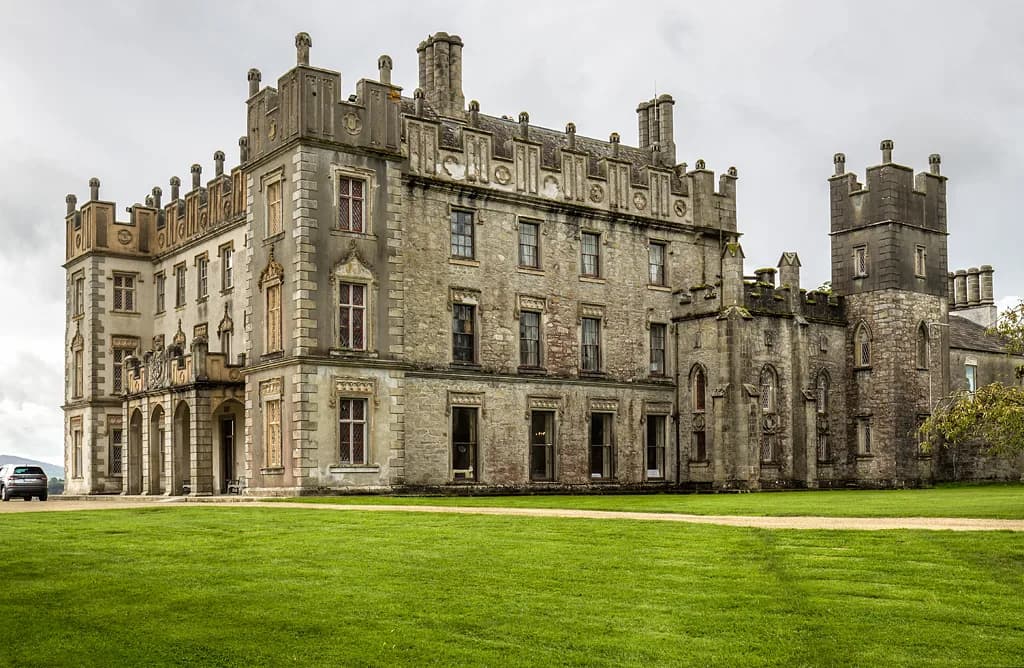
The building you see is not a medieval castle that survived intact. The present house was rebuilt in 1731 and then substantially remodelled in the early nineteenth century by Sir Richard Morrison and William Vitruvius Morrison, who gave it Tudor Gothic detailing. That pairing of an eighteenth-century core with later Gothic dress is the key to reading the facade and the interiors.
Where Borris House Sits
The house occupies a position in the centre of Borris, in south Carlow, with the wider estate spreading out from the village edge. Carlow Tourism gives the address as Borris, Co. Carlow, R95 Y2T1, with phone 059 9771884 and email info@borrishouse.com for enquiries, all of which are the published contact details to use before travelling.
The surrounding landscape is part of the experience: the National Inventory of Architectural Heritage describes the house as set against Mount Leinster and the Blackstairs Mountains, overlooking the River Barrow as it winds through woodland. That geography matters for planning, because it explains why the demesne setting and its approach is treated by Carlow Tourism as an attraction in its own right rather than mere grounds.
The Family and the Kings of Leinster Tradition
Borris House is presented by Carlow Tourism as the ancestral home of the MacMurrough Kavanaghs, kings of Leinster, and the heritage record likewise notes that the house traces its ancestry to the royal ruling families of ancient Ireland. Treat that descent as the family's and the heritage record's tradition rather than as settled, independently proven genealogy; it is the frame the house itself uses to tell its story.
That Leinster royal connection has a wider architectural afterlife in the south-east. Aoife MacMurrough, daughter of the Leinster king Diarmait, is associated with the medieval fortress remains at the rock of dunamase in County Laois, which makes a useful companion stop for travellers tracing the same dynastic thread across the region. If the dynastic story pulls you further, the ancient sites ireland guide sets tombs and trackways alongside such fortresses, and the castles in county galway guide carries the same thread westward through later tower houses and fortified homes.
From 1731 Rebuilding to Tudor Gothic Remodelling
The architectural sequence is the most concrete thing to hold onto when touring the house. The building was rebuilt in 1731, and the Morrisons' early nineteenth-century work introduced Tudor Gothic motifs including curvilinear hood mouldings and battlemented parapets, according to the National Inventory of Architectural Heritage. Look for those battlements and moulded window heads on the exterior before you go inside.
Sir Richard Morrison and his son William Vitruvius Morrison were responsible for that remodelling, which is why the house reads as a layered composition rather than a single-period building. Visitors who expect a pure Georgian box or an untouched medieval tower will find something more composite, and more interesting for it: the Gothic skin sits over an earlier structure.
For readers building a wider picture of Irish building history, this house is a good case study in how Irish country houses were repeatedly refashioned. That pattern recurs across the island's architectural story, from tower houses to nineteenth-century remodelling, and the broad irish architecture context helps place Borris within it.
Inside the House Tour
The interior is a suite of named rooms, and knowing them in advance helps you follow the guide. The National Inventory records an entrance hall with florid plasterwork by George Stapleton, a dining room with columnar screens, a bow-ended drawing room and a vaulted library. Those four spaces are the spine of the tour.
The house retains much of its original furniture and paintings in situ, so the rooms are shown furnished rather than as empty period shells. That continuity is what distinguishes a lived-in family house from a museum display, and it is worth asking the guide which pieces have stayed with the rooms and which have been brought back.
The Demesne, Gardens and Landscape Features
Carlow Tourism describes 650 acres of woodland and gardens around the house, with a demesne parkland landscape of serpentine avenues capturing views of Mount Leinster, the Blackstairs Mountains and Mount Brandon. Walking the grounds is a separate activity from the interior tour, so treat the two as different parts of a visit rather than one continuous ticket.
Among the landscape features the tourism authority names are specimen trees, the original stew pond and an eighteenth-century ice house, all of which reward a slower walk with attention to the ground rather than the skyline. The Lace Garden is also listed as part of the grounds, alongside the restored Victorian laundry.
The Granary Film, Laundry and Lace Museum
In the recently restored Granary, visitors can watch a film on the history of the McMorrough Kavanaghs and Borris House, which is a sensible first stop because it gives the family narrative before you enter the rooms. The same source notes a restored Victorian laundry on the grounds, a reminder that the working estate extended well beyond the principal rooms.
The National Inventory states that visitors to Borris House can avail of tours of the adjoining private chapel and the recently restored Borris Lace Museum. Read that carefully: these are tour inclusions described alongside the house visit, not separate attractions with open public access, so do not plan to drop into the chapel or museum independently.
The Store at Borris House sits at the front gate entrance and sells local crafts, jewellery, ceramics, leather goods and textiles. It is a distinct stop from the house tour, useful at the start or end of a visit rather than something to fold into the guided hour.
Practical Visiting: Dates, Tour Times and Booking
Carlow Tourism publishes a seasonal pattern of opening in July and August, with house tour times given as 1pm and 2pm, and notes opening at other times through the year with instructions to check the website for precise times. Those dates and times are attached to specific seasonal notices, so verify the current calendar on the official Borris House site before you build a day around them rather than assuming a walk-in tour.
A fee applies and the amount should be checked with the house, since the published admission detail points readers to the website for current charges. A secondary travel guide indicates that visits are booked in advance, which is a reasonable habit to adopt even where not stated, but confirm directly rather than relying on third-party summaries.
The Festival and the House's Cultural Role
Borris House is the venue for the Borris House Festival of Writing and Ideas, according to Carlow Tourism. That gives the house a contemporary cultural function beyond the tour circuit and explains why its calendar can look different from a standard heritage property's, with event programming potentially affecting access on particular days.
For travellers interested in how Irish buildings are used today rather than only preserved, this is the relevant angle: an ancestral house that still hosts family life, tours and a public ideas festival is a working inheritance, not a frozen exhibit. The wider Ancient Sites in Ireland material is a reasonable next step for readers extending an architectural trip beyond Carlow, and the castles in county galway guide covers another branch of that same building story.
Who Borris House Suits
Borris House rewards travellers who want a guided, inhabited country house with a genuine architectural story: a 1731 core, a Morrison Gothic remodelling, furnished rooms and a demesne with named landscape features. It suits visitors who are content to plan around fixed tour times and confirm the calendar before travelling.
It is a poor fit for anyone seeking unescorted access to the interiors or guaranteed drop-in tours, and the chapel and lace museum should not be treated as standalone open attractions. Check the official website for the current schedule and admission before setting out, and use the published Borris contact details for questions the calendar does not answer.
Explore more Ireland guides
Frequently Asked Questions
Can you visit Borris House without booking?
Do not assume it. Carlow Tourism publishes house tour times of 1pm and 2pm alongside specific seasonal dates, which suggests a scheduled rather than continuous tour model, and secondary material indicates advance booking is the practice. Confirm the current arrangement on the official Borris House website before travelling.
What does the Borris House tour cover?
The interior tour covers a suite of rooms including an entrance hall with George Stapleton plasterwork, a dining room with columnar screens, a bow-ended drawing room and a vaulted library, shown with original furniture and paintings. The National Inventory also mentions tours of the adjoining private chapel and the Borris Lace Museum as part of a visit; treat these as tour inclusions rather than separately open attractions.
Is Borris House a medieval castle?
No. The present house was rebuilt in 1731 and remodelled in the early nineteenth century by Sir Richard Morrison and William Vitruvius Morrison, who introduced Tudor Gothic motifs such as curvilinear hood mouldings and battlements. Its ancestry reaches back to the royal families of ancient Ireland, but the standing building is not a medieval fortress.
Is the Borris Lace Museum separately open to the public?
It is described as a tour inclusion alongside the adjoining private chapel rather than as an independently open attraction. Plan it as part of a house visit and confirm with the house whether it is included on the day you attend.
Can you walk the Borris House demesne independently?
Carlow Tourism describes 650 acres of woodland and gardens with avenues, specimen trees, a stew pond and an eighteenth-century ice house, but that does not establish free public walking at all times. Ask the house about grounds access when you confirm your visit.
Where exactly is Borris House?
It is in the centre of Borris town, in south County Carlow, with the published address Borris, Co. Carlow, R95 Y2T1. Carlow Tourism gives phone 059 9771884 and email info@borrishouse.com for direct enquiries.
What else is on the estate besides the house?
The Granary shows a film on the family and house, the Lace Garden and restored Victorian laundry are on the grounds, and the Store at the front gate sells local crafts and textiles. Treat these as separate stops from the guided interior tour.
Sources
You might also like



Continue reading
More guides you'll find useful





