

Irish Thatched Cottages: The Craft and Three Cottages to Visit
Irish thatched cottages are a living building tradition, not one postcard image. See why the craft is under pressure and how to visit three documented examples.
On this page
Irish thatched cottages are better understood as a working building tradition than as a single postcard type. Thatch has to be replaced periodically, which keeps a thatcher's craft in demand, and the cottages that survive served very different purposes, from rebel refuge to summer retreat to ornamental folly. The Heritage Council, the State's heritage advisory body, frames thatching as a critically endangered traditional skill, and three Heritage Ireland properties open to visitors show how far apart thatched buildings can be in date and intention.
What Thatch Is and Why It Needs Care
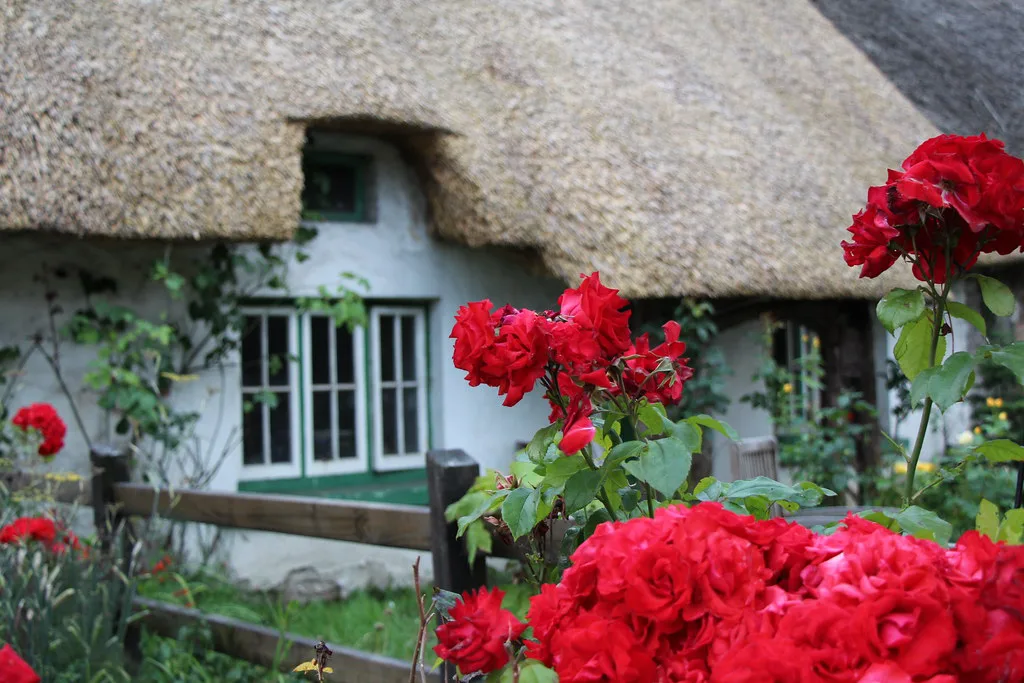
A thatched roof is a covering of plant material laid and fixed by hand, and it does not last indefinitely. The material must be renewed from time to time, so every thatched building depends on a continuing supply of trained workers as much as on the original builder's design. This maintenance cycle is the practical reason thatch is a living tradition rather than a preserved finish.
The Heritage Council describes the craft as being at a critical point in Ireland, with a serious shortage of thatchers to look after these buildings. It also notes that the skill was historically handed down within families, a pattern that no longer tends to hold. That break in transmission, rather than any lack of interest in old buildings, is what makes the roof type vulnerable.
For visitors, the takeaway is that a thatched roof you see on a drive is the product of ongoing work, not a relic left untouched since construction. Understanding that changes how you read these buildings: the roof is the most renewable part of the structure and the part most exposed to changes in the labour market.
Skills, Grants and Owner-Side Pressures
The Heritage Council has documented the difficulties that owners and prospective buyers face, particularly in securing insurance cover for thatched property. Its advice page describes the problem in terms of insurers' risk perceptions and the knock-on effect on mortgages and sales. That material is aimed at owners, not at visitors, and it should not be read as travel planning information.
The same page sets out funding routes for repairs, including a Department of Housing, Local Government and Heritage thatching grant for owner-occupied houses and ring-fenced money under the Built Heritage Investment Scheme. It also refers to 2023 fire-safety guidance warning that solid fuel stoves present a greater risk to thatch than other heating, including traditional open fires, and the Heritage Council strongly encourages owners not to use them. These are practical supports for people responsible for the buildings, and they sit alongside the craft-training effort rather than replacing it.
One response to the thatcher shortage was the introductory course the Heritage Council announced with Kilkenny and Carlow Education and Training Board, which began on 20 January 2025 in Sheepstown, County Kilkenny and ran for 42 weeks with a work placement included. It was described at the time as the first course of its kind since 2009. That programme is now a dated milestone in the sector's history rather than a course open for enrolment, so anyone seeking current training should approach the Heritage Council or KCETB directly instead of assuming it is running again.
Cottage One: Dwyer McAllister Cottage, County Wicklow
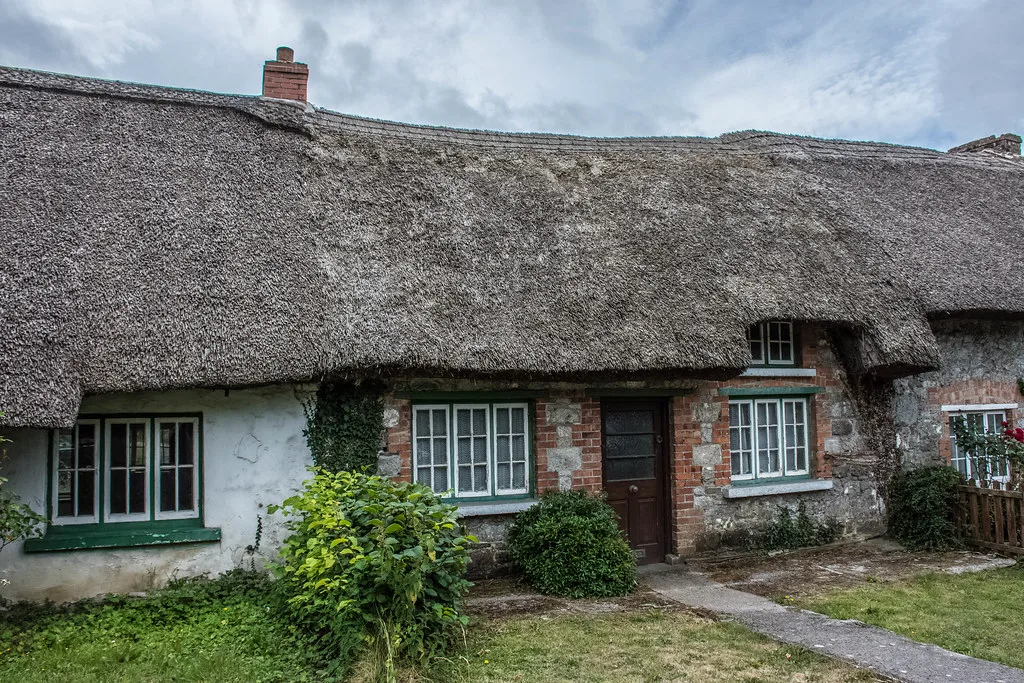
Dwyer McAllister Cottage is a thatched and whitewashed building below Keadeen Mountain, off the Donard to Rathdangan road in County Wicklow. In the winter of 1799, in the aftermath of the 1798 Rebellion, the rebel Michael Dwyer fought off encircling forces here; his comrade Samuel McAllister drew fire and was killed, allowing Dwyer to escape across the mountains. The story gives the building a place in insurrection history that few rural cottages can claim.
The cottage was later burned and lay in ruins for almost 150 years before being restored in the twentieth century. Inside, the presentation includes everyday objects of the period, such as a roasting spit and a churn, alongside weapons like pikes that belonged to conflict rather than domestic life. The mixture is useful: it shows a cottage interior as both a home and, in this case, a battleground.
Access requires planning. The published season runs June to September, daily from 14:00 to 18:00 with last admission 45 minutes before closing, and visitors are asked to telephone two days ahead to arrange entry. The site notes limited access and uneven walkways, so it suits those prepared for rough ground. On 23 October 2026 the cottage is outside that published season, and entry should not be assumed.
Cottage Two: Pearse's Cottage at Ros Muc, Connemara
Ionad Cultúrtha an Phiarsaigh, better known as Pearse's Cottage, stands at Ros Muc in the heart of the Connemara Gaeltacht off the R340. Patrick Pearse, a leader of the 1916 rebellion, built it as a summer cottage for himself. The visitor centre interprets the landscape and the Gaelic culture and language that drew him there, and local guides lead the interpretation.
The cottage itself is reached by a short stroll across the bog, and it is presented as it was when Pearse left for the last time in 1915. That detail makes the visit as much about the approach through wet Connemara ground as about the building. A café on site carries a 2026 notice, and visitors with disabilities should note the restricted access reported for the property.
Opening is daily, with April to October hours of 09:45 to 18:00 and November to April hours of 09:30 to 16:00; last admission is 45 minutes before closing in both seasons. A typical visit is estimated at one to one and a half hours, which is realistic once the walk and the centre are counted. Because the site sits deep in the Gaeltacht, it pairs naturally with a wider look at the castles in County Galway rather than being squeezed into a coastal dash.
Cottage Three: The Swiss Cottage near Cahir, County Tipperary
The Swiss Cottage, about two kilometres south of Cahir, is a cottage orné: a deliberately fanciful version of an ideal countryside cottage, used for picnics, small gatherings and fishing and hunting parties, and as a retreat from the nearby big house. It was built in the early 1800s by Richard Butler, first Earl of Glengall, and the official account believes the Regency architect John Nash was persuaded to design it. Its present name appears to come from a resemblance to an Alpine cottage.
Inside are a graceful spiral staircase and decorated rooms whose wallpaper is partly original and partly the result of a 1980s restoration in which the fashion designer Sybil Connolly was responsible for the interiors. It is a thatched building, but reading it as a typical rural dwelling would miss the point: this is architecture designed to look rustic while serving polite leisure. If you want a broader frame for the buildings around it, the Irish Architecture guide offers a useful place to start. For a similar comparison of designed heritage in another county, see our guide to castles in Kilkenny.
The 2026 season runs from 12 March to 4 November, daily 10:00 to 18:00 with last admission at 17:15. The interior can be seen by guided tour only, on a first come, first served basis, with a maximum of 12 people per tour; groups of ten or more must pre-book, indoor photography is not allowed, and access is limited. Approach the cottage via Cahir and the R670 only, as access from the R668 Clogheen road is not permitted.
Reading the Three Cottages Together
Put side by side, the three buildings show how little "thatched cottage" tells you on its own. Dwyer McAllister is a rebel refuge turned period exhibit, Pearse's Cottage is an intellectual retreat embedded in a Gaeltacht landscape, and the Swiss Cottage is an ornamental retreat with a designed interior. Thatch unites them in material, not in meaning or date.
That distinction matters when you plan a visit. Each property publishes its own season, hours and entry arrangements, and one site's arrangements do not carry over to another. Irish Architecture, from medieval towers to country houses, offers a useful frame for placing these cottages in context, but the site pages remain the authority on access.
Respecting the Rest
Many thatched houses on Irish roads are private homes, and a roof that invites a photograph is not an invitation to enter. Visitors should enjoy them from a safe public viewpoint and reserve interior visits for properties that publish opening arrangements. That courtesy is part of why the remaining buildings survive in use rather than as exhibits.
The maintenance work behind the roofs continues beyond the visitor season. Anyone interested in the craft itself should follow the Heritage Council's advice pages, and anyone planning a specific visit should confirm hours with Heritage Ireland shortly before travelling.
Plan Your Visit
Start with the type of cottage you want to see: a battle site with period objects in Wicklow, a Gaeltacht retreat in Connemara, or a designed cottage orné near Cahir. Then check the season and the entry method for that individual property, since one is phone-ahead and seasonal, one is daily with shorter winter hours, and one runs on first-come guided tours. If you want wider context on Ireland's built heritage before or after, the Rock of Dunamase in County Laois gives a very different sense of what survives from the past.
Explore more Ireland guides
Frequently Asked Questions
Why is there no single type of Irish thatched cottage?
Because thatched roofs were applied to buildings serving very different purposes and periods. Dwyer McAllister Cottage is associated with the fighting of winter 1799, Pearse's Cottage was built as a summer retreat in the Connemara Gaeltacht, and the Swiss Cottage is an early nineteenth-century cottage orné designed for leisure. Thatch is the shared material, not a shared building type.
Why does thatch need regular replacement?
The roof covering is plant material that has to be renewed periodically, so a thatched building depends on available thatchers as well as on care from its owners. The Heritage Council has warned that the craft is at a critical point in Ireland owing to a shortage of thatchers.
Can I just turn up at Dwyer McAllister Cottage?
Not reliably. Its published season is June to September, daily from 14:00 to 18:00, and visitors are asked to telephone two days in advance to arrange access. Outside that season, including late October, entry is not promised, so check with Heritage Ireland before travelling.
Is Pearse's Cottage open in winter?
Yes, it opens daily all year, but the winter season from November to April closes earlier than the April to October season. Last admission is 45 minutes before closing in both cases, and the site reports restricted access for visitors with disabilities.
Do I need to book the Swiss Cottage tour?
No booking is described for individuals; interior access is by guided tour on a first come, first served basis, with a maximum of 12 people per tour. Groups of ten or more must pre-book. Arrive early in busy summer periods and expect delays, and note that indoor photography is not allowed.
Which road should I use to reach the Swiss Cottage?
Access is via Cahir and the R670 only. The official page states there is strictly no access from the R668 Clogheen road, so set your route through Cahir rather than approaching from the wrong side.
Can I visit privately owned thatched houses I pass on the road?
No. Many thatched buildings are occupied homes rather than visitor attractions, and their owners' privacy should be respected. Confine interior visits to properties that publish opening arrangements, such as the Heritage Ireland sites described here.
Sources
- Thatched Properties | An Chomhairle Oidhreachta
- Critically endangered skill given lifeline with launch of first thatch training course in 15 years | The Heritage Council
- Ionad Cultúrtha an Phiarsaigh Conamara- Pearse’s Cottage and Visitor Centre | Heritage Ireland
- Dwyer McAllister Cottage | Heritage Ireland
- The Swiss Cottage | Heritage Ireland
You might also like



Continue reading
More guides you'll find useful



