
Clonalis House: O'Conor Seat, Collection and Visit Planning
Clonalis House near Castlerea is the O'Conor Don family seat, built circa 1878. See what the guided tour covers and how to plan around its short summer season.
On this page
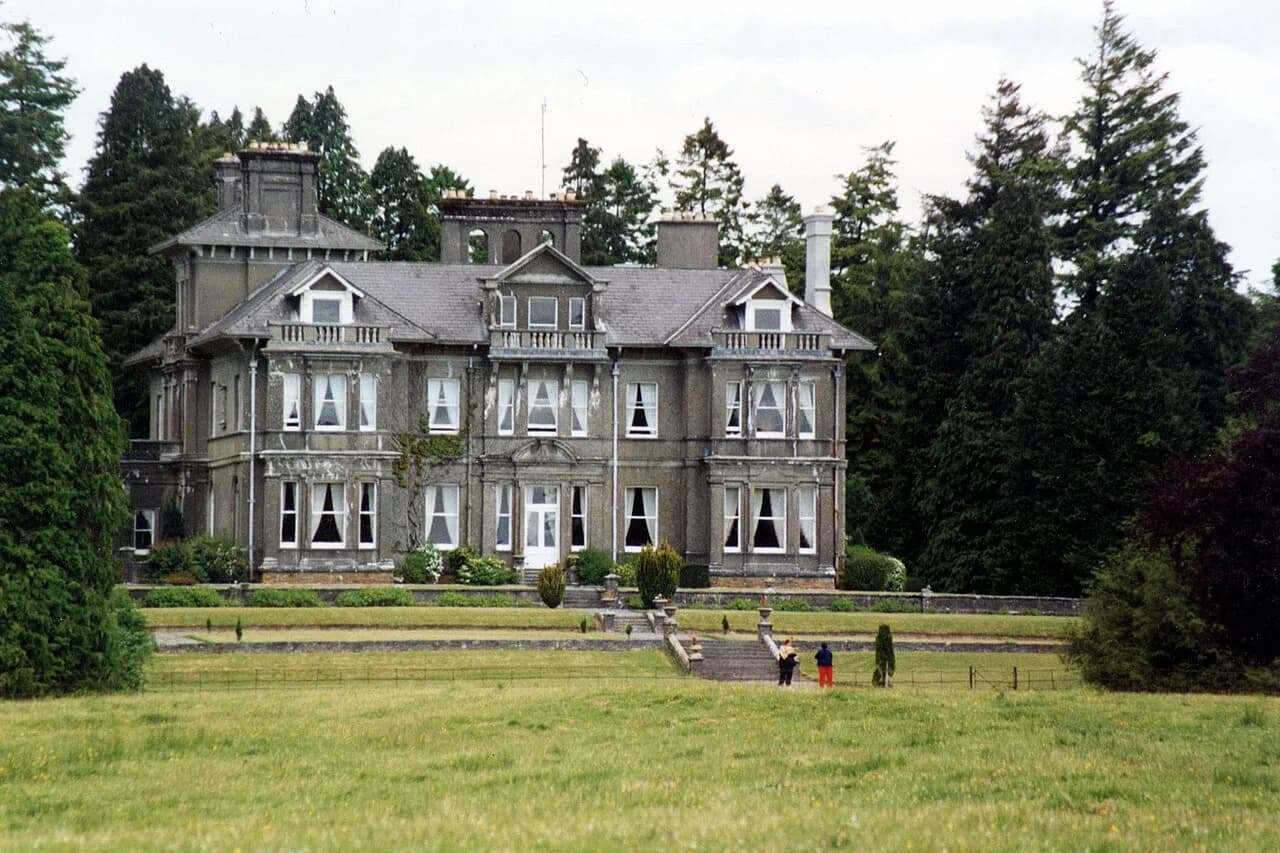
Clonalis House, outside Castlerea in County Roscommon, is the seat of the O'Conor Don family and remains a lived-in country house rather than a state-run museum. Visits are by guided tour, and the present building is Victorian: the family's association with the estate is far longer than the house itself. The distinction matters, because anyone expecting a medieval castle will instead find a 19th-century Italianate house packed with an older documentary and musical collection.
A Victorian House on an Older Family Estate
Historic Houses of Ireland places Clonalis outside Castlerea and describes it as the ancestral home of the O'Conor family, presented by that source and by the house itself as descendants of Ireland's last High Kings and traditional Kings of Connacht. That royal lineage is the family's and heritage bodies' long-held framing rather than a settled genealogical verdict, so read it as tradition with deep roots. The present house was built by Charles Owen O'Conor Don in 1878 to replace a late 17th-century house that now stands ruined, which keeps the building's age clearly separate from the estate's much longer tenure.
The O'Conor Archive is substantial: over 100,000 manuscripts, many in Irish and some reaching back to the 16th century, alongside family portraits and a library of more than 7,000 books. Much of that library was gathered by the 18th-century antiquarian Charles O'Conor of Belanagare. For a visitor, the practical point is that this is a working family archive shown in furnished rooms, not a curated national exhibition with object labels at every turn.
Cockerell's Design: Tower, Gables and the Garden Front
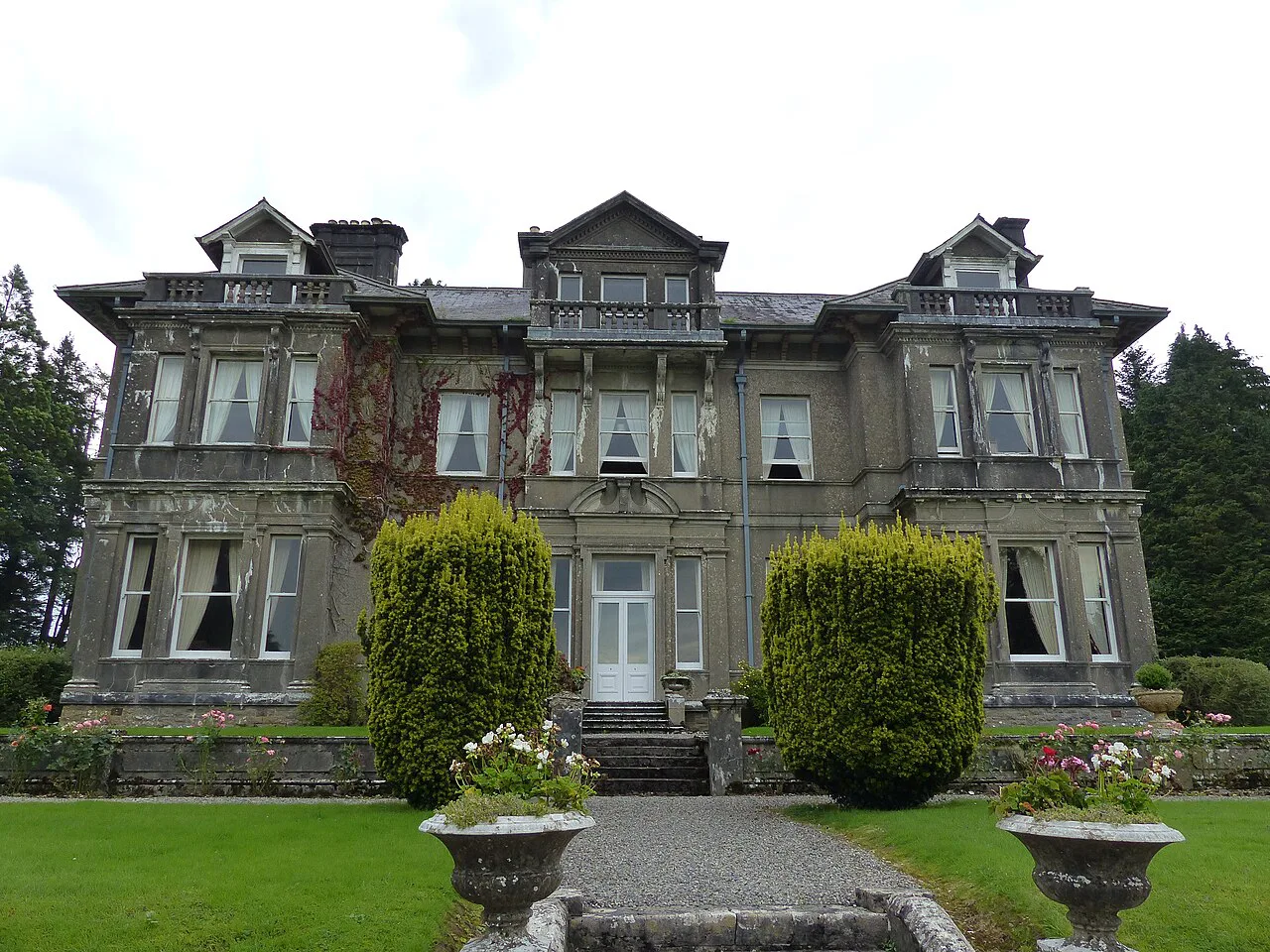
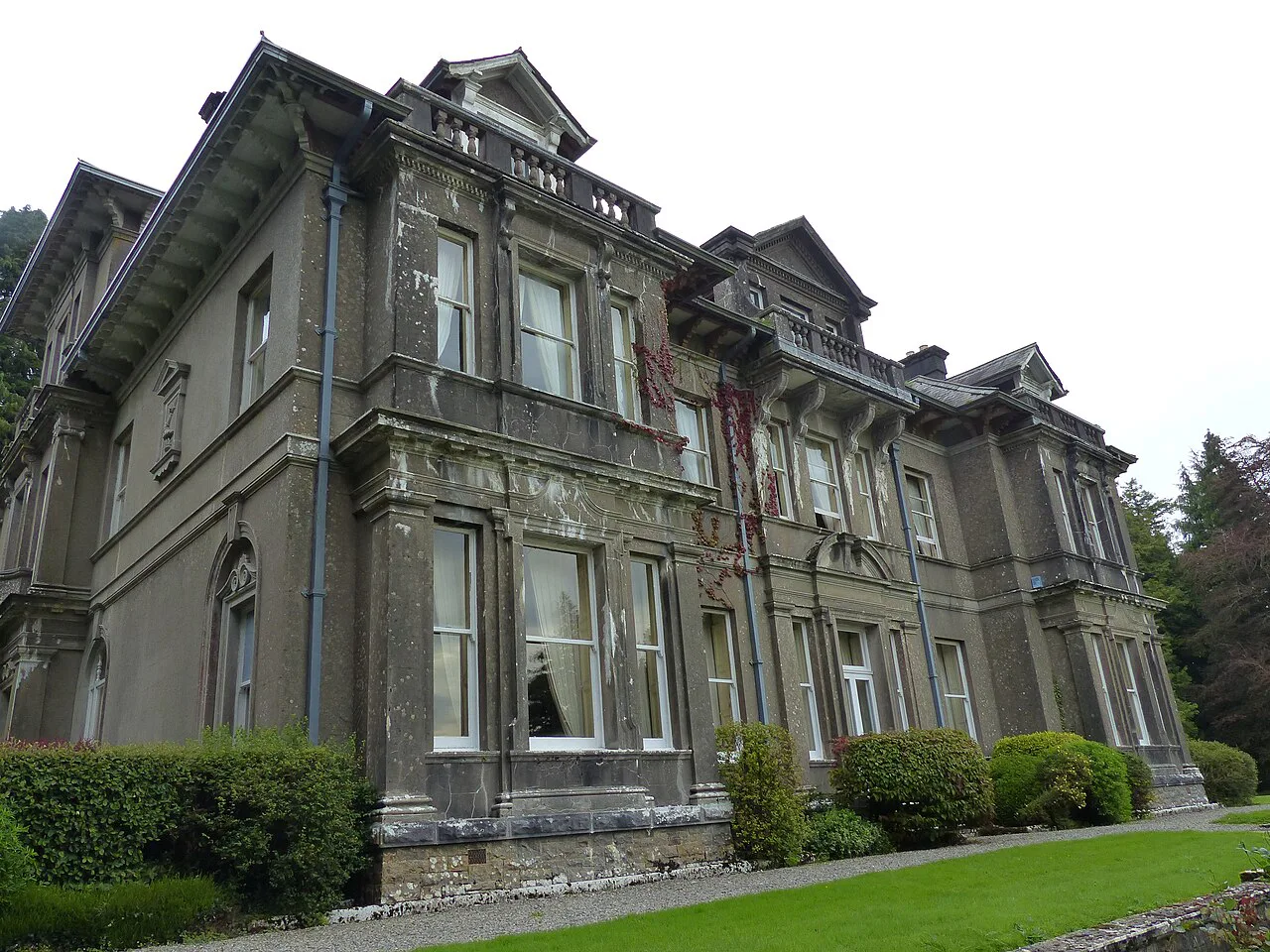
The English architect Frederick Pepys Cockerell designed Clonalis in a transitional style, part Italianate and part Queen Anne revival, and Historic Houses of Ireland notes he was trying to establish an Irish practice at the time. The entrance front has a square central tower, while the garden front is symmetrical, with projecting half-octagonal end bays, gables, balconies and tall chimneys. Inside, a large entrance hall with pink marble columns leads to reception rooms fitted with tripartite chimneypieces in marble, flanked by niches for turf and timber.
The Irish Georgian Society independently dates the house to about 1878 and describes it as late Victorian Italianate, one of the first buildings in Ireland constructed from poured concrete, in its characterisation. That attribution is worth knowing if you follow building history, because concrete construction is unusual in an Irish country house of this date and style. The society also records conservation grants in 2022 for timber sash windows and in 2024 for work to the front facade, naming the architects and contractors involved, which shows the fabric is being maintained rather than frozen.
Inside the Collection: Manuscripts, Harp and Inauguration Stone
Guided tours are built around the family's collection, which the operator lists as antique furniture, historic treasures and more than 100,000 archived manuscripts. Among the highlights named are the harp of Turlough O'Carolan, the last of the great Irish bards, and the inauguration stone of the O'Conor kings. A 16th-century verdict under Brehon Law is also cited among the tour stops, giving the collection a legal as well as a musical dimension.
Perhaps the single most important book at Clonalis is the Book of O'Conor Don, written by Irish monks at Ostend in 1632, which Historic Houses of Ireland singles out from the library. Seeing a 17th-century manuscript in a family room rather than a museum case changes how you read it: the house is the context, and the tour guide's account ties object to family. The trade-off is that you cannot browse at will, so listen for the pieces you most want to understand and ask about them.
If the Gaelic and medieval material is what draws you, it helps to have seen other Irish sites first. The collections here sit within a wider story of Irish architecture, and a comparison with earlier stone-built places sharpens what is distinctive about a Victorian house holding older artefacts. For that earlier layer, our guide to ancient sites ireland covers the tombs, forts and trackways that predate any country house, and the castles in county galway guide picks up the story with later fortified sites.
Planning Around the Short Tour Season
Ordinary guided day tours run from 21 June to 31 August, Monday to Saturday, according to the operator, with two Heritage Week Sundays named on the day-tours page. Tours start outside the main entrance door and last roughly 45 minutes to an hour. The operator states adult admission at €14.50, senior and student at €12.50, and children at €6.50, and advises booking online in advance. Treat all of this as tied to the published season rather than a permanent timetable, since the operator reserves the right to change dates and times without notice.
The operator's own pages disagree on the last tour of the day, with one giving 1pm and another 3.00pm, so do not build a tight schedule around either figure. Confirm the day's last departure when you book, and allow margin either side in Castlerea. Tours are also suspended on event days, which the operator asks visitors to check before travelling.
For architecture in the same vein, Borris House, Co. Carlow offers another privately held country house with a family story, useful if you are assembling a wider itinerary of Irish houses rather than a single stop.
Group Tours and the April to September Window
Pre-booked large group tours run from 1 April to 30 September and are arranged by email, according to the operator's visitor FAQ, which widens the window well beyond the summer day-tour season. The operator also offers tailored group tours where a member of the O'Conor family shares the stories behind the treasures. Private dining in the main house can be arranged by appointment for groups or retreats, though that is a separate arrangement from a standard visit.
For an independent traveller, the trade-off is simple: the day-tour route asks you to fit a short summer window and book ahead online, while the group route suits parties who can organise in advance and travel outside midsummer. Neither route promises a walk-up tour in October, so pick your window and plan the booking around it.
Access, House Rules and What to Expect Inside
The operator is explicit that access to the house is not level, that there is no lift and that there are steps inside; visitors with limited mobility are asked to make contact before travelling so arrangements can be discussed. Prams and pushchairs are not allowed in the house, only small bags are permitted, and photography indoors and drones are prohibited because Clonalis is still a family home. These are firm house rules rather than preferences, and knowing them in advance avoids friction at the door.
The same still-inhabited character explains why the collection is shown on a guided route rather than as a free-flow exhibition. You get an hour of concentrated context, but you cannot linger alone or photograph details for later study. Reading up beforehand on the O'Conor family, the Brehon Law material and O'Carolan helps you use that hour well.
Gardens, Grounds and the Estate Outdoors
The gardens at Clonalis are private and can only be seen by joining a tour or staying in the guest accommodation, so do not plan a casual garden stroll as an alternative to the house. Beyond the formal lawns, the operator encourages guests to use the estate's rolling grounds and woodland walks, and notes there are rivers on the estate where children and anyone who cannot swim must be closely supervised at all times. Weather advice is straightforward: expect rain and bring suitable footwear and a jacket.
Historic Houses of Ireland describes the house as surrounded by formal lawns and terraces with views over the park, which is the setting you are paying for as much as the rooms. For contrast, a roofless medieval site such as the Rock of Dunamase in County Laois shows what an unprotected Irish stronghold looks like today, a useful counterpoint to a maintained family house.
Out of Season: Plan for Next Season
As of 23 October 2026, both stated tour windows at Clonalis have closed for the year: ordinary day tours ended on 31 August and the April to September group-tour slot has also passed. Nothing in the operator's published material sets a reopening date for the following season, so there is no reliable date to plan around yet. Check the operator's own pages for the next season's dates before booking travel or accommodation.
The sensible approach is to treat this guide as next-season preparation: decide whether you need the day-tour format or a pre-booked group visit, read up on the collection, and confirm the season, last tour and accessibility arrangements directly when bookings open. Self-catering cottages are listed as available all year round, but availability and rates are matters to confirm with the operator rather than assume.
If you are touring Ireland's historic houses more widely, the same principle applies everywhere: published seasons are short and changeable, and the primary record is the house's own site. Use independent heritage sources to understand what you will see, then verify the practical details at the source before you go.
Plan Your Visit
Clonalis House rewards a prepared visitor: a circa-1878 Italianate house attributed to Cockerell, held by the O'Conor family, with a collection spanning manuscripts, the O'Carolan harp and the Book of O'Conor Don. It is not a state museum, not a medieval castle and not a place to wander into off-season. Book within the published window, confirm the day's arrangements, and give yourself time in Castlerea either side of the tour.
Explore more Ireland guides
Frequently Asked Questions
When can you tour Clonalis House?
The operator publishes ordinary guided day tours from 21 June to 31 August, Monday to Saturday, plus two named Heritage Week Sundays. Larger pre-booked group tours run from 1 April to 30 September and are arranged by email. Outside those windows there is no published tour access, so confirm current dates on the operator's site before planning travel.
How long does the Clonalis House tour take and what does it cost?
The operator describes the guided tour as lasting roughly 45 minutes to one hour and publishes a tiered admission price for adults, seniors and students, and children. Those figures belong to the stated summer season rather than a permanent rate card, and the operator reserves the right to change dates and times. Check the price and duration at the time of booking.
Can you visit the Clonalis gardens without booking a tour?
No. The operator states the gardens are private and can only be accessed by taking a tour or staying in the guest accommodation. The estate grounds and woodland walks are described for guests, and rivers on the estate require close supervision of children and non-swimmers.
Is Clonalis House accessible for visitors with limited mobility?
The operator advises that access to the house is not level, that there are steps inside and that there is no lift. Visitors who need assistance are asked to contact the house in advance so arrangements can be discussed. Because the building is a family home with historic thresholds, plan for assistance rather than assuming step-free access.
What is there to see inside Clonalis House?
The guided route covers richly furnished reception rooms and a collection that includes more than 100,000 archived manuscripts, family portraits, a library of several thousand books, the harp of Turlough O'Carolan, the O'Conor inauguration stone and a 16th-century Brehon Law verdict. The Book of O'Conor Don, written by Irish monks at Ostend in 1632, is among the most important volumes.
Can you take photographs inside Clonalis House?
No. Indoor photography is not permitted and drones are banned, because Clonalis remains a family home. Prams and pushchairs are also excluded from the house, and only small bags may be carried inside. Leave larger kit in the car and plan to remember the rooms rather than photograph them.
What should I confirm before travelling to Clonalis?
Confirm three things with the operator: that tours are running on your chosen date, the departure time of the last tour, and any access arrangements you need. The operator's own pages give different last-tour times and state that tours do not run on event days, so check rather than rely on a published schedule. No reopening date for a later season is published.
Sources
You might also like



Continue reading
More guides you'll find useful





