
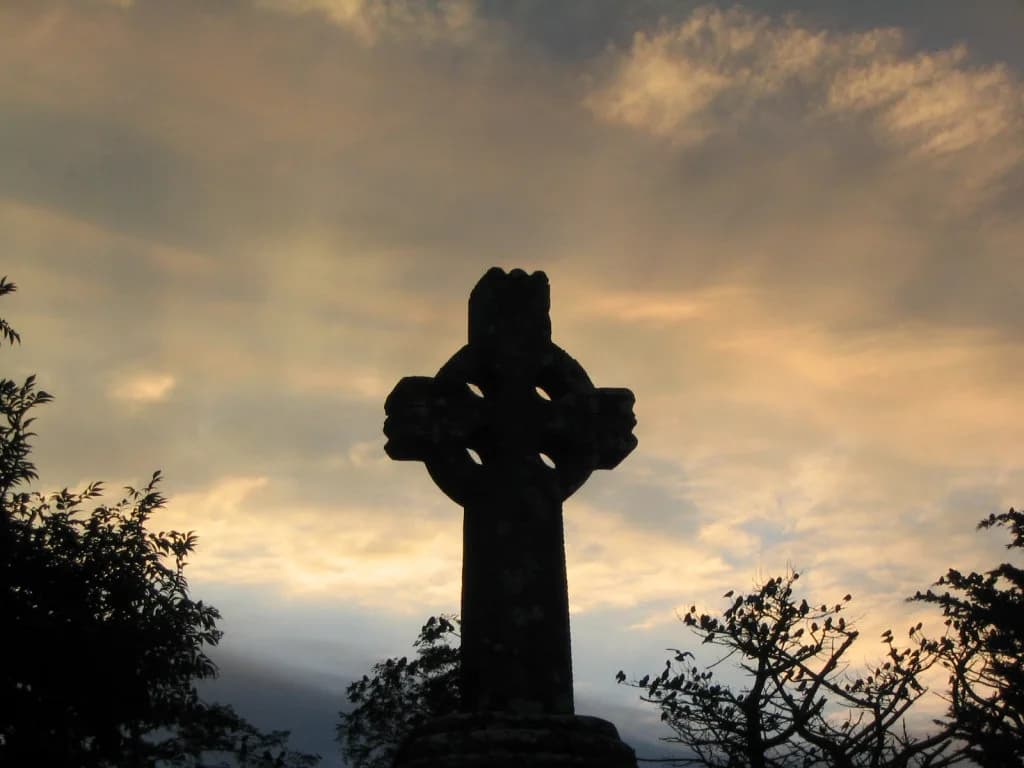
Celtic Ireland: Real Sites and Artefacts to See
Celtic Ireland is best read as an evidence trail, from Tara's earthworks to Ardmore's ogham stones and early medieval treasures in the National Museum.
On this page
Celtic Ireland works as a shorthand, but it is not a period and it does not describe one people. The material usually gathered under the phrase spans at least three very different phases: Bronze Age metalwork and burial pottery, Iron Age monuments and ornament, and early medieval Christian metalwork made centuries after the Roman world had faded. Treating those as one culture flattens the story and leads visitors to expect gold torcs in places where only earthworks survive.
The practical consequence is that you should plan by evidence type rather than by the word Celtic. Open monuments such as the Hill of Tara and Dún Aonghasa reward walking and reading the landscape; museum cases in Dublin reward close looking at technique; a cathedral in County Waterford holds carved stones whose value is in the lettering. Each demands a different pace, a different pair of shoes and a different kind of attention.
Which place speaks to which period
A quick orientation helps before you commit a day. The Hill of Tara covers the longest span, from a late Stone Age passage tomb through Iron Age and early Christian prominence, and it is an open site accessed throughout the year. Dún Aonghasa on Inis Mór is a prehistoric stone fort with later refortification, reached by a one-kilometre walk from its visitor centre. The National Museum of Ireland holds the metalwork and hoard material that gives context to both, while Ardmore in County Waterford offers carved ogham stones in a cathedral setting.
Each carries a trade-off. Tara is exposed and uneven, so weather decides how long you linger. Dún Aonghasa requires ferry or air travel to the Aran Islands and a rough final approach near an unfenced cliff. The museum is indoor and controlled but only the Tara Brooch entry states an object is on display. Ardmore gives you stones in a Christian building, not a prehistoric landscape, so read them as early medieval memorials rather than survivals of an older faith.
Start with the Bronze Age, but do not call it Celtic
The Bronze Age is the earliest strand and it is explicitly pre-Iron Age. According to the National Museum of Ireland, knowledge of working gold and copper arrived from around 2500 BC, and deposition in hoards left the museum with a rich holding of bronze weapons and gold ornaments. That material is older than anything reasonably labelled Celtic, and calling it so confuses chronology with culture.
The scale of the collection is the useful detail for a visitor. The museum records more than fifty lunulae, the crescent-shaped gold neck ornaments that are the most characteristic Early Bronze Age Irish gold object, along with over 2,000 Early Bronze Age axeheads. It also holds pottery from more than 1,300 graves, including over 700 Food Vessels. These numbers tell you that what you see in a case is a fraction of a very large body of material, most of it deposited deliberately rather than lost.
Hoard finds give the period its drama. The Dowris hoard from County Offaly may have contained around 218 bronze objects, including swords, spearheads, cauldrons, buckets and horns, while a large gold hoard found at Mooghaun North in County Clare in 1854 was mostly bracelets but included neck ornaments, ingots and inter-looped rings. Bog finds add organic material, such as wooden block wheels from Doogarymore in County Roscommon and a woollen garment from Cromaghs in County Antrim.
One find ties Ireland to a wider European network without any need for invasion stories. A graduated amber necklace from Cogran in County Offaly may have held as many as 160 beads, and the raw material came from the Baltic region. That is a fact about trade and exchange, not about ethnicity, and it is a more honest reading than treating every exotic object as evidence of newcomers.
Hill of Tara: earthworks instead of palaces
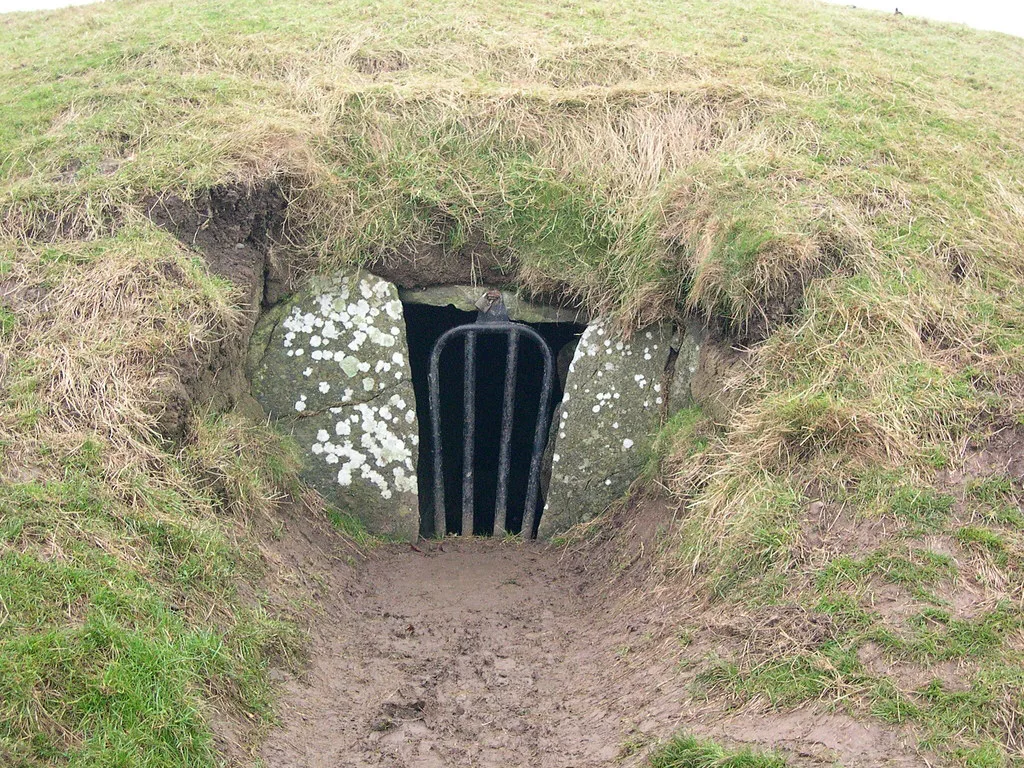
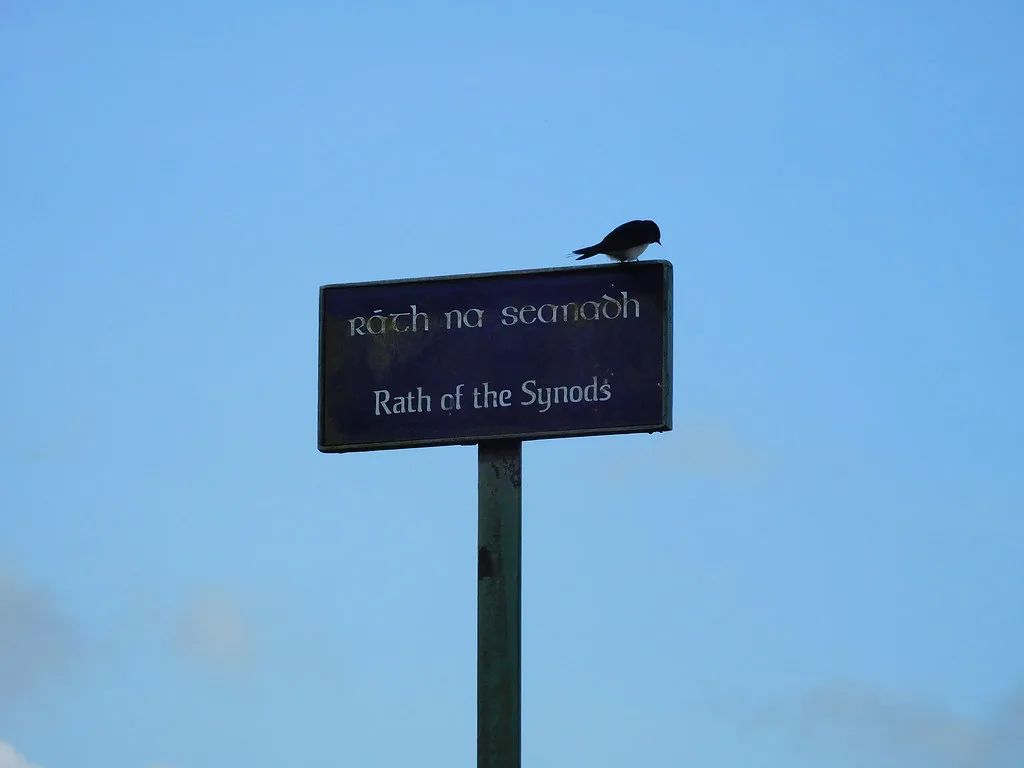
Tara became significant in the Iron Age, between roughly 600 BC and AD 400, and rose to supreme prominence into the Early Christian period as the seat of the high kings of Ireland. The site had already mattered in the late Stone Age, when a passage tomb was built there. Heritage Ireland notes that the halls and palaces have disappeared and only earthworks remain. Visitors should therefore expect a grassy, contoured landscape rather than standing buildings.
The Lia Fáil is the focal point most people remember. Heritage Ireland describes it as the great coronation stone and one of the four legendary treasures of the Tuatha Dé Danann, standing on the monument known as An Forradh. That framing is legend, preserved in the official account rather than presented as documented history, and the distinction is worth holding onto when you read the site. St Patrick is said to have come to Tara in the fifth century, after which the site's importance became increasingly symbolic.
For the visit itself, Heritage Ireland states that Tara is an open site accessible throughout the year, with guided tours available. Much of the tour is outdoors over uneven terrain, so weather-protective clothing and walking shoes are advised. Dogs are not allowed on tours or in the visitor centre except guide or assistance dogs, and a downloadable social guide is offered to help first-time visitors prepare. Tour times and any charges are not specified on the page, so confirm them with Heritage Ireland before travelling.
If your interest runs to the centuries after Tara's royal phase, the medieval Irish world is a separate field with its own sites and figures. The wider story of medieval Ireland gives useful context for how power, church patronage and lordship shifted after the period described at Tara. The same question of where to read the evidence in a city rather than a landscape is answered by these Museums in Cork: City and County Collections.
Dún Aonghasa: a fort, a cliff and a walk
Dún Aonghasa is the largest of the prehistoric stone forts of the Aran Islands, perched on a sheer sea cliff above the Atlantic. It consists of three massive drystone defence walls, and outside them runs a chevaux-de-frise, a dense band of thousands of jagged upright stones designed to impede intruders. The fort is over 3,000 years old, and excavation has revealed prehistoric metalworking, houses and burials. The whole complex was refortified in AD 700–800.
Access is the key planning fact. After a €1.6 million refurbishment, the visitor centre serves as the gateway to the monument and sits at the start of a one-kilometre pedestrian route to the cliff-top fort; Heritage Ireland states that it operates year-round with guided tours. The centre closes from 24 to 30 December, and the average visit is given as one to one and a half hours. The last section of the path crosses rough natural rock, so boots or strong walking shoes are recommended, and there is no fence or barrier at the edge of the 87-metre drop. Drones are not permitted.
Getting there shapes the day. The fort lies about seven kilometres west of Cill Rónáin, reached by ferry from Ros a' Mhíl or by ferries from Doolin in County Clare to Inis Mór, with an air service to Cill Éinne. Buses, bicycle hire and horse and carriage hire are available at the Cill Rónáin ferry port. Heritage Ireland also lists free admission when staying overnight on Inis Mór in participating accommodation, so ask your accommodation whether it participates rather than assuming.
Early medieval metalwork: the later strand
The objects most often shown as Celtic art in Ireland are usually early medieval Christian metalwork, not Iron Age work. The Ardagh Chalice and the Tara Brooch are eighth-century AD pieces, made for a Christian context, and describing them simply as Celtic blurs both their date and their purpose. What connects them to older traditions is style: curvilinear ornament and techniques that draw on La Tène decoration of the Iron Age, reused centuries later.
The later medieval centuries bring their own cast of figures, from the dynastic rivalries that shaped church patronage to the Church reform movement that reorganised dioceses. If you want to follow that later story beyond museum cases, the medieval Ireland section of this site tracks the buildings and events that survive. Among them, Brian Boru in Ireland gives a sense of how the eleventh century reshaped political power in ways that had nothing to do with the Bronze Age.
The Tara Brooch: a name that misleads
The Tara Brooch was not found at Tara. The National Museum of Ireland records that it came from the seashore near Bettystown, County Meath, in 1850, and that its provenance was attributed to Tara by a dealer in order to increase its value. That is a useful warning for anyone reading labels: names can preserve marketing rather than findspots, and the brooch's own catalogue entry records the true findspot.
The object itself is cast and gilt silver, elaborately decorated on both faces. The front carries exceptionally fine gold filigree panels with animal and abstract motifs separated by studs of glass, enamel and amber; the back is flatter with cast decoration in scrolls and triple spirals that the museum says recall La Tène decoration of the Iron Age. A plaited silver wire chain attaches by a swivel formed of animal heads framing two tiny cast glass human heads. The museum ranks it with the Ardagh Chalice and the Derrynaflan Paten as representing the pinnacle of early medieval Irish metalworkers' achievement.
Display is the one practical point you can rely on here. The catalogue entry for the brooch states that it is on display, which is more than the museum says for most other individual pieces. Check the entry before a museum visit rather than assuming a specific object will be in a case.
The Ardagh Chalice: silver for the Mass
The Ardagh Chalice is an eighth-century AD silver vessel used for dispensing Eucharistic wine during Mass. It was found in the nineteenth century at Reerasta, near Ardagh in County Limerick, as part of a hoard uncovered by a young man digging for potatoes. Its form recalls late Roman tableware, but the museum is clear that the method of construction is Irish, a distinction worth making when the word Celtic is used loosely.
Construction details reward close looking. The bowl and foot are spun silver, joined by a bronze pin, with applied gold, silver, glass, amber and enamel ornament on the outer bowl. The names of eleven apostles and St Paul are inscribed below a band of gold filigree and studs, and the underside of the foot is highly decorated and set with a polished rock crystal at its centre. The museum ranks it alongside the Tara Brooch and the Derrynaflan Paten as a high point of early medieval craftsmanship.
Ogham stones at Ardmore
Ogham is a script of lines and notches cut along the angle of a stone, based on the Latin alphabet and read from the base upwards. Waterford City & County Council notes that roughly 400 inscriptions survive across Ireland and western Britain, mostly in Counties Kerry, Cork and Waterford, and that the vast majority record personal names used as grave markers or territorial markers. The inscriptions date from the fourth century to the late seventh century.
Ardmore has three. Two of them have been relocated within the cathedral, and the third is kept in the National Museum of Ireland. One of the relocated stones stands 1.27 metres high and carries a multi-line inscription read as a genealogy of Luguid; the other is 1.3 metres high, bears the name AMADU, translated as beloved, and has a small incised cross on the sloping top of the stone on the side opposite the inscription. The council page gives no opening hours, tickets or interior access arrangements for the cathedral, so treat those as matters to confirm locally on arrival.
Reading these stones well means resisting two temptations. The first is to treat ogham as a secret druidic code; it is a script for names, and the council describes it in plain epigraphic terms. The second is to imagine the stones in their original positions when two now sit inside a building, moved for preservation or display. The honest experience is a carved early medieval memorial read in a Christian setting.
Building a period-aware route
A sensible itinerary groups places by evidence type rather than by county. Spend museum time in Dublin looking at technique in the early medieval cases, then take a day for Tara to see how a royal landscape is read from earthworks, then plan the Aran Islands as a separate excursion with its own ferry timetable. Ardmore fits a Waterford leg, where the stones are the point rather than scenery. This avoids long drives between places that have little interpretive connection.
Prepare for the outdoor elements properly. Tara and Dún Aonghasa both involve uneven ground, and Dún Aonghasa adds rough rock near an unfenced cliff edge, so footwear matters more than any guidebook. Waterproof layers are worth carrying even on a bright morning at Tara, since the site offers little shelter. At the museum the constraint is different: allow time to look closely rather than ticking off cases, because the value is in filigree, spun silver and inscribed names seen at close range.
Where an older monument sits near a later one, resist drawing a line of descent. The passage tomb at Tara, the Bronze Age hoards in the museum and the eighth-century chalice are separated by millennia and by very different beliefs. If you want to extend a visit into later history, the castles of County Galway offer medieval buildings of a different period and purpose, and they are worth treating as their own chapter.
Reading the Evidence, Not the Label
Celtic Ireland is most useful as a question rather than an answer. The Bronze Age hoards, the Iron Age earthworks at Tara, the refortified fort at Dún Aonghasa and the Christian metalwork of the eighth century each need to be described on their own terms. The moment one word covers all of them, both the chronology and the craftsmanship get lost.
Use the primary sources as your check. Heritage Ireland publishes the access arrangements for Tara and Dún Aonghasa, the National Museum catalogues its objects and states which are on display, and Waterford City & County Council describes the Ardmore inscriptions in detail. Where those pages are silent on hours, tickets or display, that silence is a prompt to ask rather than an invitation to guess.
Explore more Ireland guides
Frequently Asked Questions
Is Celtic Ireland the same as the Iron Age?
No. The word Celtic is used loosely for a much wider span of material. Irish Iron Age monuments and ornament form one strand, but Bronze Age gold and pottery are older, and the most famous early Irish metalwork, including the Ardagh Chalice and the Tara Brooch, dates to the eighth century AD in a Christian context. Planning by evidence type rather than by the label keeps the chronology straight.
Where can I see the Tara Brooch, and was it found at Tara?
The National Museum of Ireland's catalogue entry for the brooch states that it is on display; check that entry before visiting, since display arrangements can change. It was not found at Tara. The museum records a findspot near the seashore at Bettystown, County Meath, in 1850, and says the Tara attribution was made by a dealer to raise the object's value.
What survives to see at the Hill of Tara today?
Earthworks rather than buildings. Heritage Ireland notes that the halls and palaces have disappeared, leaving a contoured landscape, with the Lia Fáil standing on the monument known as An Forradh. Tara is an open site accessible throughout the year with guided tours, and the ground is uneven, so walking shoes and weather-protective clothing are advised.
How long is the walk to Dún Aonghasa and what should I wear?
The visitor centre sits at the start of a one-kilometre pedestrian route to the fort, and the last section crosses rough natural rock. Boots or strong walking shoes are recommended. There is no fence or barrier at the cliff edge, which drops 87 metres, so keep back and supervise children. Drones are not permitted at the site.
Where are ogham stones found in Ireland?
Roughly 400 inscriptions survive across Ireland and western Britain, with the bulk in Counties Kerry, Cork and Waterford, according to Waterford City & County Council. Most record personal names and were used as grave or territorial markers. They date from the fourth century to the late seventh century and are read from the base of the stone upwards.
Can I see Bronze Age gold without calling it Celtic?
Yes. The National Museum of Ireland holds a large Bronze Age collection, including more than fifty gold lunulae and over 2,000 Early Bronze Age axeheads, much of it from hoards. This material predates the Iron Age and should be described by period and technique rather than folded into the word Celtic. Only the Tara Brooch entry confirms an object is on display, so check current displays with the museum.
What should I check before travelling to these sites?
Confirm access details with the operator, not an old guidebook. Heritage Ireland publishes arrangements for Tara and Dún Aonghasa, including the Dún Aonghasa visitor centre's year-round operation with guided tours and its closure from 24 to 30 December. The Ardmore page does not state opening hours or ticket arrangements for the cathedral, so ask locally. Ferry and air links to Inis Mór also need checking.
Sources
- Bronze Age | National Museum of Ireland
- Dún Aonghasa – Ancient Stone Fort and Visitor Centre | Heritage Ireland
- Hill of Tara | Heritage Ireland
- The Ardagh Chalice | National Museum of Ireland
- The 'Tara' Brooch | National Museum of Ireland (https://www.museum.ie/en-IE/Collections-Research/Collection/The-Treasury/Artefact/The-Tara-Brooch/4e7de8cc-9cf5-4352-a20a-34caf1bf4d95)
- Ogham Stones in Ardmore - Waterford City & County Council
You might also like



Continue reading
More guides you'll find useful



