
Vikings in Ireland: Towns, Kings and the Clontarf Legacy
Vikings in Ireland were raiders, traders and town-builders. See how Limerick and Dublin took shape, what happened at Clontarf, and where the evidence survives.
On this page
Vikings in Ireland are best understood as a sequence rather than a single event: early ninth-century raids, temporary camps, permanent trading settlements at port towns, and finally Hiberno-Norse kings who minted coins and negotiated with Irish dynasties. The popular image of the raider is not wrong, but it is incomplete. The evidence below comes from Irish institutional collections and one port-town operator, and it shows where the raiding story ends and the town story begins.
This guide anchors that sequence in named places: the Viking settlement layer at Limerick's King's Island, the Hiberno-Norse kingship of Dublin, and the career of Brian Boru, whose death at Clontarf in 1014 is often misread as the end of Norse power. It also separates medieval records from early modern printed commentary and from later saga retellings, because the three do not say the same things. Where a display is time-limited, that is stated precisely.
Raids, Camps and the First Contacts
The earliest Viking activity in Ireland was raiding, and the Limerick operator King John's Castle describes early ninth-century raids in the Shannon region followed by a temporary ship camp in 861. A camp is not a town: it marks a season or a campaign, not a permanent population with streets, workshops and a mint. That distinction matters because it explains why the story of Vikings in Ireland runs in phases rather than as one arrival.
Monastic records preserve the shock of those attacks. The Bodleian Libraries' announcement of the Annals of Inisfallen exhibition notes that the manuscript details Viking raids on Skellig Michael off the Kerry coast, alongside mythical invasions, the coming of the Normans and unusual weather. The Annals are a year-by-year chronicle compiled over centuries by many scribes, so they record events as annalists chose to frame them rather than as neutral news. Read them as a medieval historical source, not a modern report.
For the academic frame around this period, Trinity College Dublin's history module on kingship and warfare covers Irish society from around 1000 to 1318, beginning with Brian Boru and Clontarf and moving through inter-provincial warfare and the late 1160s English invasion. It is a course outline rather than a visitor exhibit, but it is useful for understanding how historians periodise the era. Use it to orient yourself before visiting collections, not as evidence that any object is on display.
Limerick: From Ship Camp to Viking Town
Limerick gives the clearest single case of the shift from raiding to settlement. The King John's Castle operator dates a permanent Viking settlement on King's Island generally to 922, describing a community involved in trade and craftsmanship as well as conflict. That date is the operator's framing of a broadly accepted chronology, so treat it as a general anchor rather than a documented founding ceremony.
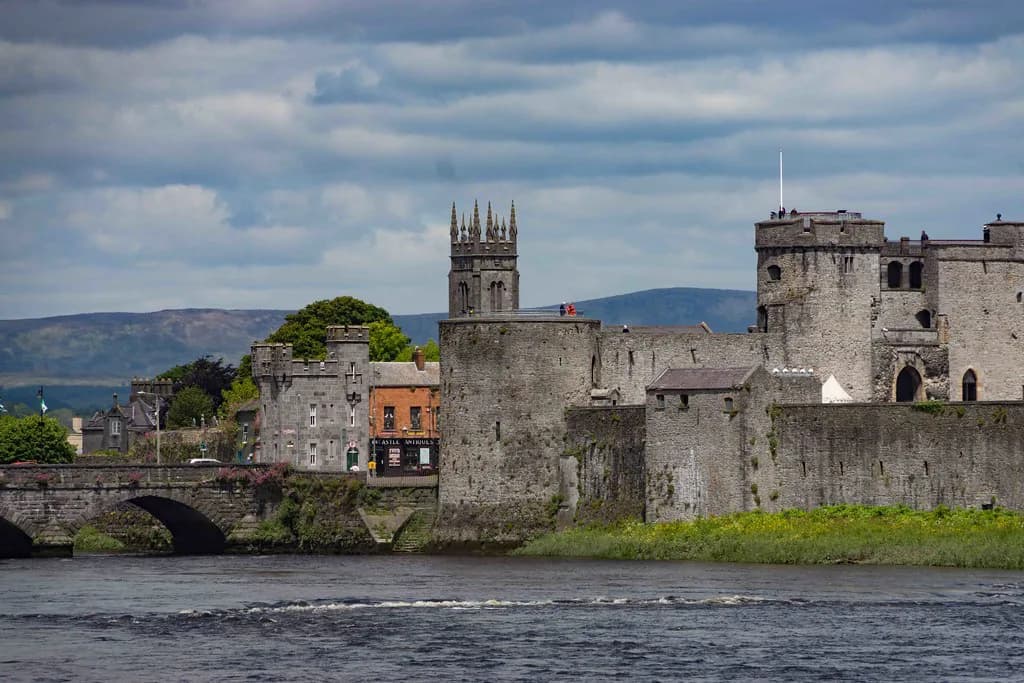
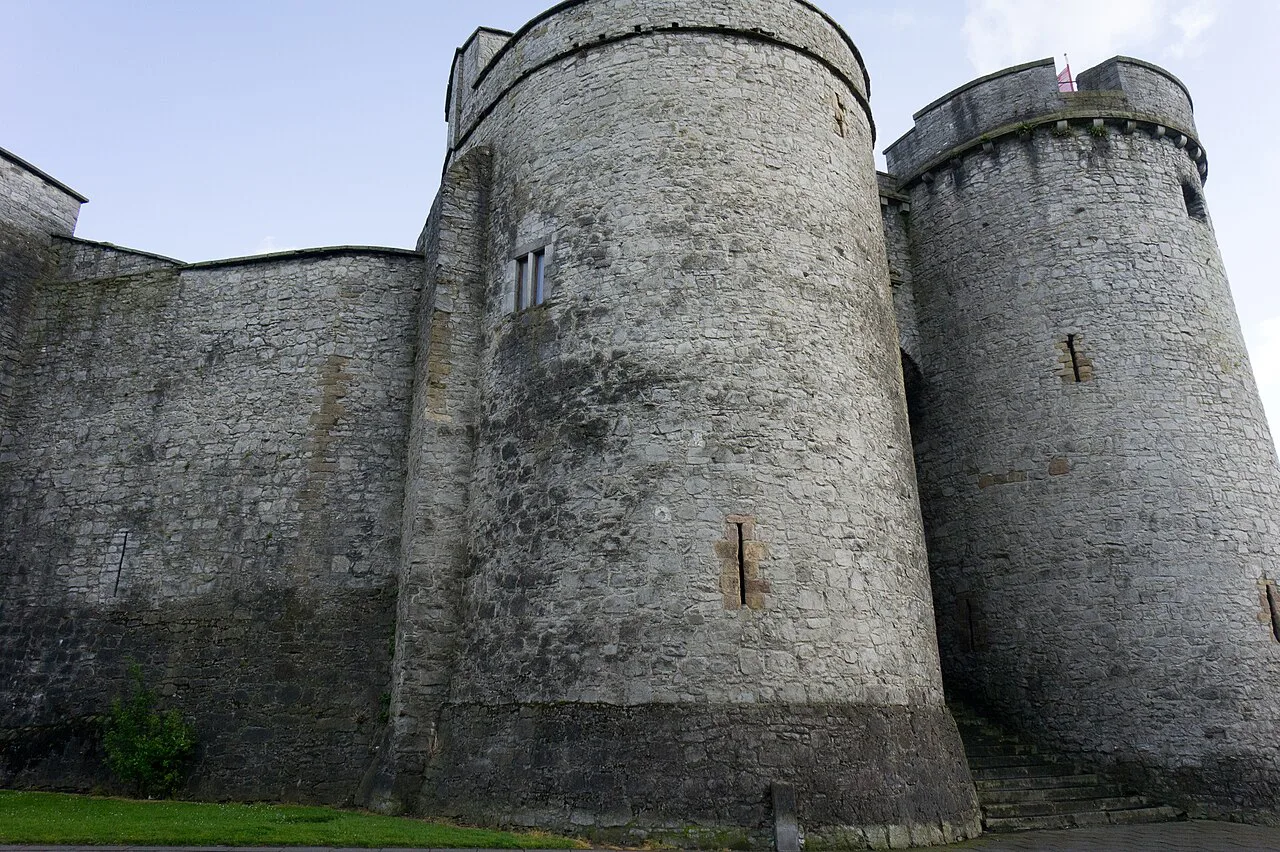
One common error needs correcting before you arrive: the standing King John's Castle is not a Viking-built castle. It is a later structure, and the Viking evidence concerns an earlier settlement layer beneath and around the same island location. The castle is worth visiting for its own history, but it does not preserve Viking houses or docks for you to walk through. Read the operator's Viking page for the early context, then treat the castle as a later chapter built on an old town site. For the site itself, the King John's Castle, Limerick: A Visitor Guide to the Riverside Fortress covers what stands there today and where the Viking layer sits beneath it.
The location itself carries the story. King's Island, formed by the Shannon, offered the kind of riverine position that made sense for a trading community connecting inland Ireland with seaways. If you want the broader context of what came after the Vikings in this part of Ireland, the Norman arrival of the late twelfth century reshaped the same towns and river crossings.
The Four Ports and the Viking Economy
The Edward Worth Library's exhibition on early medieval Ireland, drawing on early modern printed accounts, notes that Vikings developed ports at Dublin, Wexford, Waterford and Limerick and used them to connect with markets across the seaways. That is a statement about the four port towns as a group, not a claim that each was founded in the ninth century. The same exhibition shows how much of this picture comes from commentators such as Gerald of Wales, whose twelfth-century text was inflammatory and prompted later refutations.
Trade, not only plunder, drove the port towns. The Worth exhibition describes imported goods becoming everyday necessities for the native Irish, which is a useful corrective to the raider stereotype. Coins, weights and waterfront workshops are the kinds of evidence that show a working economy, and they are the reason archaeologists treat these towns as urban foundations rather than fortified camps.
For a wider view of Ireland before and alongside the Viking period, the medieval ireland guide covers the island's settlements, churches and lordships across the same centuries. It helps place the port towns within a landscape that was already densely organised before the ships arrived.
Sitriuc Silkbeard and Hiberno-Norse Dublin
Dublin's Hiberno-Norse kingship is best approached through Sitriuc Silkbeard, king of Dublin from 989 to 1036 according to the Worth Library exhibition. The same exhibition credits him, via the numismatist argument it presents, as the first king in Ireland to mint coinage, with coins bearing his name and image circulating at home and abroad. Attribute that claim to the exhibition, which analyses early modern printed accounts, rather than treating it as an unmediated contemporary fact.
Sitriuc is often reduced to his defeat at Clontarf, but the Worth material stresses his survival and strategic flexibility. It notes his 1028 pilgrimage to Rome and his association with the founding of Christ Church Cathedral in Dublin after his return. Those details are presented through the exhibition's reading of early modern antiquarian writing, so they are best read as its scholarly interpretation rather than as a simple contemporary record.
His career shows how Hiberno-Norse Dublin worked: alliances with Leinster kindred, contacts with Scandinavian powers, and a reign long enough to shape a city. If you want to follow the dynasty question further, the Brian Boru in Ireland page covers the Irish high-kingship and the kings who confronted Dublin, from Máel Sechnaill's rivalry to Brian's final campaign. The two stories are entangled, and neither makes sense alone.
Brian Boru and the Road to Clontarf
Trinity College Dublin Library's Brian Boru exhibition traces his rise from Munster, where he succeeded his assassinated brother Mathgamain in 976 and spent years securing his power base. By 1002 he had outmanoeuvred Máel Sechnaill, king of Tara, and went on to force submissions from the major kings of Ireland. That political and military climb, not the battle alone, is what made him Ireland's most famous high king.
The exhibition highlights the Book of Armagh, an early ninth-century manuscript containing documents on St Patrick, a complete New Testament, and a text inserted around 1005 that calls Brian Imperator Scotorum, Emperor of the Irish. The exhibition describes it as the only surviving item known for certain to have been in Brian's presence, and as a record of an agreement between Brian and the church of Armagh. That is a strong evidential claim, but it concerns a manuscript's history, not a promise that the object is currently on public view.
The same exhibition notes that bells were among the most important religious objects in medieval Ireland, used to validate oaths and excommunications, and that political alliances were likely ratified on objects like them. It also describes a bronze bell believed to have been found in church ruins near Louisburgh, County Mayo, on a site previously used as a Viking camp. Brian died at Clontarf in 1014, and the exhibition presents the battle as the end of a spectacular career rather than the end of Norse Ireland.
Clontarf's Contested Afterlife
Later accounts of Clontarf diverge sharply. The Worth Library exhibition points out that sources are not in unison about Sitriuc's role in the battle, with saga tradition portraying him as sitting it out in Dublin while later commentators suggested defending the city against a post-battle sack was the wiser course. The one firm fact the exhibition asserts is that he survived. That gap between sources is a useful reminder to label saga material as saga.
It is a common misconception that Clontarf ended Viking influence in Ireland. Brian Boru was killed, but Norse-Irish towns, trade and kingship continued, and Trinity's history module describes the English invasion of the late 1160s as perhaps the single most formative development in Irish secular affairs. For a focused account of the battle itself, see the battle of clontarf page.
Reading the battle through its retellings is part of the interest. Seventeenth- and eighteenth-century writers such as Geoffrey Keating and Roderick O'Flaherty built their histories from sacred and secular sources, and Edward Worth collected their books alongside Gerald of Wales. Those books tell you what early modern Ireland thought about its past, which is a different question from what happened in 1014.
Where to See the Evidence
The most direct physical opportunity in this guide is the free exhibition Recording the Past: The Annals of Inisfallen and the Making of Irish History at the Glucksman, University College Cork, dated from 2 September to 1 November 2026. The manuscript is a single bound volume in Irish and Latin, first copied around 1092 and continued by many later hands into the 15th century. Do not assume it remains on physical display after 1 November 2026.
If you cannot reach Cork within that window, the Bodleian Libraries have made the Annals freely available online through the Digital Bodleian, where a complete high-resolution facsimile supports research and teaching. A digital facsimile lets you read every page but cannot replace seeing vellum under glass; the trade-off is between permanence of access and the physical presence of the object.
Trinity College Dublin Library's Brian Boru exhibition page and the Edward Worth Library's early medieval Ireland exhibition both function as institutional collection resources, with object descriptions and interpretation. Neither page states that a named object is on public display now, so check current arrangements before planning a visit around a specific item.
A Short Chronology to Carry With You
A working sequence helps on site. Early ninth-century raids give way to a temporary ship camp in 861; Limerick's permanent settlement is generally dated to 922; Brian Boru secures dominance by 1002; Clontarf is fought in 1014; and the English invasion arrives in the late 1160s. Keep those anchors in mind and the museum labels and information panels will make more sense.
Add the Annals of Inisfallen to that timeline: first copied around 1092, continued contemporaneously from the late eleventh to the fourteenth century, and later extended into the 15th century. Such chronicles preserve events long after the Viking age, which is precisely why historians read them critically. For the pre-Viking and early Christian background, the ancient sites ireland guide offers landscape context.
Reading Viking Ireland on the Ground
Viking Ireland is not a single site you can tour in an afternoon. It is a set of layers: a settlement layer on Limerick's King's Island, port-town economies in the south and east, a coin-minting Dublin kingship, and manuscript evidence preserved in Oxford and shown briefly in Cork. Plan by evidence type rather than by county, and decide in advance whether you want museum objects, town streetscapes or manuscript facsimiles.
The Gaelic political world that the Vikings negotiated with, and sometimes married into, is covered in the gaelic ireland guide. It is worth reading for how Irish kingship absorbed newcomers rather than simply resisting them. The two traditions shaped each other, and that mutual shaping is the real subject of Vikings in Ireland.
Plan Your Visit
Start with what is dated. The Annals of Inisfallen exhibition at the Glucksman in Cork is scheduled for 2 September to 1 November 2026, and the Digital Bodleian facsimile is available online independently of any visit. Then add the institutional collection pages from Trinity and the Edward Worth Library for object descriptions and interpretation, treating them as teaching and research resources rather than confirmed displays.
Two details need checking before you travel: confirm the exhibition is still running if your visit falls near its 1 November 2026 end date, and confirm current collection access at Trinity and the Worth Library before building an itinerary around a named manuscript. For Limerick, read the castle operator's Viking page for early context, but expect a later castle, not Viking fabric.
Explore more Ireland guides
Frequently Asked Questions
Were the Vikings raiders or settlers in Ireland?
Both, in phases. The earliest activity was raiding, followed by temporary camps such as the 861 camp at Limerick, and eventually permanent settlements at port towns. Limerick's permanent settlement on King's Island is generally dated to 922 by the castle operator, and Dublin developed a Hiberno-Norse kingship that minted its own coinage. The raider image captures the first phase but misses the towns that followed.
Did the Vikings found Ireland's cities?
Not in the simple sense. A group of four port towns, Dublin, Wexford, Waterford and Limerick, is described as Viking-developed in the Worth Library's exhibition on early medieval Ireland. That describes ports and trade networks, not a single ninth-century founding moment for every Irish city. Check each town's own archaeology and museum interpretation rather than assuming a common origin story.
What happened at the Battle of Clontarf in 1014?
Brian Boru, high king of Ireland, died at Clontarf in 1014, ending a spectacular career that began in Munster and included forcing submissions from the major Irish kings. The battle's details are contested: sources differ on the role of Dublin's king Sitriuc Silkbeard, who survived. Clontarf did not end Norse influence in Ireland, and later towns, trade and kingship continued.
Who was Sitriuc Silkbeard?
He was the Hiberno-Norse king of Dublin from 989 to 1036, according to the Edward Worth Library exhibition. The same exhibition credits him as the first king in Ireland to mint coinage, and notes his 1028 pilgrimage to Rome and his association with the founding of Christ Church Cathedral. Those details are presented through the exhibition's reading of early modern printed accounts, so treat them as its scholarly interpretation rather than neutral contemporary record.
Where can I see Viking-era evidence in Ireland?
The Annals of Inisfallen is scheduled for free public display at the Glucksman, University College Cork, from 2 September to 1 November 2026, and a complete high-resolution facsimile is freely available through the Digital Bodleian. Trinity College Dublin Library's Brian Boru exhibition and the Edward Worth Library's early medieval Ireland exhibition provide object descriptions and interpretation online. Confirm current physical display arrangements before travelling.
Is King John's Castle in Limerick a Viking castle?
No. The standing castle is a later structure, and the Viking evidence at Limerick concerns an earlier settlement layer on King's Island, generally dated to 922. The castle's operator publishes Viking history context for the area, but you should not expect to walk through Viking-built fabric. Treat the castle visit as later history built on an older town site.
Why do accounts of the Vikings in Ireland differ so much?
Medieval chronicles, early modern printed histories and later sagas each framed the past differently. The Annals of Inisfallen were compiled by many scribes over centuries; Gerald of Wales wrote an inflammatory twelfth-century text that prompted later refutations; saga tradition portrayed Sitriuc Silkbeard as sitting out Clontarf. Reading which kind of source you are looking at explains most of the contradictions.
Sources
You might also like



Continue reading
More guides you'll find useful



