
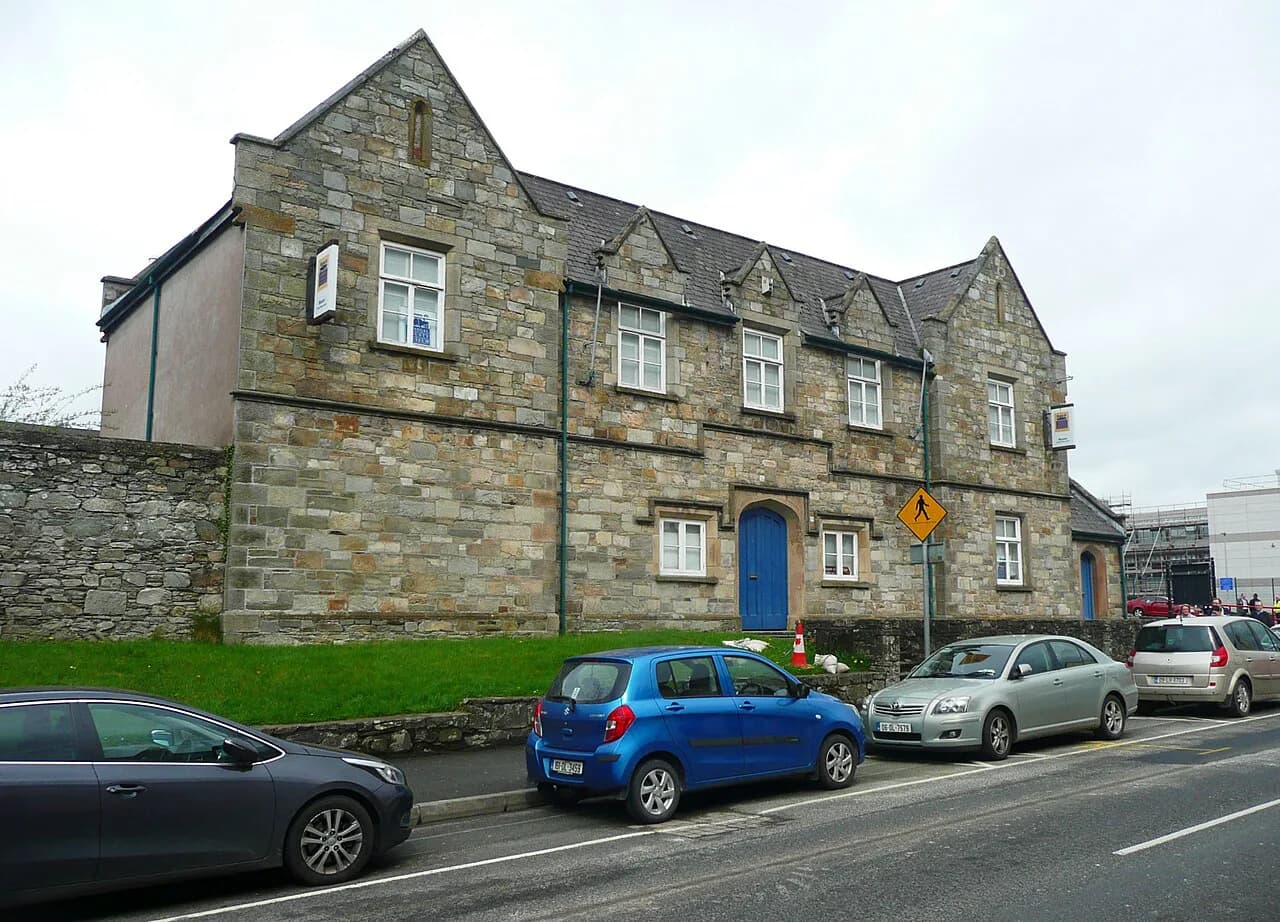
Donegal County Museum: A Visitor Guide to Letterkenny's County Collection
Donegal County Museum in Letterkenny is free to enter and holds a state-recognised archaeology collection. Here is what to see and how to plan a visit.
On this page
Donegal County Museum is the county's own museum, run by Donegal County Council's Culture Division at 2 High Road in Letterkenny, and admission is free. It is the kind of institution where a modest floor area carries a serious remit: caring for archaeological objects on behalf of the State, running research programmes, and interpreting a county whose records stretch across centuries. Plan around what the museum actually does rather than a list of headline objects.
The museum publishes weekday hours of 10.00 to 16.30 and a Saturday slot of 13.00 to 16.30, with the same page also carrying a 12.30 to 13.00 closure line that reads as attached to the Saturday schedule. Treat Sunday opening, public holiday opening and tour availability as unconfirmed rather than assuming them. A quick phone call on (074) 912 4613 before travelling settles the question.
A Council Museum With a Legal Role
This is not an independent charitable collection but a local authority museum, which shapes what you find inside: a county-focused display programme, a public research function, and community projects run through the Culture Division. The operator describes free admission and full accessibility, so cost and step-free access should not be the deciding factors in whether to call in. Pair the museum with a walk around central Letterkenny rather than treating it as a full-day destination.
Because it sits within the council structure, the museum's work overlaps with the county's archive service and with council-led heritage initiatives, which explains why its public programme leans toward research and commemoration as much as object display. Visitors expecting a large national-style gallery should recalibrate: the value here is local depth and the connections staff can draw between collections. Allow time to read rather than to rush past cases.
What Designated Museum Status Means for Visitors
Donegal County Museum is a Designated Museum under the National Cultural Institutions Act 1997 and the National Monuments (Amendment) Act 1994, according to the operator. In practice that means it is legally entitled to retain archaeological objects on behalf of the State, and the National Museum of Ireland will lend objects for display only to institutions holding that designation. When you look at archaeological material here, you are seeing objects that belong to the public rather than to a private collector.
The designation also gives curators a working role in the find-reporting system: archaeological objects found with no known owner are State property, and finds must be reported to the National Museum of Ireland, a Designated museum such as this one, or An Garda Síochána. That single fact reframes a case of pottery or metalwork as part of an active legal process rather than a static display. If you have a find of your own, the museum is a legitimate first point of contact.
The collection itself is described as growing and spanning a wide range of periods and topics, and the museum maintains a Sketchfab collection online. Online viewing is useful preparation but is not evidence of what is physically on show on any given day, so ask staff about current displays rather than treating digital items as guaranteed gallery contents. For wider context on Ireland's prehistoric and early historic material, compare with other Ancient Sites in Ireland.
Research You Can Follow Up After the Visit
The museum's best-known research programme concerns Donegal people in the First World War, underway since 2001. The County Donegal Book of Honour, The Great War 1914-1918 was first published in 2002, and the museum updated and reprinted a fifth edition in 2019. A searchable database based on the book exists, which makes the museum a practical starting point for family history rather than a purely interpretive stop.
The museum invites corrections and additional names by email or post to the High Road address, so a visitor who spots a gap in a family record can contribute rather than simply consume. That openness is worth knowing before you arrive with notes in hand. Bring what you already have, because staff time at a small museum is limited and a specific query gets a better answer than a general one.
For orientation on the period before you visit, the wider irish war of independence material gives the political sequence that shaped the decades after the war these records document. The museum's own WWI holdings are a county-level record, not a campaign narrative, so set expectations accordingly. The two together work better than either alone.
Project History Rather Than Current Exhibitions
Several of the museum's most visible projects are best read as completed project history, not as promises of what is on display. Between 2017 and 2020 the museum took part in the CINE digital heritage project with partners in Norway, Iceland and Scotland, working with communities in Killybegs and on Inch Island; the outputs included a virtual presentation of St Catherine's Church and graveyard in Killybegs and a virtual exhibition on Inch Island's history. More recently it has been a partner in the DACCHE climate-heritage project, working at Portbane/Tonduff, Dunree and with the West Inishowen History and Heritage Group.
The Ballyshannon Workhouse reconstruction shows the same pattern of research feeding public interpretation. The workhouse was built in 1841 and 1842 and opened on 6 May 1843 to hold 600 inmates, closing on 1 March 1922; the museum and the county archives service later commissioned a virtual reconstruction using George Wilkinson's plans and a conservation report. That is a digital resource about the building created by the museum and archives service, not a claim that the original workhouse is open to visitors, so treat it as research context rather than an excursion.
Workhouse history tends to pull visitors toward the Famine era, but the same buildings stayed in use through the revolutionary decade, which is why a workhouse record can appear in a civil war enquiry. The irish civil war overview is a useful companion for understanding why institutional records from the 1920s matter to family historians. Read project descriptions on the museum's site as background, then ask staff what is currently on view.
The Letterkenny Workhouse Memorial Garden Beside the Museum
The Letterkenny Workhouse Memorial Garden sits beside the museum, and in 2024 the council completed renovations including new pathways, seating and planting, along with two information boards explaining the garden and its link to the workhouse complex that has shaped the area since the mid-1840s. It is an outdoor companion to the museum rather than part of it, so weather and daylight matter. Read the boards first, then carry that context into the museum's workhouse material. If the garden's institutional history leaves you wanting more built heritage, the castles in county galway guide shows how another county's sites are interpreted and accessed today, and the ancient sites ireland guide covers the tombstones, forts and trackways that predate them.
Because the garden is a memorial space attached to an institutional history, it rewards a slower read than a quick photograph. The workhouse system that produced it belongs to the Poor Law world of the 1840s, when Donegal's workhouses were built and run by Boards of Guardians whose minutes and registers now sit in the county archives. Visit the garden and the museum in the same outing to make the connection concrete.
Archives Are a Separate Service in Lifford
A common misunderstanding is that the museum is where you consult county records. It is not: Donegal County Archives is a separate service based at the Three Rivers Centre in Lifford, and records are viewed by appointment arranged by email. The archive collection is one of the most extensive local authority holdings in the country, covering plans, maps, letters, minutes, registers, photographs and oral recordings, with the Poor Law Union records for the eight Donegal workhouses among its most important holdings.
If your interest is the 1840s to 1920s institutional record, plan the archive appointment as a separate day rather than folding it into a museum visit, and arrive with the names, places and dates you already have. The museum's projects page states that the county archives hold almost 400,000 items relating to the eight Donegal workhouses, dating from 1840 to 1923, and that the archives can be viewed by appointment in Lifford — a research collection rather than a display. For comparative county collections, the Monaghan County Museum is a useful benchmark of how local authority museums handle similar material, and the castles in county galway guide shows how one county's built heritage is interpreted and opened to visitors today.
Practical Notes on Hours, Access and Contact
The museum states opening Monday to Friday 10.00 to 16.30, and Saturday 13.00 to 16.30; the contact page also carries a 12.30 to 13.00 closure line that appears tied to the Saturday schedule, a detail worth confirming by phone rather than interpreting. Admission is free, the building is described as fully accessible, and the phone number is (074) 912 4613.
Two factors should shape your timing. First, a weekday morning gives you the longest uninterrupted window, whereas Saturday visitors arrive after 13.00 and may meet a lunchtime gap depending on how the closure line applies. Second, staff availability for research queries is not published, so phone ahead if your visit depends on speaking to a curator about a specific record or find.
The address is 2 High Road, Letterkenny, and the museum's postal line for correspondence is the same High Road building. If you are travelling specifically for family history, cross-reference the museum's databases before you go so the on-site time goes on gaps rather than basics. Visitors tracing how a county museum frames local political and family history can follow the wider irish war of independence material as background reading before arriving with questions.
Framing a Short Visit
Build your visit around the museum's stated strengths: the archaeological collection and its Designated Museum status, the First World War research and Book of Honour database, and the project work that connects the museum to communities across the county. Add the memorial garden next door for the workhouse context, and keep the Lifford archive for a separate, pre-booked appointment. That structure uses a compact museum well instead of padding it out.
Confirm the day's hours by phone before you travel, and ask what is currently on display if a particular project drew you there. Project pages describe work the museum has done, not a guaranteed exhibition list. Approach it as a county institution with a working research role and the visit will make more sense than a checklist of objects would suggest.
Explore more Ireland guides
Frequently Asked Questions
Is Donegal County Museum free to enter?
The museum states free admission on its contact and opening hours page. That applies to general entry at the High Road building; it does not extend to the county archive service in Lifford, which is a separate, appointment-based resource.
What does Designated Museum status mean for visitors?
It means the museum is recognised under the National Cultural Institutions Act 1997 and the National Monuments (Amendment) Act 1994 as entitled to retain archaeological objects for the State. In practice, archaeological material you see there is publicly owned, and the museum can receive reported finds.
Can I research Donegal workhouse records at the museum?
Not on the spot. The county archive collection, including Poor Law Union records for the eight Donegal workhouses, is held by Donegal County Archives at the Three Rivers Centre in Lifford and consulted by appointment. The museum's own workhouse material is interpretation and research support, such as the Ballyshannon virtual reconstruction.
What are the opening hours of Donegal County Museum?
The operator lists Monday to Friday 10.00 to 16.30 and Saturday 13.00 to 16.30, with a 12.30 to 13.00 closure line that reads as attached to the Saturday schedule. Sunday and public holiday opening are not stated, so phone (074) 912 4613 before travelling.
Is the Letterkenny Workhouse Memorial Garden part of the museum?
No. It is an outdoor garden beside the museum, renovated by the council in 2024 with new paths, seating and planting plus two information boards. It has no published separate opening times, so treat it as a daylight stop alongside a museum visit.
Is the museum fully accessible?
The operator describes the building as fully accessible and free to enter. Accessibility of individual programmes or events is not stated, so ask when booking or phoning if you have specific requirements.
Sources
You might also like



Continue reading
More guides you'll find useful





