
Irish Civil War: Places, Objects and Records to Visit
A guide to the Irish Civil War of 1922 to 1923, covering its key events and the Dublin museum, gaol and online records where visitors can explore it.
On this page
The Irish Civil War was fought in 1922 and 1923 between two Irish sides that had split over the Anglo-Irish Treaty. It is a separate conflict from the War of Independence of 1919 to 1921 and from the 1916 Rising, and treating those dates as interchangeable muddles the story. For a visitor, the war is best approached through the objects, prison buildings and records that survive it.
The material traces of the period are concentrated in Dublin and largely indoors: a free permanent museum display, a former county gaol that requires a booked tour, and a free digital archive you can use from anywhere. Rain will not cancel any of them, and the museum and archive cost nothing to use. This guide explains what each one holds, how to get in, and where the compromises lie.
When the Civil War Happened and Why It Started
The Anglo-Irish Treaty was signed on 6 December 1921. The Irish Free State came into being a year later, on 6 December 1922, as a dominion under the Crown rather than the republic that later emerged (House of Commons Library). The Treaty did not create partition; Northern Ireland had the option to stay in the United Kingdom and took it. Keeping these dates distinct from 1916 and from 1921 matters when you read museum labels and archive catalogues.
In Ireland, acceptance of the Treaty divided the independence movement. The Dáil approved it by 64 votes to 57, and the anti-Treaty members walked out in protest. The war that followed set the pro-Treaty Free State Army against the anti-Treaty IRA, and it was fought across the island rather than in a single city. That split is the organising idea behind almost every Civil War exhibit you will see.
If your interest is really in the earlier guerrilla campaign against Crown forces, the 1919 to 1921 period has its own history and its own sites. The Irish War of Independence, 1919 deserves separate reading before you compare it with the Civil War, because the two are often displayed side by side without enough explanation of the difference.
The Four Courts and the Opening of the Fighting
The Civil War is generally dated from the shelling of the Four Courts in Dublin on 28 June 1922. Anti-Treaty forces had occupied the building from the previous April and used it as a headquarters. When they ignored an ultimatum to leave, Free State artillery opened fire, and some of those guns had been supplied by the British.
The bombardment had a consequence that reaches far beyond the fighting. The Public Records Office stood within the same complex, and the fire destroyed thousands of documents, some dating back to the thirteenth century. Some loose archival paper was scattered around the building, and while an appeal was made for its return, a good deal of it was kept as souvenirs.
The Four Courts remains a working courts building, and this guide does not present it as a visitor attraction with tours or displays about 1922. Treat it as historical context to read about rather than a stop on a walk, and put your time into the museum and archive collections instead.
Executions, Casualties and the Human Cost
The Free State introduced emergency legislation that allowed military courts to sentence people found armed or aiding attacks on state forces. The Public Safety Bill took effect on 15 October 1922, and the state sanctioned the execution of between 77 and 81 anti-Treaty fighters over the course of the war. Among those shot on 8 December 1922 were Rory O'Connor, Liam Mellows, Richard Barrett and Joe McKelvey.
The human cost of the war is not precisely known. The Museum gives an estimated range of roughly 1,500 to 1,700 dead, including an estimated 300 to 400 civilians, while noting the true figure was probably higher. Read those numbers as attributed estimates rather than a settled count, because no complete record survives.
Two of the war's best-known deaths came within ten days of each other in August 1922. Arthur Griffith, who led the treaty negotiations and defended the settlement in the Dáil, died on 12 August. Michael Collins was killed at Béal na mBláth on 22 August while travelling through his home county. These are events to read about and see represented in museum collections, not sites with visitor displays of their own.
The precise date of the ceasefire is not consistent across published accounts, so avoid building an itinerary around a single anniversary. If the ending of the war matters to your visit, check how a given exhibition or publication dates it before quoting one.
Irish Wars 1919 to 1923 at Collins Barracks
The most direct place to encounter Civil War material is the Irish Wars 1919 to 1923 display at the Soldiers and Chiefs exhibition at Collins Barracks, part of the National Museum of Ireland in Dublin 7. It has been substantially reimagined for the museum's centenary commemorations. It is a permanent exhibition rather than a touring show, which makes it easier to plan around.
The interpretation covers civil disobedience, imprisonment, hunger striking, propaganda, the role of women in the conflict and the effect on civilians, using objects rather than only text panels. The museum has also published an online version of the exhibition for visitors who want to examine selected pieces before or after a trip. Use it as a companion, not a substitute, since it covers only a selection.
Among the items the museum describes as returning to display after years in storage are death masks of Arthur Griffith, Michael Collins, Cathal Brugha and Terence MacSwiney. Other pieces include handcuffs worn by Seán Hogan at Knocklong and experimental weapons made by the IRA, alongside newsreel footage from the period. The display changes, so check what is actually showing rather than assuming a particular mask or loan object is out.
Admission to the National Museum's sites is free, and individuals and small groups do not need to book. Groups of eight or more must arrange a visit through the museum's bookings office in advance.
Practical Access at Collins Barracks
Collins Barracks opens Tuesday to Saturday from 10:00 to 17:00, and on Sunday and Monday from 13:00 to 17:00, with a late opening until 20:00 on the last Thursday of each month. It closes on Christmas Day, St Stephen's Day and Good Friday, and the museum recommends last entry around 16:30 so there is time to see the galleries.
The museum warns that some galleries may close at short notice for operational reasons, and it advises calling ahead on the day if you are travelling for a particular display. Gallery 4 of Soldiers and Chiefs, which covers the Irish in British Regiments, is temporarily closed. Do not read that as the whole exhibition being shut; the Irish Wars material sits elsewhere in the galleries.
Two practical limits are worth knowing before you arrive. Cloakroom service is restricted, so bring no more than a backpack, and on-site parking is pay and display with no overnight option. The galleries themselves are accessible, with lifts, ramps and wheelchairs available at reception.
Kilmainham Gaol: The Prison Behind the Records
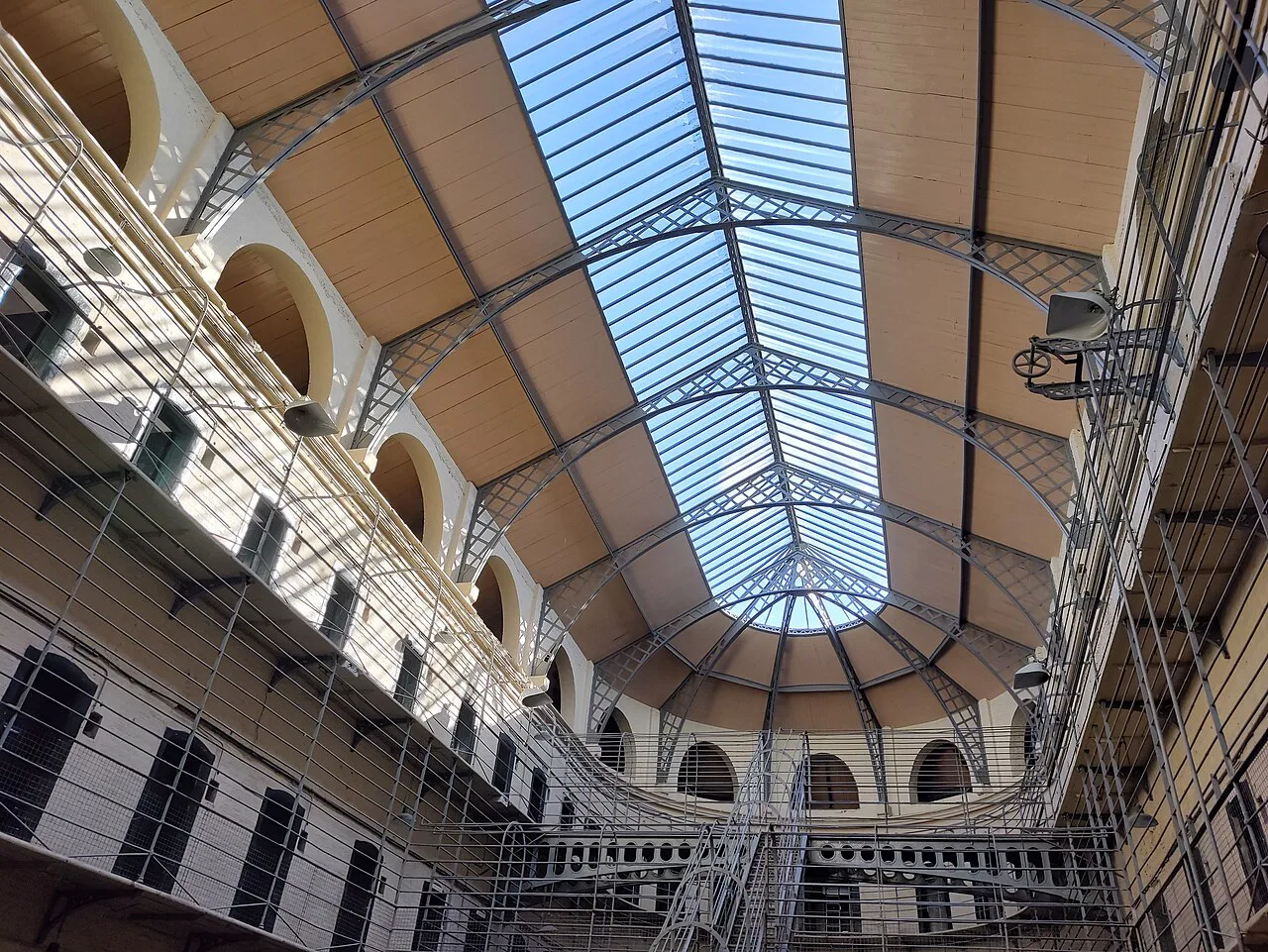
Kilmainham Gaol opened as Dublin's county gaol in 1796 and operated until 1924, which means it was still in use through the Civil War. Its population was not only political: men, women and children convicted of ordinary crimes were held there too. That mix is what makes it a penal history site rather than a simple roll-call of famous prisoners.
Visiting works differently from the museum. Access to Kilmainham Gaol is by guided tour that must be booked in advance, and the operator suggests allowing about 90 minutes. There is no walk-in admission to plan around on a whim, so fix your slot before you build a day around it.
Part of the tour takes place outdoors and the interior is cold in winter, so it is not a reliable wet-day shelter. Dress for the temperature and expect to move between buildings. The museum element and the gaol tour are related but separate parts of the visit, so check what your booking covers.
Reading the prison alongside the Collins Barracks objects gives you a clearer picture of what the Civil War did to people than either display manages alone. A prison cell block and a case of handcuffs speak to each other across the city. Build the two into separate days rather than rushing both.
Records and the National Archives Decade of Centenaries
If you want to work from original material rather than interpretation, the National Archives of Ireland runs a free online Decade of Centenaries resource covering 1912 to 1923. Its scope runs through the War of Independence and the Civil War and includes series such as Dublin Metropolitan Police detective reports on suspects, and the surviving 1901 and 1911 censuses.
This is an online collection, not a venue to turn up at with a day bag, so plan screen time rather than travel time. The distinction matters because the material is dispersed and catalogued rather than laid out for a casual walk-through. Search by place or name before you go looking for a physical archive reading room.
For the Civil War specifically, the archival trail is thinner than for the earlier conflict, and many events are best reconstructed through local newspapers. The museum's online exhibition is a useful bridge between the two, pairing objects with the stories behind them.
Choosing Between the Options
Three routes suit three different interests. Collins Barracks gives you objects, labels and a broad interpretation of the whole 1919 to 1923 period, with no ticket cost and no need to book as an individual. Kilmainham gives you the physical prison experience, but requires a booked tour and a longer time commitment. The National Archives gives you documents to read from anywhere.
If you have only one free afternoon, Collins Barracks is the lower-risk choice because it needs no advance arrangement and can absorb short-notice gallery closures within a larger site. If the prison itself is the point of your trip, book Kilmainham first and fit the museum around it. Neither substitute explains the other.
Planning Around the Civil War
Start with the dates: a treaty signed in December 1921, a Free State that took effect in December 1922, and a war fought across 1922 and 1923. Then choose your entry point, whether that is a free permanent exhibition, a pre-booked prison tour or a free archive collection you can read from home.
Check hours, closures and tour availability shortly before you travel, since gallery closures can be announced at short notice and guided access at the gaol must be reserved. The historical dates in this guide are fixed; the practical details are not. For the broader historical sequence, continue with our guide to Irish history. To place these sites within the earlier city story, our Dublin History: A Chronological Guide to the City's Key Sites covers the periods either side of 1922.
For another heritage guide, read about Easter Rising 1916.
Explore more Ireland guides
Frequently Asked Questions
What was the Irish Civil War and when did it happen?
It was a conflict fought in 1922 and 1923 between Irish nationalists who accepted the Anglo-Irish Treaty and those who rejected it. It followed the War of Independence of 1919 to 1921 and is a separate event from the 1916 Rising.
How was the Civil War different from the War of Independence?
The War of Independence was fought against British Crown forces. The Civil War was fought between Irish sides over the treaty settlement, with the pro-Treaty Free State Army against the anti-Treaty IRA.
Where can I see Civil War objects in Dublin?
The Irish Wars 1919 to 1923 display at the National Museum of Ireland at Collins Barracks covers the period through objects, including material on imprisonment, propaganda and the effect on civilians. It forms part of the wider Soldiers and Chiefs exhibition.
Is the Collins Barracks museum free to enter?
Yes. Admission to the National Museum of Ireland sites is free, and individuals and small groups do not need to book. Groups of eight or more must arrange a visit in advance.
Should I visit Collins Barracks or Kilmainham Gaol for Civil War history?
Collins Barracks is easier to fit in because it needs no booking, but it is interpretation through objects. Kilmainham was a working county gaol until 1924 and gives you the physical prison experience, though access is by pre-booked guided tour only.
What happened at the Four Courts in 1922?
Anti-Treaty forces occupied the building from April 1922, and Free State forces shelled it on 28 June 1922. The Public Records Office in the same complex was destroyed in the resulting fire, along with thousands of documents.
Where can I research the Civil War in original records?
The National Archives of Ireland's Decade of Centenaries resource is a free online collection covering 1912 to 1923, including police reports and census records. It is a digital resource rather than a site to visit.
Can I visit the Four Courts as a Civil War site?
The Four Courts is a working courts building and is not presented as a visitor attraction for the 1922 events. Read about the shelling and its aftermath, then see related objects at the museum instead.
Sources
- Irish Wars 1919 to 1923 | Decorative Arts & History | National Museum of Ireland
- Opening Hours, Location and Facilities | Decorative Arts & History | National Museum of Ireland
- Decade of Centenaries Collection | The National Archives of Ireland
- The Anglo-Irish Treaty, 1921
- Kilmainham Gaol Museum | Heritage Ireland
You might also like



Continue reading
More guides you'll find useful




