
Bram Stoker's Dublin: Gothic Places and Literary Context
Trace Bram Stoker's Dublin through his Clontarf birthplace, Trinity College, Marsh's Library and Dublin Castle, with Irish Gothic literary context.
On this page
Bram Stoker's Dublin is not a single ticketed attraction but a scatter of places across the city, each with its own access rules. Some are public streets and parks you can walk freely; others are separately managed venues whose opening arrangements sit with each institution, so confirm before you build a day around them.
The route most often described runs from Clontarf on the northside through Trinity College and Marsh's Library to Dublin Castle and St Michan's Church, with an October festival adding a seasonal layer. Treat the associations between these places and Dracula as reported connections rather than documented inspiration, and use the city's literary collections to place Stoker beside the writers who came before and after him.
What a Stoker Visit to Dublin Actually Covers
The practical split is between observable exterior sites and venues with their own management. The house at 15 Marino Crescent is private, so the birthplace stop is a street-level look rather than a tour. Trinity College, Marsh's Library, Dublin Castle and St Michan's Church each set their own arrangements for visitors, and nothing in the published material establishes current hours, entry terms or crypt access for them.
That means the sensible approach is to treat a Stoker day as a walking framework with bookable interiors fitted around it. If you want the wider canon, the Irish writers collection gives the literary backdrop that makes Stoker more than a single novel. Decide first which interiors matter to you, then confirm each one directly.
Clontarf and the Birthplace at 15 Marino Crescent
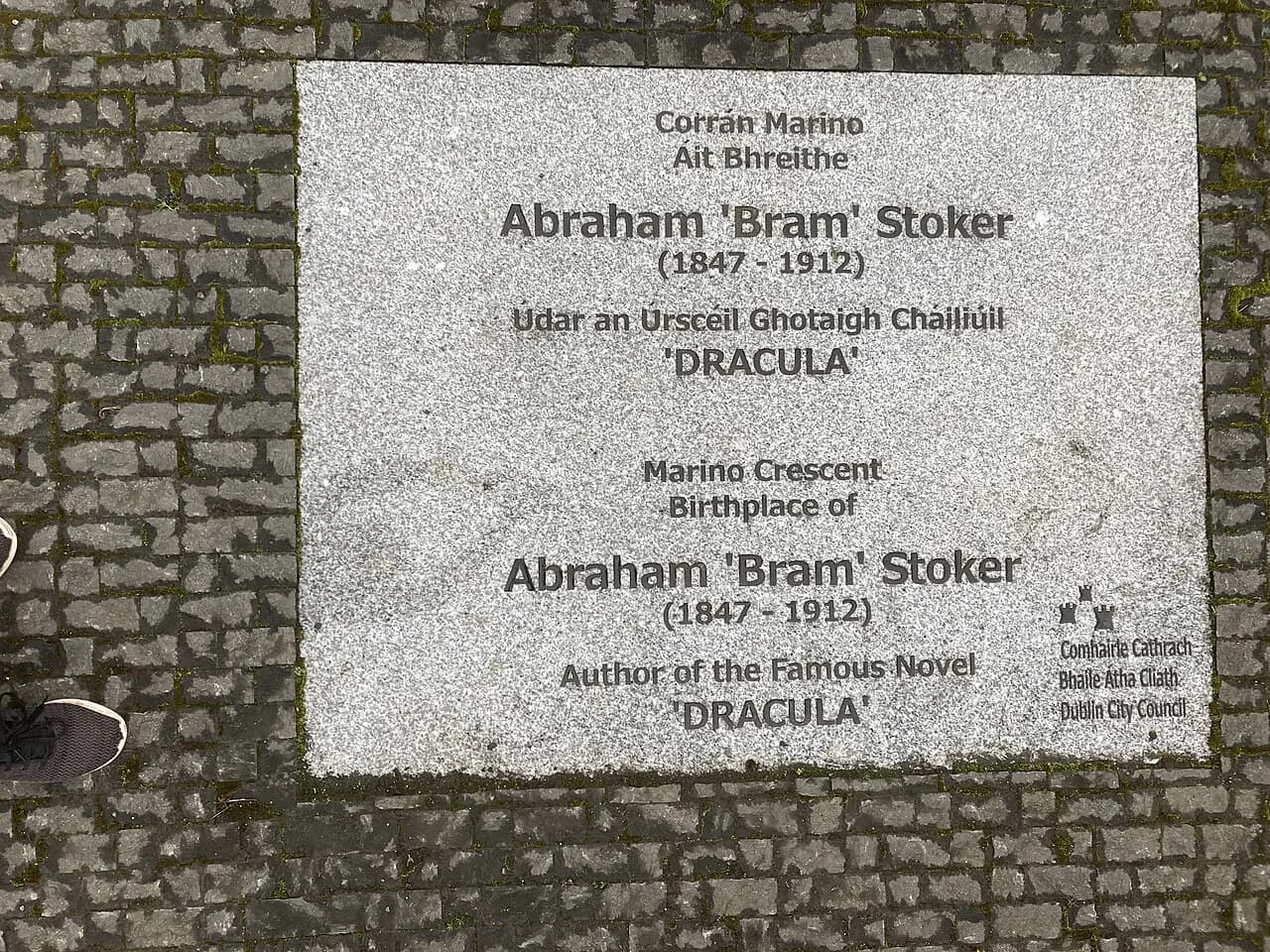
Clontarf, on the north side of Dublin Bay, is a quiet coastal suburb where the Stoker story begins in the telling of the Irish Tourism blog. That account gives his birth date as 8 November 1847 at 15 Marino Crescent and notes that the park opposite the terrace is now known as Bram Stoker Park. These biographical details come from that blog rather than a scholarly source, so read them as reported.
The house itself is privately owned today, so the visit is an exterior one: the terrace, the street and the small park across from it. Go for the setting and the sense of place rather than for rooms or exhibits, and keep noise and photography respectful of residents.
Trinity College Dublin and Stoker's Student Years
Stoker's student period at Trinity College is the second anchor of the route, and the Irish Tourism blog reports that he entered in 1864, studied mathematics and took part in debating, theatre and sport. Those claims, including the sporting nickname, belong to that blog. What is plainly on offer for a visitor is Trinity's setting: Front Square and the Long Room are the recognizable heart of the campus.
Do not assume admission to the campus buildings or the library from a Stoker association alone. Campus access, library viewing and any exhibition arrangements change, so check Trinity's own visitor information before setting out. If your interest is the wider Irish canon rather than Stoker specifically, the material on seamus heaney ireland offers a useful counterweight from a different literary tradition.
Marsh's Library and Its Gothic Interior
Marsh's Library, a short walk from St Patrick's Cathedral, is the most atmospheric interior on the route. The Irish Tourism blog reports that it was established in 1707, describes its dark wood and iron cages, and mentions a Halloween-season Dracula Trail. The library publishes its own visiting arrangements, and the blog's account should be read as a seasonal possibility rather than a fixture.
Whether you can go inside on your dates, and whether any themed trail is running, must come from the library's own published information. Stoker is said to have spent time here, but the sources frame this as an association rather than proof that the building shaped his writing. Build the library in as a stop you confirm, not one you assume.
Dublin Castle and the Undercroft
Beneath Dublin Castle, the Irish Tourism blog describes the Undercroft as medieval walls and a hidden river once associated with imprisonments and executions. The same blog links this setting to Stoker's period as a civil servant in nearby offices, a connection worth treating as reported rather than verified. The castle is a working government site with its own visitor operation, and it publishes which areas visitors can enter.
Access to the Undercroft is by the castle's arrangements, not by turning up at a gate, so check its official information before visiting. For contrast with Dublin's medieval remains, the guide to ancient sites ireland widens the picture beyond the capital's streets.
St Michan's Church and the Crypt Question
St Michan's Church on Church Street earns its place on Stoker routes because of its crypts, which the Irish Tourism blog describes as holding mummified remains and as open to the public. That last point carries the most weight of any claim on the route and the least independent verification here. Treat the blog's description as background rather than a guarantee of entry.
Before travelling, confirm with the parish or the church's own published information whether the crypts are receiving visitors and on what terms. If they are not, the churchyard and the surrounding streets of the old northside still belong to the walk. Do not plan a trip whose only purpose is the crypt without that check.
The Irish Gothic Lineage: Maturin, Le Fanu and Wilde
Stoker did not invent Irish horror, and Visit Dublin's listing for a Dark Dublin walking tour names three predecessors: Charles Maturin, Joseph Sheridan Le Fanu and Oscar Wilde. That framing places Dracula in a longer tradition of Irish writing about the uncanny rather than as an isolated phenomenon. The same listing explores Stoker's work against his own era and the older stock of Irish stories about spirits and the underworld. To see where Stoker sits against the city's older landmarks and institutions, use this Dublin heritage guide.
For readers who want that lineage laid out beyond a single walk, the Irish writers collection is a natural starting point, and the profile of lady gregory ireland shows how another figure from that world fitted into Dublin's cultural life. Reading a little Le Fanu before you go makes the city's Gothic geography easier to see.
The October Festival Weekend
Each year the Bram Stoker Festival takes place on the last weekend in October, according to Ireland.com, with Gothic productions staged in locations around the city, from outdoor spectacle to performances in libraries and crypts. The same feature notes walking tours, exhibitions and discussions of Stoker's work, and it points readers to the festival's own website and social channels for the full programme.
Because the programme is published by the festival rather than fixed in advance, plan around the weekend and then read the official listings for what is actually on. Ireland.com also names Trinity College, Dublin Castle, St Michan's Church and Marsh's Library among the buildings associated with Stoker that festival-goers have explored, which makes the weekend a convenient moment to combine several stops.

Self-Guided Route or Scheduled Walking Tour
The trade-off is control versus context. A self-guided route lets you linger at Marino Crescent or Front Square and skip interiors that are closed, but it leaves you interpreting fragments. A scheduled tour supplies a narrative and a guide, at the cost of fixed dates and a group pace. Visit Dublin lists a Dark Dublin walking tour for Friday 23 to Monday 26 October 2026, so treat those dates as the extent of what is confirmed and check for later listings separately.
Whichever you choose, a compact order helps: Clontarf first, then Trinity and Marsh's Library on foot, then Dublin Castle, finishing at St Michan's if the crypts are confirmed open. If your interests run to other Dublin writers, the guide to samuel beckett dublin shows how a single-author walk can be structured around one part of the city.

Plan Your Stoker Day
Bram Stoker's Dublin rewards a route built on what you can actually enter. The birthplace at Marino Crescent is an exterior stop, Trinity and Marsh's Library are settings to confirm individually, Dublin Castle's Undercroft runs on the castle's terms, and the St Michan's crypts need direct verification before you rely on them.
Two checks do most of the work: the individual venue for interior access, and the festival's own channels for October programming. Everything else, from the Clontarf seafront to the public streets of the old northside, you can walk without a ticket.
Explore more Ireland guides
Frequently Asked Questions
Where was Bram Stoker born in Dublin?
The Irish Tourism blog reports that he was born on 8 November 1847 at 15 Marino Crescent in Clontarf, on the city's north side, and that the park opposite the terrace is now called Bram Stoker Park. That date and address come from a single secondary blog rather than a scholarly biography, so treat them as reported details and verify against a published biography if precision matters to you.
Can you go inside Bram Stoker's birthplace?
No. The house at 15 Marino Crescent is privately owned, so the visit is limited to the exterior, the terrace and the public park across the street. Plan the stop as a short look at the setting rather than a house tour, and keep noise and photography considerate of the people who live there.
Which Dublin places are associated with Bram Stoker?
The commonly described route links his Clontarf birthplace with Trinity College Dublin, Marsh's Library near St Patrick's Cathedral, Dublin Castle and its Undercroft, and St Michan's Church on Church Street. Ireland.com also names Trinity College, Dublin Castle, St Michan's Church and Marsh's Library as buildings associated with Stoker that festival visitors have explored. Each interior is managed separately, so confirm access with the individual site rather than assuming the whole route is open.
Is there a Dracula trail in Dublin?
The Irish Tourism blog mentions a Halloween-season Dracula Trail at Marsh's Library, but no source establishes that it runs year-round or what it contains. Check the library's own published information for your dates instead of planning around the trail. Separately, Visit Dublin lists a Dark Dublin walking tour for 23 to 26 October 2026 that covers Stoker's work and the Irish Gothic tradition.
When does the Bram Stoker Festival take place?
Ireland.com states that the festival is held each year on the last weekend in October, with Gothic productions, walking tours, exhibitions and discussions staged across Dublin. The programme is published by the festival itself, so read its official website and social channels for what is on rather than relying on any preview. Bookable venues on the route set their own arrangements during the weekend.
Do you need to book Dublin's Stoker-themed walking tours?
Ticketing and booking terms are not published in the sources here, so check the tour listing or the operator's own page before you travel. Visit Dublin lists the Dark Dublin walking tour only for Friday 23 to Monday 26 October 2026, and future recurrence is not established, so do not assume the same walk runs at other times. If those dates do not suit, a self-guided route through the same streets needs no booking.
Sources
You might also like



Continue reading
More guides you'll find useful





