
Samuel Beckett in Dublin: Birthplace Context, Trinity, UCD and the Liffey Bridge
Trace Samuel Beckett's Dublin through his Foxrock birthplace, Trinity College and UCD's Beckett Country exhibition, plus the Calatrava bridge carrying his name.
On this page
Samuel Beckett's Dublin is not a single museum but a handful of places that carry his name in different ways. A south Dublin birthplace, a university where he studied and briefly taught, a working library holding a permanent photographic exhibition, and a river crossing designed by Santiago Calatrava together sketch the outline, though only some of them can actually be visited as literary destinations. The pages below pair each place with what it genuinely offers today.
The distinction matters more here than in most literary cities. Some of these sites are biography, some are architecture, and one is an exhibition you can walk through. Treating them as equivalent sets up disappointment, especially if you arrive on the Liffey expecting a Beckett interpretative centre. This guide separates them so you can plan around what is real, what is background, and what simply honours the name.
Why Beckett's Name Recurs Across Dublin
Beckett was born on 13 April 1906 at Cooldrinagh in Foxrock, then studied modern literature and romance languages at Trinity College Dublin, where he also competed in sports including cricket and golf. After graduating he taught briefly at Campbell College in Belfast and later at the École Normale Supérieure in Paris, where he met James Joyce. Dublin's UNESCO City of Literature office summarises this trajectory, including his 1969 Nobel Prize, which he accepted reluctantly, and his death in Paris in 1989.
For a visitor, the useful takeaway is that Beckett's Dublin is mostly biographical and commemorative. The Foxrock house, the Trinity connection and the later Paris life are context, not attractions with opening hours. The one substantial indoor Beckett display in the city sits at University College Dublin, and the most visible daily-life landmark is the bridge over the Liffey. If your interest runs to other writers as well, the wider set of Irish Writers covered elsewhere gives useful comparison for how Dublin treats its literary figures.
Foxrock and Cooldrinagh: Birthplace as Background
Cooldrinagh, in Foxrock south of the city centre, is recorded as Beckett's birthplace, and the Dublin City of Literature profile notes that the locality later appeared in both his prose and his plays. That topographical echo is the reason the area comes up in literary discussion, and it gives readers of the novels and plays a real-world anchor to hold alongside the text. What the sources do not record is any public access to the house or any visitor arrangements in Foxrock itself.
Treat Foxrock as background rather than a stop with a ticket desk. If you want to see where his early world lay, a look at the district on a map is enough to understand the geography; do not plan around entering buildings or finding displays. The permanent exhibition at UCD is the practical place to see landscape tied to text, since it was built expressly around that relationship. Foxrock adds orientation; the exhibition adds interpretation.
Trinity College Dublin: Student and Short-Term Lecturer
Beckett's Trinity connection runs in two directions. He studied modern literature and romance languages there and represented the college in several sports, and in 1930 he returned as a lecturer, resigning after only four terms in December 1931 according to the Dublin City of Literature account. The campus is therefore part of his formation as a writer, and the short lecturing stint is a genuine, if brief, chapter in his Dublin years.
No source describes a Beckett room, display or tour at Trinity, so do not expect to step into a preserved study or teaching space. The honest framing is that this is a campus where he studied and taught briefly, not a Beckett attraction. Beckett's own Trinity link stays modest and architectural rather than curatorial.
UCD's Beckett Country Exhibition: Origins and Provenance
The Beckett Country began as a photographic exhibition tied to Eoin O'Brien's book of the same name, which explored the places and landscape behind Beckett's writing. It was compiled by the Department of Topography and Design at Reading University with assistance from James Knowlson and David Davison, ran to 33 panels, and was first exhibited at the University of Reading Library in May 1986. It travelled widely before being donated to UCD in November 2007, where UCD Library now provides a permanent home.
The origin story explains the exhibition's character: it is a documentary presentation pairing place with text, not a collection of manuscripts or personal effects. Eoin O'Brien, a cardiologist and Beckett scholar, wrote the underlying book for Beckett's eightieth birthday, and UCD's version blends original panels with newly formatted photographs. Knowing this helps you decide whether the display suits you, and it makes clear that the value lies in connections between landscape and writing rather than in objects.
What the Exhibition Looks Like on the Ground
At UCD the exhibition sits on Level 2 of the James Joyce Library and is organised into eight thematic sections. Because it is extensive, not all 33 panels can be displayed simultaneously, so expect a partial showing arranged for thematic display rather than a complete run of the original set. That constraint is worth knowing before you travel across the city, since a visitor hoping to read every panel in sequence will be disappointed.
For the complete material, UCD Digital Library has digitised both the book and the original exhibition booklet, and its staff are the stated contact point for access to those items. That makes the digital route the better choice if you want the full photographic record, while the library display gives a physical, thematic sample in a working academic building. The page states no opening hours for the display, so confirm access arrangements with UCD Library before making a special trip.
The Samuel Beckett Bridge: A Dublin City Council Commission
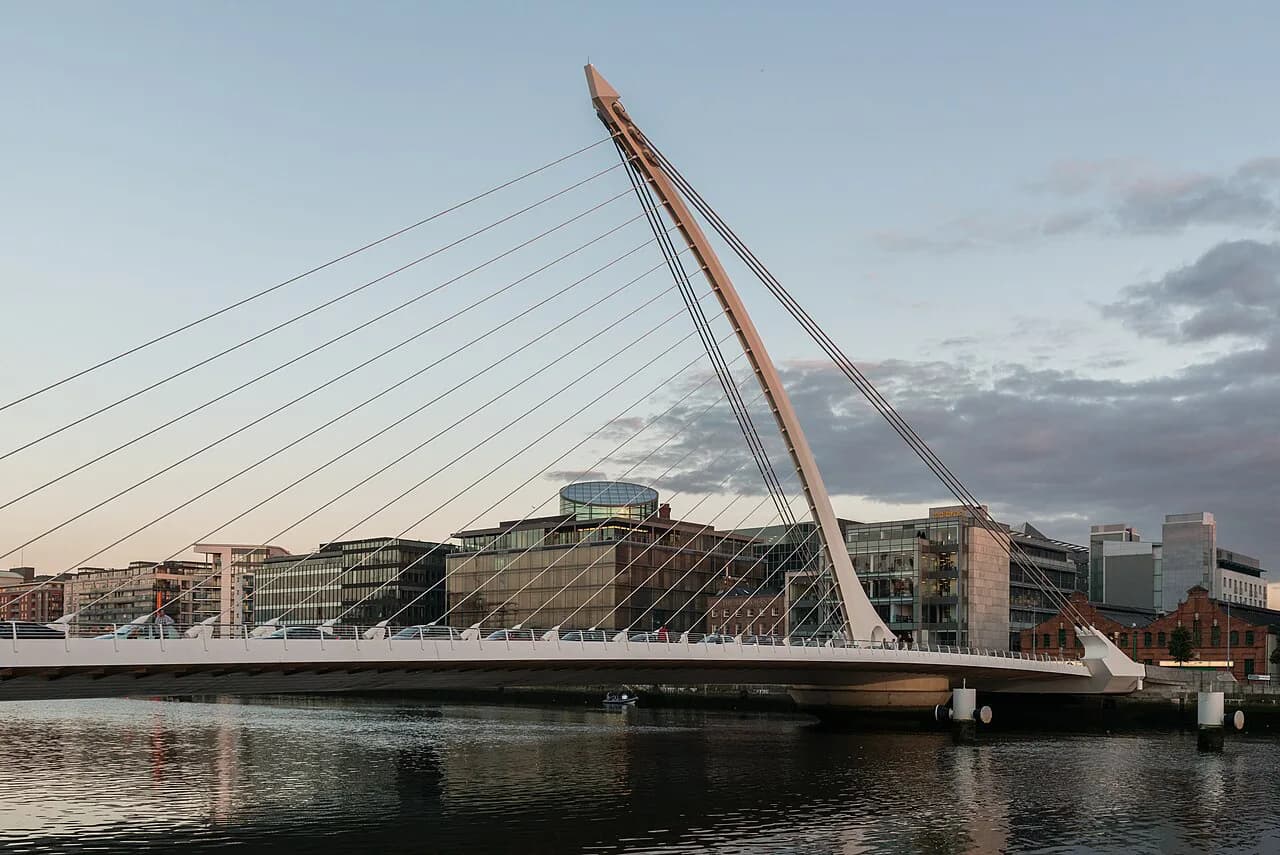
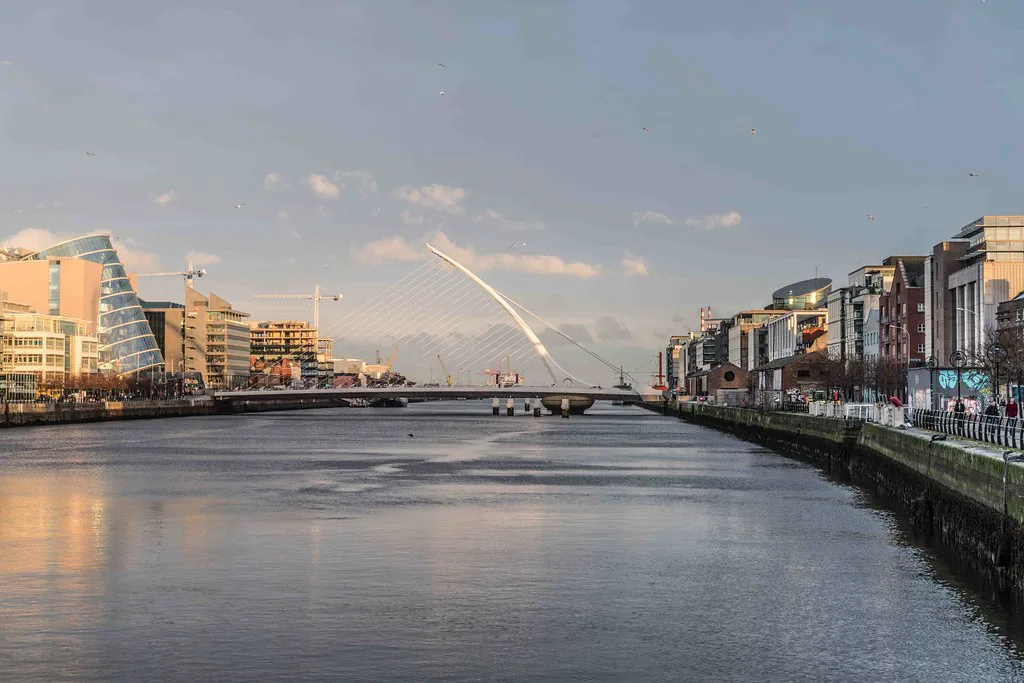
The bridge that carries Beckett's name across the Liffey was commissioned by Dublin City Council and designed by Santiago Calatrava; the same practice also designed the James Joyce Bridge, completed in 2003. Formerly known as Macken Street Bridge, it links Macken Street and Cardiff Lane on the south side with Guild Street on the north. Calatrava's project notes describe a cable-stayed balanced bridge with two unequal spans, carrying both vehicles and pedestrians.
Its position makes it a natural part of a river walk rather than a detour, since it completes an urban axis across the water. The design is the reason to look closely: the pylon and cables are meant to be read as structure, not as a monument to Beckett's writing. There is no museum, exhibition or visitor centre on the bridge, and the sources describe no set visiting arrangements, so plan for a crossing and a view rather than an attraction.
Reading the Bridge as Engineering
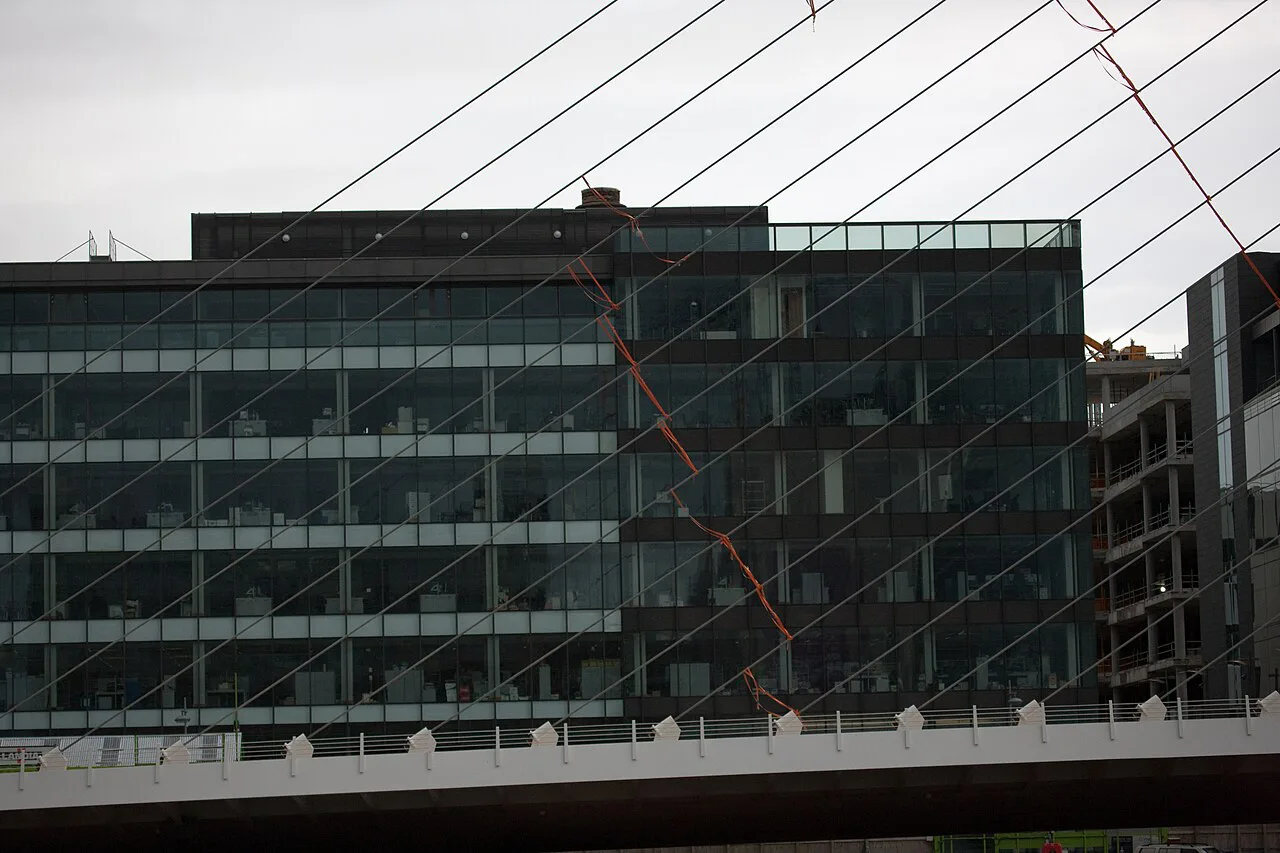
Two details reward attention. The bridge rotates horizontally through 90 degrees to free the river channel for water traffic, a mechanism housed in the intermediate pier, and that pier is founded directly on limestone bedrock with a large share of the load transferred to the ground. The pier stands only 28 metres from the south abutment, one of the measurable features of the structure worth noticing as you cross.
Pedestrians and vehicles share the crossing, which means the bridge functions as everyday infrastructure that happens to be beautifully engineered. If you approach from the south quays, look for how the deck continues an existing street rather than sitting as a standalone object. That framing, a link in a street axis rather than a sculpture, is the most accurate way to experience it, and it is the opposite of treating the Liffey landmark as a Beckett site.
Pairing the Places Without Overpromising
A sensible Beckett day separates the exhibition from the river. UCD's library display rewards a focused hour with the panels and a follow-up in the digital collection, while the bridge fits into any walk along the Liffey and asks only that you look up at the pylon and down at the pier. Foxrock and Trinity belong to the reading and orientation part of the day, not the ticketed-sightseeing part, and no source supports describing them as a formal trail.
If your literary interests extend beyond Beckett, the same logic holds: outdoor commemoration and named buildings are not the same as curated displays. Readers who want to compare how Irish literary landscapes are presented can browse other guides on the site, and the material on Seamus Heaney in Ireland is a straightforward next read. For the same question of which landmarks are real literary sites and which are context, the Dublin History: A Chronological Guide to the City's Key Sites is a helpful companion.
Practical Expectations Before You Go
Two checks cover most of the uncertainty. Confirm access to the UCD display with the library, because it sits inside a working academic building and not all panels are on view at once; and treat the bridge purely as a public crossing with no scheduled programme. Beckett's Paris life and wartime resistance work are part of his biography but are not Dublin visitor sites, so keep them as reading rather than itinerary items.
Finally, resist the temptation to rank these places against each other. They serve different purposes: one interprets place through photographs, one is a piece of engineering that honours a name, and two are biographical context you cannot enter. Approached that way, Beckett's Dublin is modest but honest, and the exhibition at UCD is the part that most repays deliberate planning. For broader context, the collected material on irish poets is a related starting point.
Plan Your Visit
Start with UCD's Beckett Country display if you want the substantive Beckett experience, checking library access before you go and using UCD Digital Library for the complete photographic record. Add the Samuel Beckett Bridge on a Liffey walk, where the unequal spans and rotating pier are the points to notice. Keep Foxrock and Trinity as orientation to the biography rather than destinations with doors to open.
That framing keeps expectations honest. No source records a Beckett museum in Dublin, public access to Cooldrinagh, or a permanent Beckett room at Trinity, and the bridge is a crossing rather than an attraction. Plan around the exhibition, enjoy the bridge for its engineering, and read the rest as context for the work itself.
For another heritage guide, read about James Joyce Dublin.
Explore more Ireland guides
Frequently Asked Questions
Is there a Samuel Beckett museum in Dublin?
No museum dedicated to Beckett is recorded in the available sources. The closest permanent display is UCD's Beckett Country exhibition on Level 2 of the James Joyce Library, which presents photographs linking landscape to his writing. The Samuel Beckett Bridge is a public road and pedestrian crossing, not a museum or interpretative centre.
Can you visit Samuel Beckett's birthplace at Cooldrinagh in Foxrock?
The Dublin City of Literature profile identifies Cooldrinagh in Foxrock as his birthplace on 13 April 1906 and notes that the locality later appeared in his prose and plays. It describes no public access to the house and no visitor arrangements in Foxrock. Treat the area as biographical and topographical context, and look to UCD's exhibition for interpretation of the landscape behind the work.
What is the Samuel Beckett Bridge and why is it named after him?
It is a cable-stayed bridge across the Liffey, formerly called Macken Street Bridge, commissioned by Dublin City Council and designed by Santiago Calatrava. It links Macken Street and Cardiff Lane with Guild Street and carries both vehicles and pedestrians. The name is a civic commemoration of Beckett, not evidence that the bridge contains exhibits or visitor facilities.
Where can I see the Beckett Country exhibition in Dublin?
It is permanently housed by UCD Library and displayed on Level 2 of the James Joyce Library in eight thematic sections. Because all 33 panels cannot be shown at once, visitors see a partial themed selection. The library page gives no opening hours, so confirm access directly with UCD Library before travelling, and use UCD Digital Library for the digitised book and booklet.
Can I see all 33 panels of the Beckett Country exhibition at once?
No. The exhibition consists of 33 panels, but the library display area is designed for thematic display of eight sections because the whole set cannot be shown simultaneously. For the complete material, request access to the digitised book and original exhibition booklet through UCD Digital Library, whose staff are the stated contact point.
How is Beckett connected to Trinity College Dublin?
He studied modern literature and romance languages at Trinity and represented the college in sports, and in 1930 he returned as a lecturer, resigning after four terms in December 1931. The sources describe no Beckett room, tour or display at Trinity, so the connection is historical and architectural rather than a curated visitor experience.
Sources
You might also like



Continue reading
More guides you'll find useful




