
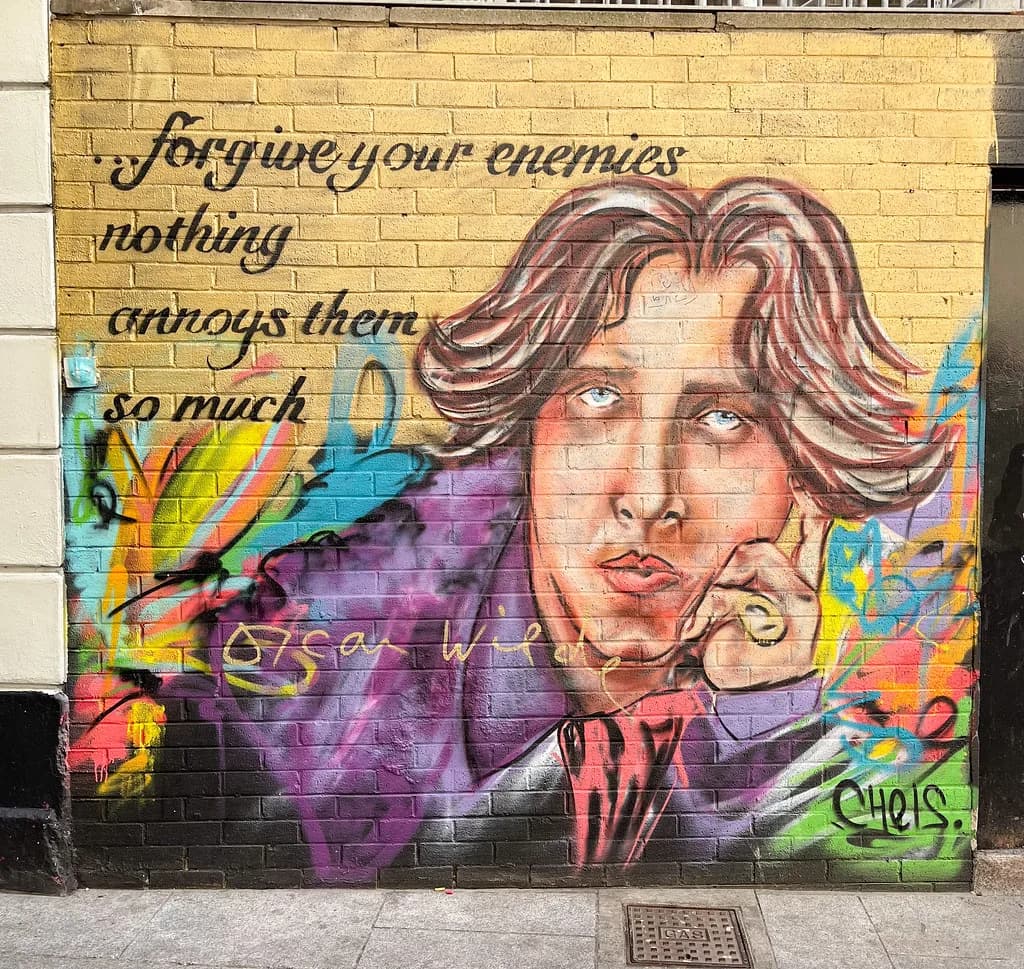
Oscar Wilde in Dublin: A Walk Through His Birthplace and Childhood Home
Trace Oscar Wilde's Dublin on foot, from his 1854 birthplace on Westland Row to his childhood home on Merrion Square and Danny Osborne's 1997 memorial.
On this page
Oscar Wilde's Dublin is traced through three documented places, all within a short walk of each other in the city centre: his 1854 birthplace at 21 Westland Row, the family home at 1 Merrion Square North from 1855, and Danny Osborne's 1997 memorial in Merrion Square Park. The first two are often conflated, but they are different buildings with different visitor status, and knowing which is which prevents a wasted morning.
The Merrion Square house is the only one of the three with formal visitor entry, and its access is limited to weekends until the end of April 2027, so the route works best when planned around that window. The memorial sits outdoors in a public park and can be seen at any point in the day, which makes it a reliable anchor if the house visit does not fit your dates.
21 Westland Row: The 1854 Birthplace
Wilde was born at 21 Westland Row in 1854, on the eastern side of the street where Trinity College now owns the terrace. The houses date from the 1830s and 1840s, and the building has been adapted for academic use rather than presented as a museum. Visitors should plan to read the site from the street and treat the interior as inaccessible unless Trinity or the occupying department publishes otherwise.
Trinity's description of the house is useful for picturing the family's early life: a standard terraced plan with an entrance hall, staircase hall and two ground-floor reception rooms, plus two interconnecting reception rooms on the first floor. The house contains a basement and four floors above, with unusual interconnecting doors between the front and back rooms. That detail alone explains how a professional Victorian household could combine work, family sitting rooms and formal drawing rooms in a single narrow terrace.
Trinity's Provost and Board have supported preserving the internal structure of No. 21 in a style faithful to the 1850s, so the house functions as a commemoration of Wilde and his parents. That preservation intent is not the same as public opening: the page describes the buildings as adapted for academic use and linked to the Hamilton Building and Biotechnology Institute at the rear. Read it as a heritage building in institutional use, not a museum.
1 Merrion Square North: The Childhood Home from 1855
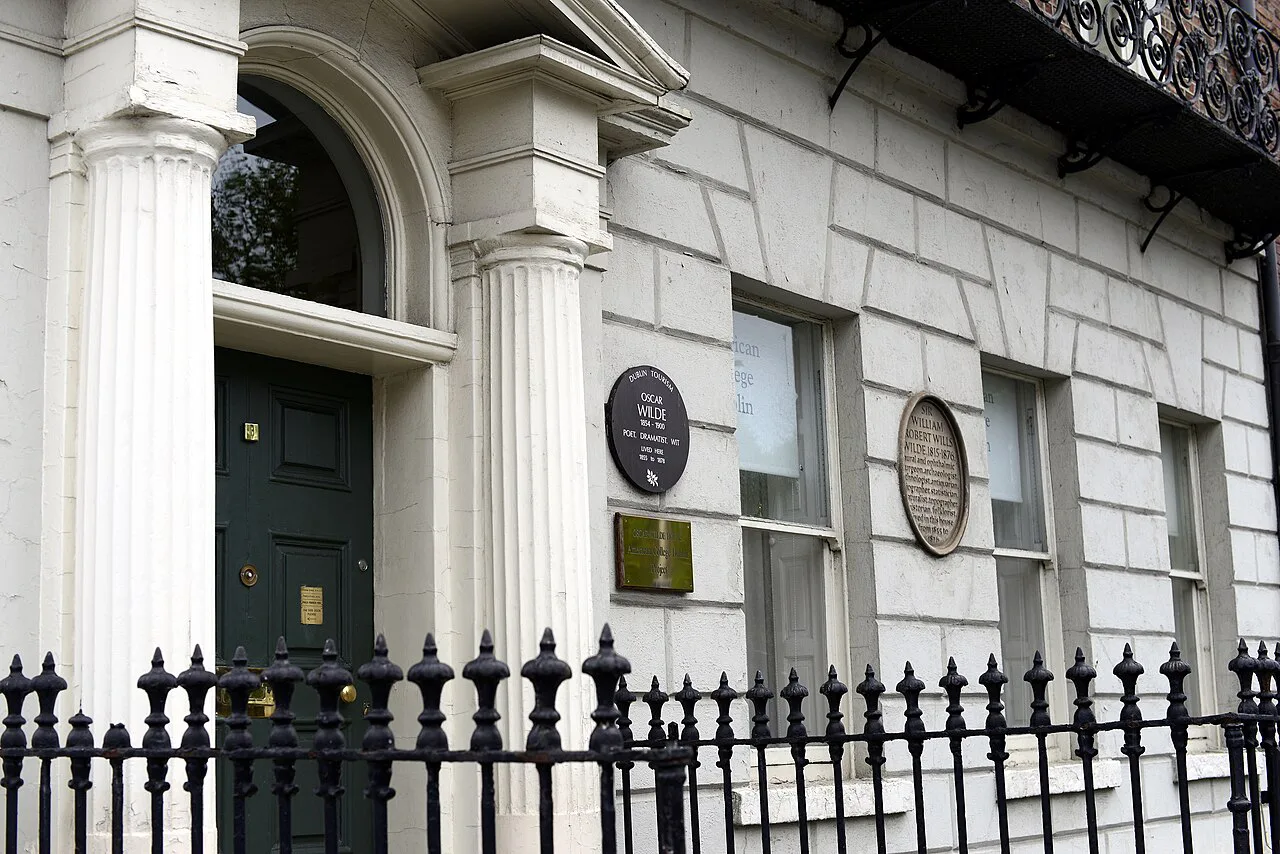
Oscar's parents, William and Jane Wilde, moved to 1 Merrion Square North in 1855, a few months after Oscar was born, and the house became the family's Dublin base for the next two decades. The birthplace on Westland Row and the childhood home here are separate addresses with separate histories, and visitors who arrive expecting one building to cover both will be disappointed. The Merrion Square house is the one with a visitor programme and published opening terms.
The household Jane and William ran was unusually public for a Victorian family. The Wilde children were schooled at home by governesses but were present at many of the dinners and social events their parents held, which gave Oscar and his siblings an early view of Dublin's intellectual life. That social education is part of the reason the house matters as more than a birthplace annexe: it was a working salon as well as a family home.
Jane Wilde ran a weekly salon on the first floor for almost two decades, drawing artists, musicians, poets, politicians and philosophers. Under the pen name Speranza she wrote verse and editorials for The Nation, and in 1891 a Dublin magazine poll named her the Greatest Living Irish Woman. Her 1849 translation of the Gothic novel Sidonia the Sorceress was later reissued in a lavish edition by William Morris, and An Post marked her bicentenary with a stamp in 2021.
Visiting the House: Published Terms Until April 2027
As of October 2026, the house is open at weekends only until the end of April 2027, for walk-in visits from 11am to 6pm with last entry at 5pm. There is no need to book a walk-in visit; tickets are bought at reception. General admission is €12, with a €10 rate for students, teachers, retired, unemployed and disabled visitors. These are dated published terms, not permanent opening hours, so check the venue's own page again before you travel.
A guided tour runs on selected weekends and costs €25 per person, with no discounts. It must be booked online through the venue's events section, and the tour is separate from the walk-in ticket, so decide which format suits you before you arrive. The walk-in gives you access at your own pace within the published window; the tour gives you a scheduled format but fewer available slots.
The building now houses American College Dublin, which offers courses including performing arts and creative writing, and the college's presence shapes what visitors should expect. This is a working institution with a visitor programme, not a dedicated museum with period rooms throughout. Plan your interior time here around the published tour or walk-in, and do not assume access to college spaces beyond what the venue advertises.
Walking from Westland Row to Merrion Square
The route between the two Wilde addresses is short and central: Westland Row runs close to Trinity's campus edge, and Merrion Square lies a few minutes further east. Walking it in the order of Wilde's life, birthplace first and childhood home second, gives the day a narrative shape and puts the park memorial at the end. Allow time to look up at the terraces rather than treating the walk as pure transit, and if the Georgian architecture itself is the draw, our Merrion Square, Dublin: Georgian Square and Park Guide covers the square in its own right.
If you want to extend the literary context, the city rewards a broader loop through its writers' landscapes, and the irish writers guide covers Dublin's literary figures across different sites. Keep the Wilde stops as the fixed points and treat any additional houses or plaques as optional additions rather than substitutes, because only the Merrion Square house has a published visitor programme among the three Wilde sites here.
The 1997 Memorial in Merrion Square Park
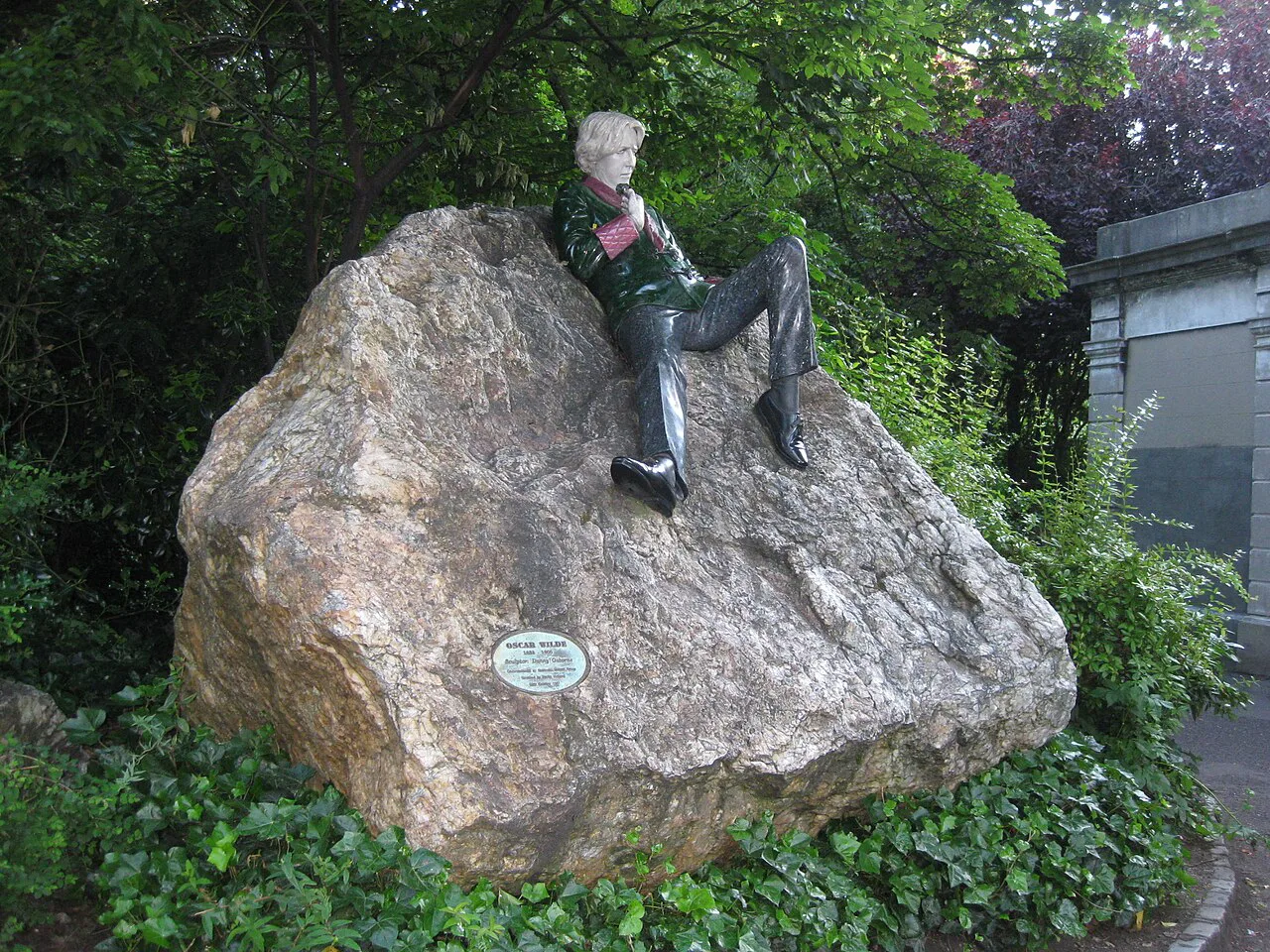
The Oscar Wilde Memorial in Merrion Square Park dates from 1997, was made by Irish sculptor Danny Osborne, and was commissioned by the Guinness Ireland Group. It took almost two and a half years from conception to completion, and the commission drew on geologists, quarry owners, glass workers and foundries from several countries. It is an outdoor sculpture in a public park, which makes it the most dependable of the three Wilde stops for a spontaneous visit.
Osborne deliberately avoided conventional marble, combining bronze, glass, granite, jade, porcelain, quartz and thulite to give a more lifelike representation. Wilde's green jacket is nephrite jade from Canada, and the red cuffs are thulite from Norway. Two stone pillars carry quotations from his writing, selected by poets, public figures and artists, and the inscriptions reproduce the handwriting of figures including Seamus Heaney, John B. Keane and President Michael D. Higgins. For more on Heaney's own place in Irish writing, see the Seamus Heaney in Ireland guide.
On top of the pillars sit two small bronze sculptures: a pregnant woman representing Constance Wilde and the theme of life, and a male torso representing Dionysus and the theme of art. Wilde himself reclines on a rocky perch and faces toward his childhood home at No. 1 Merrion Square. That orientation makes the park a natural end point for a route that began at his birthplace, and it is worth walking around the sculpture to see how the figures relate to the square.
Wilde's Dublin Years in Context
Wilde was born into a cultivated Dublin family: his father was one of Ireland's leading surgeons and his mother was a poet and expert on Irish folklore. After home schooling and a period at boarding school in Enniskillen, he won a scholarship to Trinity College Dublin in 1871, then a scholarship to Oxford in 1874. Dublin was the starting point of his education rather than the whole story, and the city's sites mark that beginning.
The family suffered the death of Oscar's young sister Isola, who became the subject of his 1881 poem Requiescat, and the British Library essay records that he carried a lock of her hair for the rest of his life. That personal context is worth holding alongside the more public story of the Merrion Square salons. The houses and memorial commemorate a family and a milieu, not only a single famous writer.
For readers who want to place Wilde among other Irish poets and playwrights, the wider Irish poets field gives breadth, but the Dublin stops remain specific to Wilde's early life. His later career, including The Picture of Dorian Gray and the 1895 trials, belongs to London and Reading rather than Dublin, and the city's sites do not attempt to cover it. Treat the walk as a prologue to the biography rather than a complete account.
Practical Trade-offs and Sequencing
The main constraint is the house's weekend-only window until the end of April 2027, so build the day around that and treat the outdoor memorial as the flexible stop. If your dates fall outside the window or on a weekday, the park sculpture and the Westland Row exterior remain available, but the Merrion Square interior does not. Check the venue page for any change to those terms before booking travel.
Choose the walk-in if you want to control your own pace within the published hours, and the guided tour if you want a scheduled format and can commit to a specific slot. The price difference is significant, and the tour has no concessions, so a group with students or retired visitors may find the walk-in better value. Neither option includes the birthplace interior, which is not open as a visitor attraction.
Beyond the three Wilde sites, Dublin offers many literary options, and comparisons with James Joyce's Dublin or a James Joyce walking tour can help you decide how much of the day to give to writers. A sensible order is Westland Row first, Merrion Square house second within its opening hours, and the park memorial last, keeping this walk focused on the city centre.
Plan Your Visit
Oscar Wilde's Dublin is best understood as three separate places rather than one: the 1854 birthplace at 21 Westland Row, which is a preserved institutional building without public interior access; the childhood home at 1 Merrion Square North, which has a weekend visitor programme published through April 2027; and the 1997 Danny Osborne memorial in Merrion Square Park, which is outdoors and freely viewable. Keeping them distinct is the single most useful planning decision.
Check the house's own page for current times, prices and tour availability before you travel, because the published terms are dated and may change after April 2027. If the house is closed on your dates, the memorial and the Westland Row exterior still give a coherent walk, and the park sculpture's orientation toward the childhood home makes a fitting end point. Book the guided tour online only if a fixed slot suits you better than the walk-in.
Explore more Ireland guides
Frequently Asked Questions
Where was Oscar Wilde born in Dublin?
Wilde was born at 21 Westland Row in 1854. The house is part of a terrace now owned by Trinity College and adapted for academic use, so it is not a museum and its interior is not presented as a visitor attraction. Visitors can read the site from the street and use Trinity's published description of the house's plan to picture the family's early home.
Can you visit Oscar Wilde's childhood home in Dublin?
Yes, at 1 Merrion Square North, but only within the venue's published access terms. As of October 2026 those terms are weekend-only walk-in visits until the end of April 2027, with last entry at 5pm, plus a separately booked guided tour on selected weekends. Check the venue's own page before travelling, because the window is dated and does not extend indefinitely.
Where is the Oscar Wilde statue in Dublin?
The Oscar Wilde Memorial stands in Merrion Square Park, opposite the childhood home. It dates from 1997, was made by Irish sculptor Danny Osborne, and was commissioned by the Guinness Ireland Group. Wilde reclines on a rocky perch facing toward No. 1 Merrion Square, which makes the park a fitting end point for a Wilde walk even if the house is closed on your dates.
What is the difference between the birthplace and the childhood home?
The birthplace at 21 Westland Row is where Wilde was born in 1854; the family moved to 1 Merrion Square North in 1855, a few months later, and that house became their Dublin base for about two decades. The two addresses are often confused, but only the Merrion Square house has a published visitor programme.
Who made the Oscar Wilde memorial and when?
Irish sculptor Danny Osborne made the memorial, which dates from 1997 and was commissioned by the Guinness Ireland Group. It combines bronze, glass, granite, jade, porcelain, quartz and thulite rather than conventional marble, and its two pillars carry Wilde quotations inscribed in the handwriting of selected public figures.
What should you see first on an Oscar Wilde walk in Dublin?
Start at 21 Westland Row to see the birthplace exterior, then walk to 1 Merrion Square North for the house visit within its published hours, and finish at the memorial in Merrion Square Park. That order follows Wilde's early life and ends at the outdoor sculpture, which remains available even if the house is closed.
Sources
You might also like



Continue reading
More guides you'll find useful




