
Irish Poets: Yeats, Heaney and Kavanagh in Four Places
Irish poets come into focus at four supported places: two National Library of Ireland exhibitions in Dublin, the Patrick Kavanagh Centre and Kerry Writers' Museum.
On this page
The most direct way into Irish poets is not a ranked list but a set of places that hold their manuscripts, personal items and local context. Four supported stops do that work: the National Library of Ireland's Yeats exhibition on Kildare Street, the same library's Heaney exhibition at Westmoreland Street, the Patrick Kavanagh Centre in Inniskeen, and Kerry Writers' Museum in Listowel. Each pairs a poet or a county tradition with material you can actually look at, which is a firmer footing than biography read in the abstract.
Why Place Matters When Reading Irish Poets
Poetry written in Ireland is unusually tied to particular ground: a farm, a parish, a river, a city street. Seeing the objects a poet kept and the drafts a poem passed through turns those references into something concrete rather than decorative. It also clarifies what a museum can and cannot tell you — a display case shows the desk, not the poem's meaning, and the reading still has to be done by you.
The wider field is covered in our guide to irish writers, which follows the novelists and dramatists alongside the poets. This article deliberately narrows to verse and to four places where a visitor can check holdings and access before travelling, rather than trying to list every poet born on the island. If your interest runs to fiction and drama first, start there and use this page for the poetry stops.
W.B. Yeats and the National Library's Yeats Collection
William Butler Yeats was born in Dublin on 13 June 1865 and died on 28 January 1939; he took the Nobel Prize in Literature in 1923 as sole laureate, writing in English, with a citation praising poetry that, in a highly artistic form, gave expression to the spirit of a whole nation. The award is useful context rather than the reason to visit. The reason is the material: the National Library of Ireland describes its Yeats Collection as the largest assembly of books, manuscripts and personal items relating to him anywhere.
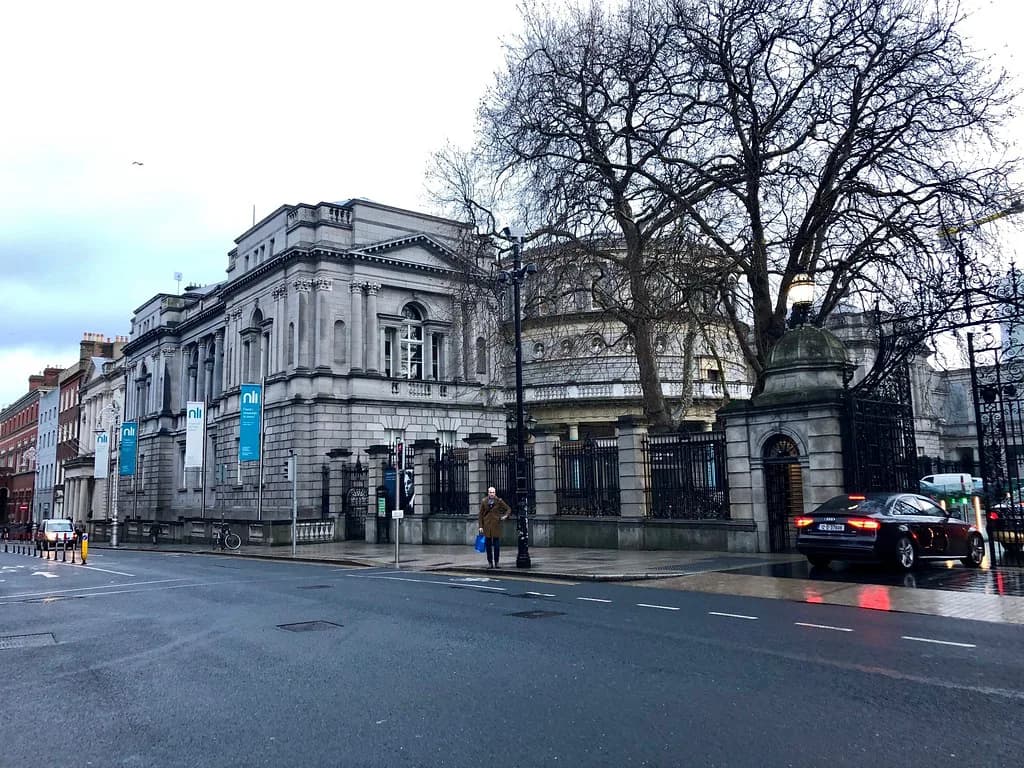
That collection is the backbone of the library's exhibition on Kildare Street, which the NLI calls award-winning. Displayed highlights include manuscript drafts of well-known poems such as The Lake Isle of Innisfree and Easter, 1916, his Nobel medal, photographs of Yeats with family and friends, and personal objects that run from school reports to a carved piece of lapis lazuli. The breadth matters: it shows a working writer's interests in folklore, theatre, politics and mysticism rather than a single polished image.
Yeats's early direction is easier to understand with the Nobel Prize account in mind. He grew up in an artistic Dublin household, spent summers at the family's house in Connaught, and drew on study of that region's folklore and customs; as a young man in London he absorbed the mysticism and symbolism of the era. With the playwright Lady Gregory he founded the Irish Theatre, which later became the Abbey Theatre, and his plays often drew on Irish legend. The exhibition's manuscripts sit within that biography rather than replacing it.
Yeats Access: Kildare Street Hours and Current Closures
The exhibition publishes its own timetable: Monday, Thursday and Friday 9.30am to 5pm, Tuesday and Wednesday 9.30am to 7pm, weekends 9.30am to 5pm, with last admission half an hour before closing, and public holiday Mondays from noon to 5pm. Those regular hours are the baseline. They are not the whole story at the moment, because the library has posted dated service changes that override parts of the schedule.
As of 23 October 2026, the Kildare Street buildings, including the Yeats exhibition, have been closed on Saturdays since 3 October 2026 and will stay closed on Saturdays until further notice; the site is also closed to the public on Monday 26 October 2026. The exhibition remains open on Sundays. The library notes that further changes can come at short notice during industrial action and asks visitors to check its opening hours page and social channels before travelling. Treat the published weekly hours and the current notice together, not one without the other.
Seamus Heaney's Ground: County Derry and Mossbawn
Seamus Heaney was born in April 1939 in County Derry in Northern Ireland, the eldest of nine children on a family farm of about fifty acres, with a father committed to cattle-dealing and a mother from a family tied to the linen mill economy. The Nobel biography frames his background as a meeting of a Gaelic pastoral past and industrial Ulster, a tension he linked to the quarrel out of which his poetry came. Rural Derry, and the farm called Mossbawn, remained what the biography calls the country of his mind long after the family left in 1953.
A scholarship at twelve took him to St Columb's College in Derry, a Catholic boarding school about forty miles from the farm — a departure he described as a move from farm labour to education. Belfast followed from 1957 to 1972, then a move to the Republic and, from 1982, regular annual teaching in America. For a reader, that sequence explains why so much of the work circles back to a specific townland even as the poet's life moved steadily further away. See also Seamus Heaney in Ireland for those places in more detail.
Heaney's Listen Now Again at Westmoreland Street
The exhibition Seamus Heaney: Listen Now Again is at the Bank of Ireland Cultural and Heritage Centre on Westmoreland Street in Dublin 2, presented in partnership with the National Library of Ireland rather than at the library's Kildare Street building. At its centre is Heaney's own writing desk, surrounded by original manuscripts, letters, unpublished work, diary entries, photographs and recordings. The material comes from the archive Heaney and his family donated to the library in 2011, and the NLI credits the curation to Professor Geraldine Higgins of Emory University.
This is the easier of the two Dublin stops to plan around. Entry is free, booking is not required, and the exhibition runs until 2027; it opens 10am to 4pm Monday to Saturday with last admission at 3.30pm and closes on bank holidays. A guided tour runs daily at 2pm, and larger groups can arrange advance bookings for a tailored visit. Kildare Street's Saturday closures and industrial-action notices belong to a different building and schedule, so do not carry them across.
Patrick Kavanagh at Inniskeen
The Patrick Kavanagh Experience in Inniskeen is a self-guided exhibition housed in the old church where Kavanagh attended Mass. Artefacts, multimedia, text and film connect his life and poetry to Monaghan, which is the point: the exhibition is built around a local landscape rather than a neutral gallery wall. For an individual visitor this self-guided format is the practical choice, since you can move at your own pace and are not dependent on a group forming.
The wider guided experience — the grave, the village and the Poetry Jukebox by the River Fane — is arranged separately and requires at least five paying participants; a bus tour has a separate minimum of ten and depends on bus availability. Neither should be assumed to be part of the standard exhibition ticket. If those elements matter to you, ask the centre in advance whether the minimum has been met on your date, and plan the trip only once you have an answer.
Kerry Writers' Museum in Listowel
Kerry Writers' Museum in Listowel collects, safeguards and interprets material relating to County Kerry's literary heritage and to the cultural and social history of Listowel and North Kerry. Its origins lie in a 1994 local literary task force, with the museum opening in April 2001, and it is a not-for-profit owned by Kerry Cultural & Literary Centre CLG. In 2018 it received Full Accreditation under the Heritage Council's Museum Standards Programme for Ireland, a voluntary benchmark of professional practice.
Its regional scope is what distinguishes it from the Dublin collections: it interprets a county's writers as a group rather than one laureate. The museum also credits itself with a role in Listowel's designation as a Heritage Town by Fáilte Ireland, and in the town's inclusion in a pilot Historic Town initiative in 2011. The museum has announced a planned multi-year refurbishment linked to the Listowel Greenway, described as a future programme; it is not evidence of a current closure, so confirm present visiting arrangements directly rather than assuming either disruption or normal operation.
How to Sequence the Four Stops
The two Dublin exhibitions pair naturally: Kildare Street and Westmoreland Street are both central and could be taken on the same weekday, with the Heaney display working as a shorter, walk-in complement to the Yeats collection. Keep the schedules separate in your head, though — one follows the library's current industrial-action notice, the other its own fixed exhibition timetable. Check the Kildare Street page on the morning you go, since that is where short-notice changes appear.
Inniskeen and Listowel are separate regional outings rather than add-ons to a Dublin day, and each rewards a slower visit tied to its landscape. If you want to broaden a Dublin literary day, a James Joyce walking tour dublin covers the city's fictional geography on foot and works well alongside the library exhibitions. Two check-current-details habits cover everything here: confirm the NLI's Kildare Street status before a Dublin visit, and confirm the Kavanagh and Kerry arrangements before travelling to Monaghan or Listowel.
Plan Around the Material, Not the Name
Approach Irish poets through what survives them: Yeats's drafts and medal on Kildare Street, Heaney's desk and letters on Westmoreland Street, Kavanagh's Monaghan church, and a county collection in Listowel. Each stop is verifiable, each has published access information, and together they cover a lyric tradition, a northern farm background and a regional literary culture without flattening them into one story. Check the institution's own page before you travel, and let the manuscripts set the reading list.
For another heritage guide, read about James Joyce Dublin, and for the city's older fabric pair these literary stops with a Dublin History: A Chronological Guide to the City's Key Sites.
Explore more Ireland guides
Frequently Asked Questions
Where can I see Yeats manuscripts and personal items in Dublin?
The National Library of Ireland's Yeats exhibition on Kildare Street draws on the library's Yeats Collection and displays manuscript drafts of poems including The Lake Isle of Innisfree and Easter, 1916, along with his Nobel medal and personal objects. Check the library's opening hours page before going, because the Kildare Street buildings currently have Saturday closures and a dated Monday closure.
Are the Yeats and Heaney exhibitions in the same building?
No. The Yeats exhibition is at the National Library of Ireland on Kildare Street. Seamus Heaney: Listen Now Again is at the Bank of Ireland Cultural and Heritage Centre on Westmoreland Street, presented in partnership with the library. Because they are separate sites with separate schedules, Kildare Street closures do not apply to the Heaney exhibition.
Is the Seamus Heaney exhibition free and do I need to book?
Entry is free and booking is not required for individual visitors. It opens 10am to 4pm Monday to Saturday, last admission 3.30pm, closes on bank holidays, and runs until 2027. A guided tour is offered daily at 2pm, and larger groups can arrange advance bookings.
What can a solo visitor do at the Patrick Kavanagh Centre?
The self-guided exhibition in the old church where Kavanagh attended Mass is the practical option for one person, using artefacts, multimedia, text and film to link his life and poetry to Monaghan. The guided experience covering the grave, village and Poetry Jukebox is arranged separately and needs at least five paying participants, while the bus tour needs ten and depends on availability.
Is the Kerry Writers' Museum worth visiting for poetry specifically?
It interprets County Kerry's literary heritage as a county-wide tradition rather than focusing on a single poet, so it suits readers interested in regional writing and local history. It is a not-for-profit opened in 2001 and accredited under the Heritage Council's Museum Standards Programme in 2018. A multi-year refurbishment is planned, so confirm current visiting arrangements directly before travelling.
Can I see all four places in one day?
No. The two Dublin exhibitions can reasonably share a day, but Inniskeen in Monaghan and Listowel in Kerry are separate regional outings that each deserve their own visit. Plan the Dublin pair around the library's current Kildare Street notice and treat the other two as independent trips with their own arrangements confirmed in advance.
Sources
- W B Yeats: Nobel facts
- Exhibition | Yeats: The Life and Works of William Butler Yeats | National Library of Ireland
- Opening Hours and Service Updates | National Library of Ireland
- Seamus Heaney Nobel biography
- Seamus Heaney: Listen Now Again
- Patrick Kavanagh Experience
- About us - Kerry Writers Museum
You might also like



Continue reading
More guides you'll find useful




