
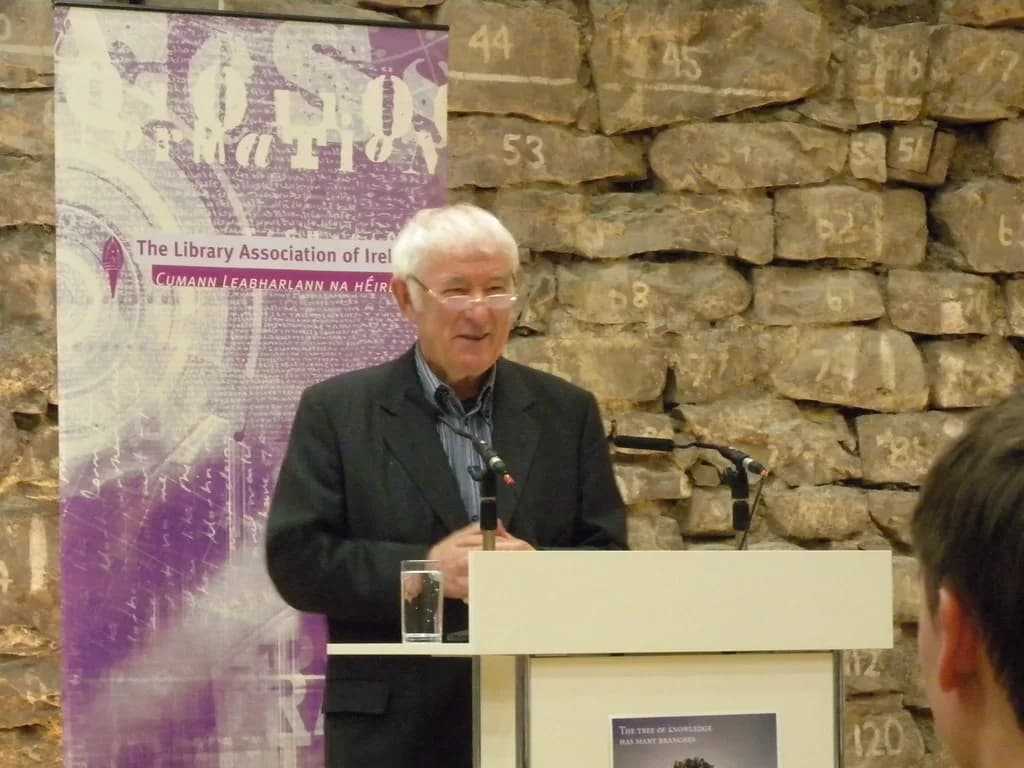
Seamus Heaney in Ireland: Where to Follow His Life and Work
Follow Seamus Heaney across Ireland, from his County Derry childhood to Dublin's free Listen Now Again exhibition and the archive holding his recordings.
On this page
For a literary traveller, the surest way to encounter Seamus Heaney in Ireland is the National Library of Ireland's Listen Now Again exhibition, housed at the Bank of Ireland Cultural and Heritage Centre on Westmoreland Street in Dublin and free with no booking required. The Irish Traditional Music Archive nearby catalogues a recording of Heaney reading alongside piper Liam O'Flynn. Everything else tied to his name is largely context: the County Derry landscape of his childhood and the houses where he wrote, none of which the sources present as visitor attractions. For wider reading, our guide to irish writers places him among his peers.
Heaney was born on 13 April 1939 in rural County Derry, in Northern Ireland, the eldest of nine children, and grew up on the family farm at Mossbawn. The Nobel Prize biography describes a County Derry farm of about fifty acres worked by his father, a cattle dealer, while his mother's family was tied to a local linen mill. That split inheritance, between a rural Gaelic past and industrial Ulster, is a useful frame for reading the poems before you travel.
Heaney's Irish Geography at a Glance
The Estate of Seamus Heaney sets out the shape of his life with dates worth carrying on a map. He boarded at St Columb's College in Derry from 1951, went to Queen's University Belfast in 1957, married Marie Devlin in 1965, moved to County Wicklow in 1972 and settled in Dublin's Sandymount neighbourhood in 1976. He died in Dublin in 2013.
That sequence helps a visitor see why a single Dublin day cannot cover him. The formative places cluster in County Derry in Northern Ireland, the writing years partly belong to a gate lodge in Wicklow, and the public legacy is concentrated in Dublin institutions. After the exhibition, anyone who wants to go further into the wider canon can browse guides to irish writers and to irish poets, since Heaney sits within both traditions even though those pages are companions rather than a route through his own places.
County Derry and the Shaping Landscape
Mossbawn is the farm of his early poems, and the Nobel biography notes that his family left it in 1953, after which rural County Derry remained a country of the mind in his work. The Estate account fills in the human reason for that move: his brother Christopher, aged four, was killed in a road accident that year, and the family moved to a new farm called The Wood outside Bellaghy. Both are places of biography, not attractions with gates and staff.
The other decisive Derry place is St Columb's College, the Catholic boarding school in the city of Derry where he won a scholarship at twelve and became a boarder in 1951. The Nobel biography frames that first departure from Mossbawn as the move from farm labour into education, a theme that runs through his work from the first collection onward. Treat the city as landscape to understand, not as a set of buildings whose interiors promise Heaney displays.
The one purpose-built Derry site named in these sources is Seamus Heaney HomePlace in his home village of Bellaghy, opened in 2016 and described by the Estate as an award-winning arts and literary centre with a permanent exhibition on his life and poetry. The available pages do not publish its opening hours, admission prices or tour arrangements, so check its own current visitor information before making a trip north.
The Writing Years: Glanmore and Sandymount Treated as Context
Glanmore Cottage in County Wicklow matters to readers because it is where Heaney turned to writing full time for about four years after leaving Belfast in 1972. The Estate describes it as a small gate lodge owned by the Canadian academic Ann Saddlemyer, and calls those years unusually productive. It is a biographical address, so plan around it rather than expecting entry.
Sandymount, in Dublin, was his home from 1976 until his death in 2013, according to the Estate biography. Knowing that he lived on that side of the city makes the Dublin stop feel less abstract, but a residential address is not a stop to add to an itinerary. The public encounter with the man waits for the institutions.
Dublin's Visitor Anchor: Listen Now Again
The National Library of Ireland's own exhibition listing places Listen Now Again at the Bank of Ireland Cultural and Heritage Centre on Westmoreland Street, Dublin 2. It lists the show as running until 2027, free to enter with no booking required, open 10am to 4pm Monday to Saturday with last admission at 3.30pm. It is closed on Bank Holidays and runs a guided tour daily at 2pm, with advance booking possible for larger groups.
The free admission is the practical argument for putting this first. A traveller on a short Dublin stop can walk in without planning a slot, and the 2pm tour gives a fixed point for anyone who likes a guided frame. If your trip falls on a Bank Holiday, the closure rule is the one detail to check before crossing the city.
The exhibition is drawn from the extensive archive that Heaney and his family gave to the National Library in 2011, and it is curated by Professor Geraldine Higgins of Emory University. The Library is the presenting institution, which matters if you want to confirm current details from the source rather than a secondary summary. Keep one check of the listing against your own dates.
Inside the Exhibition: Desk, Manuscripts and Archive
The heart of Listen Now Again is Heaney's own writing desk, surrounded by original manuscripts, letters, unpublished works, diary entries, photographs, personal artefacts and multimedia recordings. The framing is biographical and imaginative rather than a simple book display: personal objects are used to trace the forces that shaped his work. Expect to read and listen as much as to look at a desk.
The Estate's account connects the display to the wider legacy: the 2011 donation to the National Library and the show, which opened in July 2018. It also notes that the Heaney papers are among the most consulted collections there, a reminder that what is on view is a selection. The full archive is a scholarly resource, not a gallery you can browse end to end in a morning.
A Second Dublin Layer: The Poet and the Piper
Music-minded visitors get a different entry point from the Irish Traditional Music Archive's catalogue. Its record for The Poet and the Piper lists a 2003 Claddagh Records release on which Seamus Heaney recites and Liam O'Flynn plays uilleann pipes and whistle, recorded at studios in Kildare and Dublin with notes by Ciarán Carson. The listing sets out poems and airs including several Heaney titles.
This is an archive catalogue entry, not evidence of a resident listening session or an upcoming performance. Use it as a way to look up the recording and understand how poetry and traditional music were paired, then treat any listening arrangement as a question for the archive staff. The record itself is dated 2003, which is a historical fact rather than a current promise.
Visiting the ITMA Reading Room on Merrion Square
The Irish Traditional Music Archive is at 73 Merrion Square, Dublin 2, and its visit page says the main reading room is open to the public five days a week without an appointment in normal circumstances. Opening hours are 10am to 1pm and 2pm to 5pm Monday to Friday, with a lunch closure. Catalogues and the main collections are available on the ground floor in the Special Collections Room.
Two practical points shape a visit: the archive closes for the state holidays it lists, including the October Bank Holiday, so plan around that day rather than assuming the reading room is open, and wheelchair access is at the back of the building via the Fitzwilliam Place entrance. It also closes over Christmas until the first working day of the new year. Phone ahead if you have special requirements or want to speak to a particular staff member.
The Legacy Institutions Beyond the Exhibition
Two other institutions carry the Heaney name in the sources. The Seamus Heaney Centre for Poetry opened at Queen's University Belfast in 2004, the Estate records, offering tuition and events; and HomePlace in Bellaghy opened in 2016. Together they show that the legacy is not confined to Dublin, though the available pages give no visitor terms for either, so confirm arrangements directly before travelling.
The Northern strand is worth treating as a separate trip rather than an add-on to a Dublin weekend. County Derry is in Northern Ireland, so the crossing is a real journey, and the landscape that fed the poetry is rural. If you are mapping a broader literary trip, Samuel Beckett in Dublin is a useful counterpart for another writer whose city settings reward a walk.
Putting a Heaney Visit Together
For most travellers, the Dublin day is the exhibition on Westmoreland Street, timed to catch the 2pm tour or simply to arrive before last admission at 3.30pm, plus a quiet hour at the Irish Traditional Music Archive on Merrion Square if the reading room is open. The exhibition is free and needs no booking; the archive's reading room needs no appointment in normal circumstances. Check the two current-detail pinch points first: the exhibition's Bank Holiday closure and the archive's lunch and holiday closures. Since the archive sits on Merrion Square, you can pair the visit with our Merrion Square, Dublin: Georgian Square and Park Guide to make a fuller afternoon of that part of the city.
The longer trip north, to Bellaghy and the County Derry landscape, is for readers who want the places behind the poems. Keep the expectations honest: some of the most important names, Mossbawn, The Wood, Glanmore, Sandymount, are biographical markers, not attractions with a door to knock on. The visitable Heaney Ireland is the institutions that hold and show the work.
Explore more Ireland guides
Frequently Asked Questions
Where can I see a Seamus Heaney exhibition in Ireland?
The National Library of Ireland's Listen Now Again exhibition at the Bank of Ireland Cultural and Heritage Centre on Westmoreland Street in Dublin 2 is the publicly visitable display described in the sources. It uses Heaney's desk, manuscripts, letters and personal items to trace his life and work, and the Library lists it as running until 2027. Check the Library's own listing for the days you plan to travel.
Is the Seamus Heaney exhibition in Dublin free?
Yes. The National Library of Ireland lists Listen Now Again as free and requiring no booking. A daily guided tour runs at 2pm, and larger groups can arrange advance bookings for a tailored visit. The one rule to remember is that the venue closes on Bank Holidays.
Do I need to book the Listen Now Again exhibition?
No booking is required for individual visitors, according to the Library's listing. If you are part of a larger group and want a tailored visit, the page says advance bookings can be arranged. Otherwise you can simply turn up within the published hours and before last admission at 3.30pm.
Can I visit Glanmore Cottage or Heaney's Sandymount home?
These are biographical locations rather than visitor attractions in the sources. Glanmore Cottage in County Wicklow was the gate lodge where he wrote full time for about four years after 1972, and Sandymount was his Dublin home from 1976 until his death in 2013. Plan to read about them as places of context, not as stops that offer entry.
Where in Ireland can I study recordings of Heaney reading his work?
The Irish Traditional Music Archive catalogues The Poet and the Piper, a 2003 Claddagh Records release of Heaney reciting with Liam O'Flynn on uilleann pipes and whistle. The catalogue record lists the poems and airs. The archive's reading room on Merrion Square is open to the public without an appointment in normal cases, and staff can advise on access to holdings.
Is Seamus Heaney HomePlace in Bellaghy open to visitors?
The Estate of Seamus Heaney describes HomePlace as an arts and literary centre with a permanent exhibition on his life and poetry, opened in 2016 in his home village of Bellaghy. The available sources do not give opening hours, admission prices or tour details, so check the centre's own current visitor information before travelling.
Was Seamus Heaney from Northern Ireland or the Republic of Ireland?
He was born in rural County Derry in Northern Ireland in April 1939 and grew up on the family farm at Mossbawn. He later lived in Belfast, then in County Wicklow and Dublin in the Republic of Ireland, where he died in 2013. So his early life belongs to Northern Ireland and his later life to the Republic.
Sources
You might also like



Continue reading
More guides you'll find useful



