
Brownshill Dolmen: Visiting Ireland's Giant Portal Tomb
Brownshill Dolmen near Carlow town is a giant unguided portal tomb in OPW care. Learn its scale, estimated age and unexcavated status before you go.
On this page
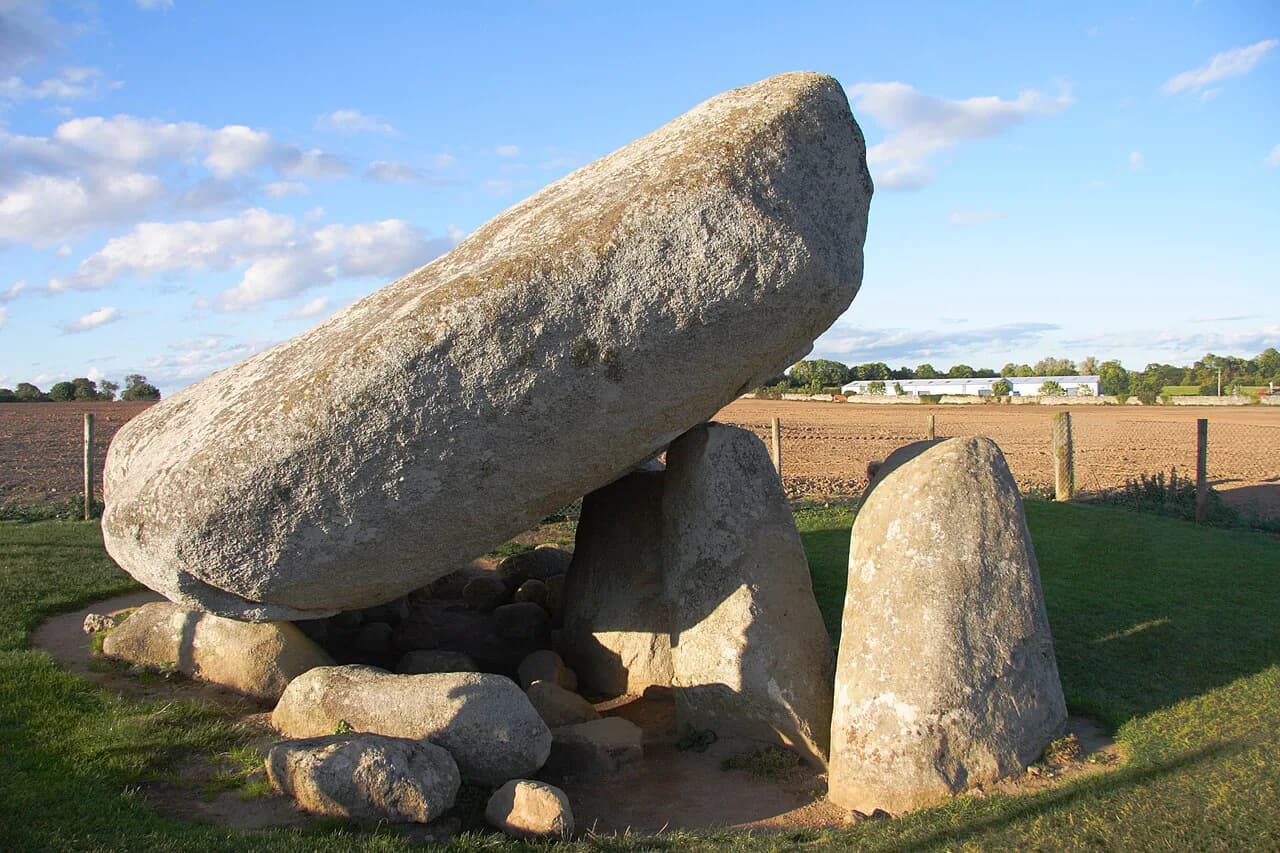
Brownshill Dolmen is a state-owned National Monument in the care of the Office of Public Works, classified by archaeologists as a portal tomb and standing about three kilometres east of Carlow town. Its enormous granite capstone rests on two portal stones, a door stone and a flat slab, making it one of the most imposing prehistoric structures in the country. This guide explains what the monument is, how old it is thought to be, why so little is known about it, and how to approach an unguided site responsibly, with pointers to wider ancient sites ireland travellers can pair with it.
What Brownshill Dolmen Is and Where to Find It
The monument sits in farmland east of Carlow town, close to the Hacketstown Road, and is signposted as a visitor stop. Discover Ireland places it in quiet meadows on the Hacketstown Road, while Heritage Ireland gives the simpler orientation of three kilometres east of the town. Treat those descriptions as the approach rather than an address you can punch into a city street grid, and check a map before setting out.
The site is also known as the Kernanstown Dolmen, and a 2013 visitor account records the Irish form Dolmain Chnoc an Bhrúnaigh along with the story that the Brownshill name came from a former landowner. That naming detail comes from a dated photo blog rather than an official gazetteer, so treat it as background colour rather than a documented land-transfer history. The official name to use when searching records or signage is Brownshill Portal Dolmen.
The Monument in Detail: Capstone, Portal Stones and Door Stone
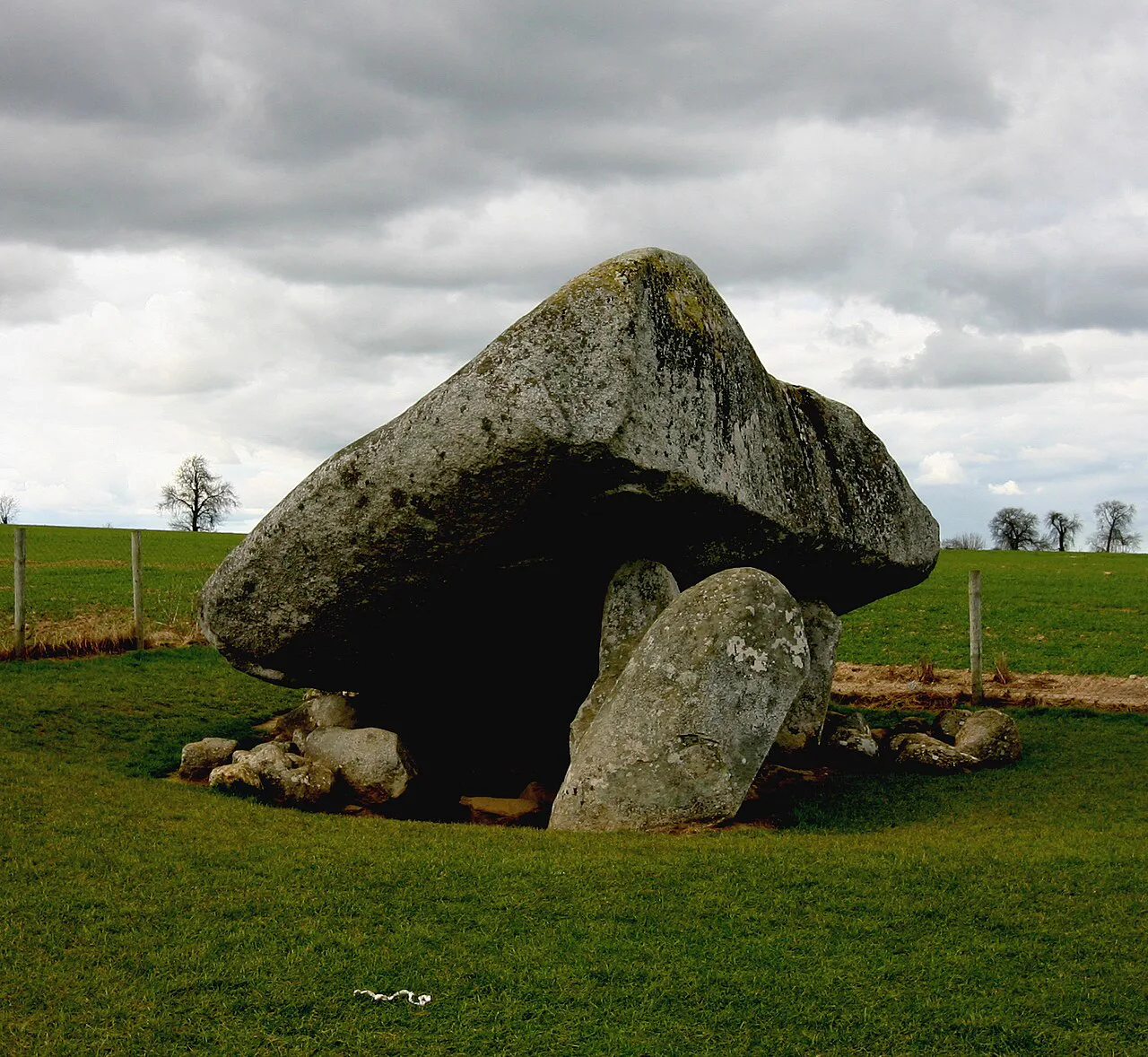
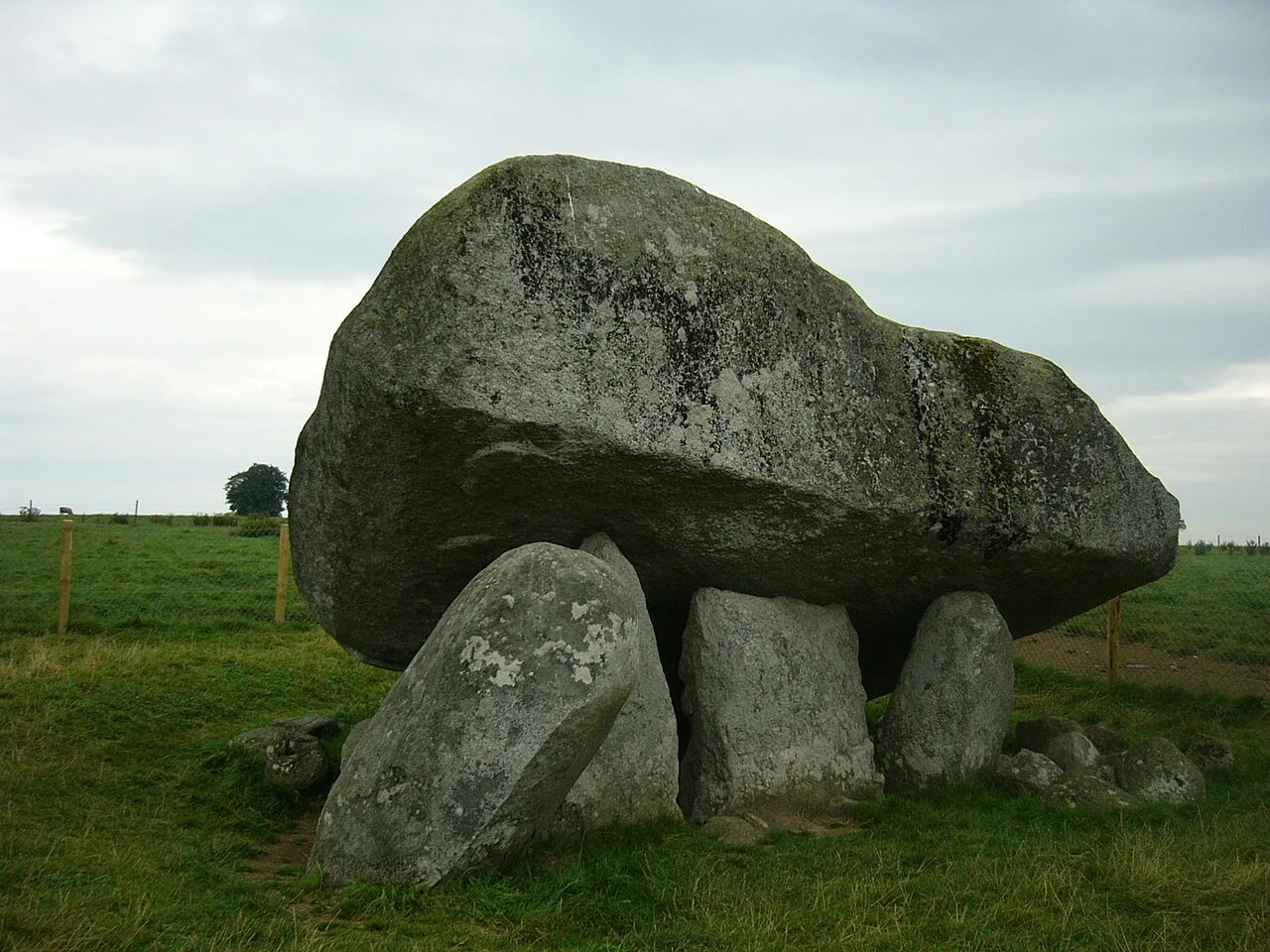
Heritage Ireland gives the capstone as roughly 4.7 metres by 6.1 metres by 2 metres, resting on two portal stones, a door stone and a flat slab. Those are the dimensions to keep in mind when you picture the structure: this is a single slab of granite of house-sized footprint, not a chamber built from many small stones. Seeing the proportions in person is the main reason the site rewards a stop.
A 2013 visitor description adds useful structural detail that the official summary does not spell out: two portal stones of about two metres in height, a door stone facing east between them, and a third prostrate stone propping the capstone at the far end. The same account notes a standing stone to the north of the monument, possibly a remnant of a facade or forecourt. Read those details as one observer's description of the stones on the ground, useful for knowing what you are looking at, not as an excavation report.
Look for how the capstone slopes downward to the west, where it rests on a low boulder according to Discover Ireland. That tilt is part of why the monument reads as a portal tomb rather than a box: the weight is carried at one end by the tall portal stones and eased down at the other. Photographs rarely convey the slope well, so walk around the monument at ground level to see it.
How Heavy? What the Figures Actually Say
The Office of Public Works describes the granite capstone as believed to weigh over 100 tonnes and reputedly the largest of its kind in Europe. Discover Ireland puts the figure at about 103 tonnes, a close independent figure rather than a conflicting one. Both are estimates, so quote the monument as over 100 tonnes and resist turning either number into a precise measurement.
You will find larger claims online, including a 2013 blog estimate of roughly 150 tons, which sits well above the official figures. Weighing a single slab is difficult, and no source in this guide reports a modern engineering survey, so the sensible approach is to describe the capstone as estimated at over 100 tonnes and note that the largest-in-Europe claim is reputed rather than formally confirmed. If exact tonnage matters to you, ask the OPW or check the Historic Environment Viewer record linked from the official page.
How Old Is It, and What Was It For?
Heritage Ireland estimates the monument at between 4,900 and 5,500 years old, placing it in the Early Neolithic. Discover Ireland gives the same range, so the age is consistent across the two official sources. Do not expect a precise construction year: this is a broad estimate derived from the monument type, not from dated material at the site itself.
Its exact purpose remains a mystery, but archaeologists widely think such tombs served as ceremonial sites for religious rites, possibly including cremation or burial. Discover Ireland also notes a theory that the monument may have functioned as a form of border marker. Present both as interpretations: the ceremony and burial reading is the mainstream one, while the boundary idea is a secondary suggestion.
Local folklore attached other meanings to tombs of this type, including the label Druid's altar and a legend linking them to Dermot and Gráinne. A 2013 blog repeats those traditions and also mentions speculation about sacrifice, none of which is archaeological evidence. If you enjoy that layer of storytelling, keep it clearly separate from what the OPW publishes about the monument.
Why So Much Remains Unknown
The dolmen itself has never been excavated, which is the single most important fact about the site. Heritage Ireland is explicit on this point, and because the monument has not been excavated there is no direct dating material and no artefact assemblage published from Brownshill. What you see is essentially the surviving stone skeleton of a monument whose earthen covering and chamber contents are unknown. If you want to compare it with a court tomb that has been investigated, the Creevykeel Court Tomb guide is a useful companion.
Comparisons come from other portal tombs that have been dug. Heritage Ireland points to Poulnabrone as an example, where excavation produced pottery, flint tools, bone pins, beads and human remains, evidence of complex burial practices. Those finds are from a different monument and cannot simply be transferred to Brownshill, but they explain why archaeologists read portal tombs as ceremonial and funerary places. The unexcavated state of Brownshill is itself the story, not a gap to be filled with invention; for a sense of how such monuments sit in the wider landscape, see the ancient sites ireland overview.
The Engineering Debate: How Was the Capstone Raised?
Moving and lifting a granite slab of this size without machinery is the question every visitor asks, and there is no settled answer. A 2013 visitor account sets out three theories: digging away surrounding ground after placing uprights, building an earth, stone and timber ramp to lever the capstone up, and progressively raising one edge by packing material underneath. That list comes from a hobbyist blog, so treat it as a summary of plausible ideas rather than an engineering consensus.
What the official sources do support is the scale of the achievement. Heritage Ireland notes that the sheer size of the dolmen raises questions about the ingenuity and capabilities of its builders, as well as the social and spiritual structures of their society. That framing is more honest than any single theory: the monument demonstrates capability, while the method remains debated. If this kind of question interests you, it is worth extending a prehistoric-themed trip to other megalithic landscapes such as the Céide Fields.
The Setting: A Monument in Farmland
The dolmen stands in working farmland, which shapes both how it looks and how you should behave. Visitor accounts from a 2013 photo blog and a later travel journal describe a small dedicated car park, information boards and a fenced paved path leading across the fields to the monument. These are observations from individual visits, not amenities confirmed on the OPW page, so plan as if you may need to park considerately and walk the last stretch.
Seeing the monument from the road as a shape on the horizon is quite different from standing beneath the capstone, and the walk in is part of the experience. One 2013 visitor remarked on how well cared for the site felt and how the path and fencing protect both the monument and the surrounding fields. The survival of a monument like this is tied to the field around it, so keep to the path and leave gates as you find them.
Visiting on a Self-Directed Basis
Brownshill is an unguided site, and Heritage Ireland carries a notice that visitors should maintain care and caution and that the OPW accepts no responsibility for damages, injuries or losses. Read that as practical advice rather than bureaucracy: the ground is uneven farmland, the stones are ancient, and there is no staff on hand. Wear shoes you can walk in and keep an eye on children and dogs.
Because this is an outdoor monument in a field, weather and daylight matter more than any timetable. No opening hours, admission charges or ticketing are published in the official listing for the site, so check the operator's own page before travelling rather than assuming a set schedule. The 2024 travel journal describes the site as unattended and reached by a short path from a small car park, which gives a realistic sense of the stop as brief and self-directed.
Do not assume you may clamber into the chamber or up the stones. The OPW guidance is about care and caution, and the structure is a protected monument rather than a climbing frame; the same travel journal describes a parent deciding against letting children go in under the capstone even without a prohibition sign. Observe from the path, take photographs from ground level, and let the stones stay undisturbed.
Protection and Stewardship
Brownshill is protected under the National Monuments Acts 1930 to 2014, which is the legal frame behind the OPW's role in caring for the site as a state-owned National Monument. That status is why the monument and its setting merit care: protection and access are being balanced on a working farm. Removing stones, lighting fires or disturbing the ground would be both damaging and unlawful.
Stewardship here is mostly a matter of small decisions: park where you do not block farm access, stay on the marked route, and leave the site as you found it. Because the setting is farmland rather than a managed park, the conduct of visitors directly affects whether access continues to be tolerated. That is a practical reason to be careful, quite apart from the legal one.
Nearby OPW Sites and Itinerary Trade-Offs
Brownshill is a short monument visit rather than a half-day destination, so the real planning question is what else to pair with it. Heritage Ireland lists nearby sites including Altamont Gardens, Dwyer McAllister Cottage, St Mary's Church Gowran, Dunmore Cave, Heywood Gardens and Kilkenny Castle. Those are named as onward options only; check each separately for what it contains and when it is open. Once you have driven this far east, Kilkenny Castle: Visiting the Butler Seat in Kilkenny City is the natural city stop to add for a change of era.
If your interest is prehistoric Ireland rather than castles and gardens, consider a wider megalithic route. Heritage Ireland points to Poulnabrone as the excavated portal tomb that helps explain Brownshill; the Hill of Tara offers a different layer of Irish ceremonial landscape, and Drombeg Stone Circle shows how stone monuments sit in other regional settings. Spreading visits across several counties means more driving, so weigh that against the depth you gain.
Plan Your Visit
Treat Brownshill Dolmen as a focused stop of perhaps an hour rather than a full day out. The reward is the sheer size of a granite capstone estimated at over 100 tonnes and the strange presence of an unexcavated monument in a working field; the trade-off is that there is little interpretation on site and no shelter if it rains. If you want a richer prehistoric context, plan a longer route that includes an excavated tomb such as Poulnabrone.
Before setting out, check the Heritage Ireland page for the latest notice and confirm the condition of the path and parking locally, since visitor descriptions are several years old. Bring footwear suited to a field, allow for Irish weather, and keep to the path once you reach the monument. Approached that way, a brief stop becomes one of the more memorable prehistoric encounters in the east of Ireland.
Explore more Ireland guides
Frequently Asked Questions
What is Brownshill Dolmen?
Brownshill Dolmen is a prehistoric portal tomb near Carlow town, classified by archaeologists as a portal tomb and cared for by the Office of Public Works as a state-owned National Monument. Its granite capstone rests on two portal stones, a door stone and a flat slab. It is also known as the Kernanstown Dolmen.
How do you get to Brownshill Dolmen?
It stands about three kilometres east of Carlow town near the Hacketstown Road, in farmland. Visitor accounts describe a small dedicated car park, information boards and a fenced path to the monument. These are observations rather than confirmed current facilities, so check the Heritage Ireland page and a current map before you travel.
How heavy is the Brownshill capstone?
The Office of Public Works describes the granite capstone as believed to weigh over 100 tonnes, while Discover Ireland gives about 103 tonnes. Both are estimates rather than survey measurements, and some independent accounts give higher figures. The claim that it is the largest capstone of its kind in Europe is a reputation rather than a verified record.
How old is Brownshill Dolmen?
Heritage Ireland estimates the monument at between 4,900 and 5,500 years old, an Early Neolithic date consistent with Discover Ireland's listing. There is no precise construction year, because the site has never been excavated and no material has been directly dated. Independent estimates in calendar years should be treated as rough approximations.
Has Brownshill Dolmen been excavated?
No. Heritage Ireland states that the dolmen has never been excavated, which is why so little is known about its original purpose and contents. Interpretations draw on other portal tombs such as Poulnabrone, where excavation revealed pottery, flint tools, personal ornaments and human remains.
Is there a charge or guided tour at Brownshill Dolmen?
No admission price or guided tour appears in the official listing, and the site is described by the OPW as unguided. Visitors are asked to maintain care and caution. For current arrangements and any notices, check the Heritage Ireland page directly before travelling, since a visitor guide cannot confirm day-to-day conditions.
What else can you visit near Brownshill Dolmen?
Heritage Ireland lists nearby sites including Altamont Gardens, Dwyer McAllister Cottage, St Mary's Church Gowran, Dunmore Cave, Heywood Gardens and Kilkenny Castle. Each has its own opening arrangements, so check separately. If you want more prehistory, Poulnabrone and other megalithic sites reward a longer itinerary.
Sources
You might also like



Continue reading
More guides you'll find useful





