
Creevykeel Court Tomb: A Neolithic Monument in Sligo
Creevykeel Court Tomb is a Neolithic court cairn near Cliffony, County Sligo, in OPW care. Read its plan, its 1935 rebuilding and what to expect at an unguided site.
On this page
Creevykeel Court Tomb is a Neolithic court tomb, also called a court cairn, standing about 2km north-east of Cliffony in County Sligo. It is a state-owned National Monument in the care of the Office of Public Works, and the OPW describes it as the largest and finest example of a court tomb in Ireland. It is an unguided site rather than a staffed attraction, so the visit is a matter of reading stonework on your own terms.
The monument rewards a little preparation. Its present appearance owes much to a 1935 excavation that dismantled and then rebuilt the cairn, so the stones you see are rearranged rather than untouched. Knowing that changes how you look at the court, the entrance passage and the divided chamber, and it makes the excavation finds easier to place.
What Creevykeel Court Tomb Actually Is
The OPW places the monument in the Neolithic period, dating it between 4000 and 2500 BC, and notes a separate Early Christian use to the north-west of the tomb. It is one of several megalithic monuments in this part of Sligo, but it should be understood as a court tomb with a single oval court, not a passage tomb with multiple courtyards. That distinction shapes everything you see on the ground.
For visitors working through the wider story of Irish megaliths, Creevykeel is a useful early stop in a broader survey of Ancient Sites in Ireland, because its plan is legible even without an interpreter present. The trade-off is that there is no exhibition to explain it: the interpretation has to come from what you already know or read beforehand.
Setting and Name: Tievebaun Mountain and Caiseal a Bhaoisgin
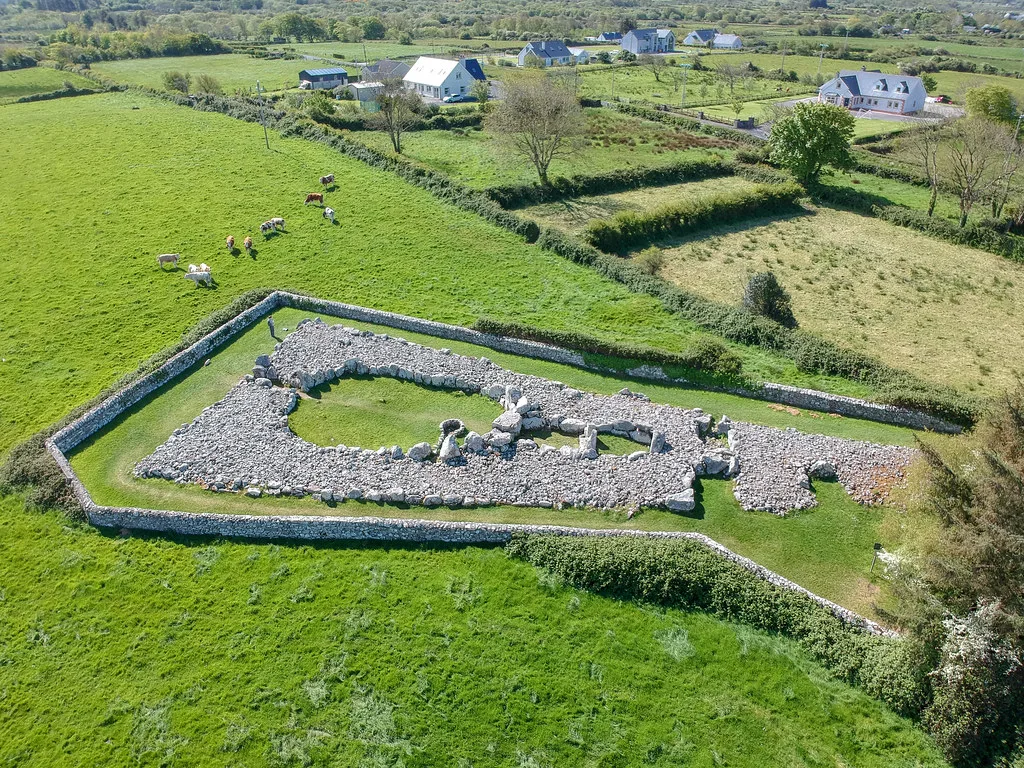
Local history writing describes the tomb as sitting on the foothills of Tievebaun Mountain, close to the sea. The same page gives the older name of the place as Caiseal a Bhaoisgin, the fort of Bhaoisgin, linking the name to a well near the cairn, and reports that Bhaoisgin has since become Wisken. That name history is a local tradition rather than a settled etymology, so treat it as reported rather than definitive.
That coastal-facing position under a mountain is part of the experience of the visit: this is not a monument in a flat field but one placed where upland and shoreline meet. Read the name alongside the setting and the tomb becomes a named place in a working landscape rather than an isolated curiosity.
Reading the Plan: Cairn, Passage, Court and Chamber
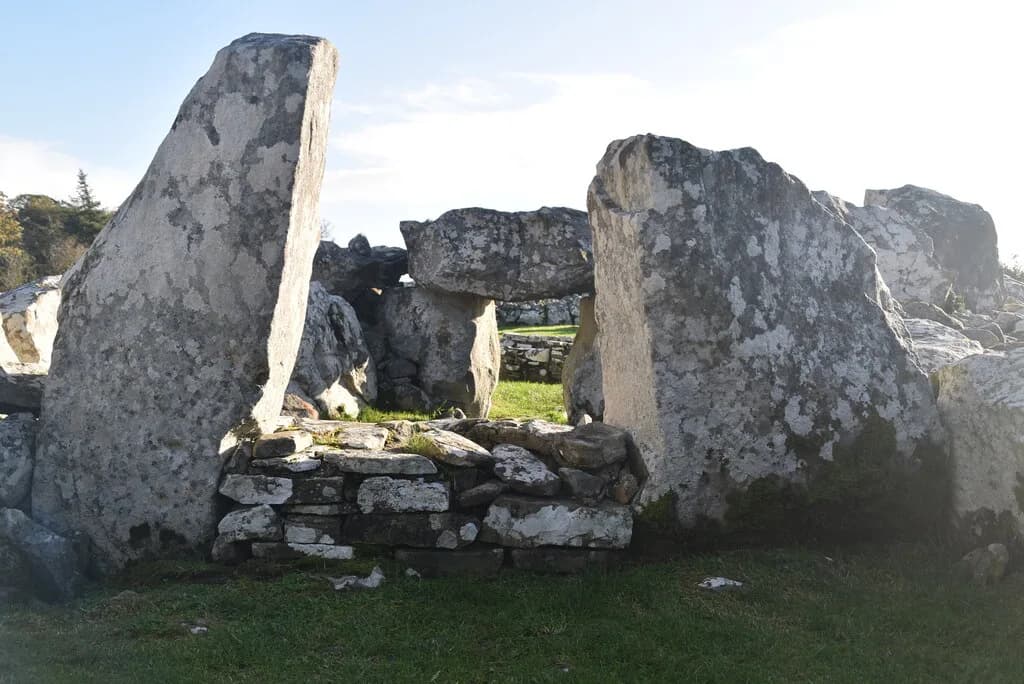
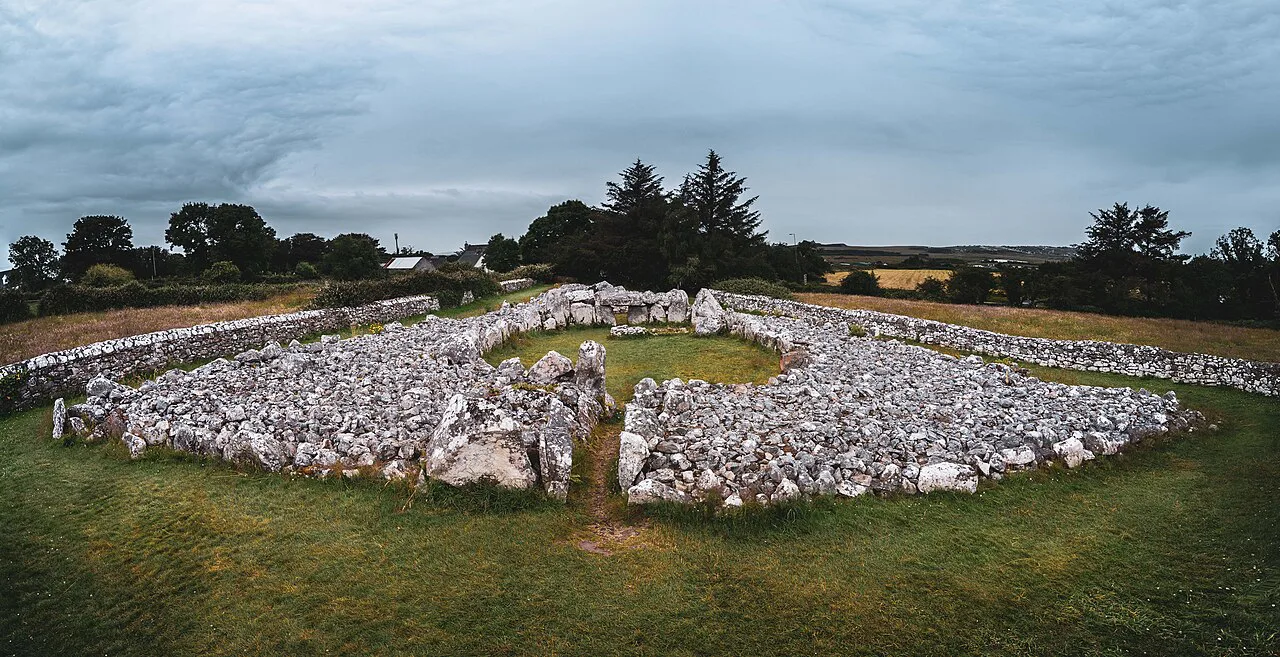
The cairn is trapezoidal, and an entrance passage leads into an internal oval court measuring roughly 15m by 9m. The main chamber, originally corbelled and roofed with a roof stone, is divided into two, and the largest of the court stones flank its entrance. Walk the sequence in that order — cairn edge, passage, court, chamber — and the architecture reads as a deliberate progression rather than a pile of boulders.
The OPW describes the main chamber as originally corbelled and roofed with a roof stone, but does not say whether the original roof survives today. What the evidence supports is the structural footprint: the court as an enclosure and the chamber as a defined compartment. Read the plan from the outside rather than assuming you can step into a covered interior.
If you are comparing plans across the island, this arrangement sits within a wider family of cairns in ireland, where the relationship between enclosing mound and inner chamber is the main thing to observe. Creevykeel's two-part chamber and single court make a clear reference point for those comparisons.
The Stones Themselves: Sandstone, Quartz and Revetment
The excavation established that the stones are local grey sandstone, and the cairn is enclosed by a stone revetment, a protective edging. Local history writing adds that the court's standing stones are massive blocks of that sandstone studded with quartz, growing larger as they approach the opening at the rear of the court. Look for the quartz inclusions before you look at the overall shape; they give the monument its texture.
The revetment is the detail most often walked past. It marks where the edge of the cairn was held in place, and noticing it helps you judge the cairn's footprint, which is considerably larger than the visible stone cluster suggests.
The 1935 Excavation and What Rebuilding Means
Creevykeel was excavated in 1935 under Hugh O'Neill Hencken, and the OPW states that the excavation removed the cairn completely before the stones were replaced. The dig also revealed cobble-stone flooring, and the current form is a reconstruction rather than an intact prehistoric surface. This is the single most important thing to hold in mind when judging the neatness of the monument.
The local history page shortens the excavator's name to Hugh O'Neill as leader of the 1935 dig and confirms that the tomb was rebuilt afterwards. The two accounts agree on the essentials, and the OPW's fuller form — Hugh O'Neill Hencken — is the one to use when precision matters. Either way, the takeaway for a visitor is the same: you are reading a reconstruction of an excavated monument.
What the Excavation Found
The finds list is unusually varied for a site of this size. It includes a polished diorite axe, pots, quartz crystals, a flint knife and a lozenge-shaped arrowhead, alongside animal bones of sheep, pig and ox, plus fish and periwinkles. The range of material suggests activity in the surrounding countryside as well as at the tomb itself.
Local history writing adds that the axe was found between the dividing stones of the large chamber, that the flint knife measured about 13cm, and that the remains of at least eight pots were recovered. It also records a worked flint, arrowheads, pot shards, quartz crystals and flint scraps among the material. These details are worth carrying with you because the sources do not indicate that any of the objects are displayed on site.
If the artefact sequence interests you more than the architecture, plan your reading around neolithic ireland before you arrive, since the monument itself carries no labels. The trade-off is time spent preparing versus time spent looking, and at an unguided site the preparation usually pays off.
A Second Life: Early Christian Metalworking in the Court
The round feature inside the court has been identified in local history writing as an Early Christian smelting pit where metal was worked, an addition made roughly 4,000 years after the monument was first built. Two hearths were found outside the circular structure. The same account suggests metalworkers in the Iron Age and Early Christian period favoured ancient and unusual places such as megaliths and crannógs, which is an interpretation rather than a certainty.
Keep this phase separate from the Neolithic story when you walk the court. The pit and hearths belong to a later reuse, and the OPW likewise records Early Christian activity to the north-west of the tomb. Seeing the monument as occupied twice over is more accurate than treating it as a single frozen moment.
Visiting Responsibly: What to Expect on the Ground
The OPW states plainly that this is an unguided site and asks visitors to maintain care and caution throughout; it does not accept responsibility for damage, injury or loss. There is no staff presence implied and no guided tour to join, so assess the ground and the stones for yourself and keep to the edges of the monument. The site is protected under the National Monuments Acts 1930 to 2014, which is the reason to leave everything as you find it.
Travel accounts report that the tomb stands right on the main road roughly north of Sligo Town, with a small carpark for stopping, and describe a clootie or wish tree at the entrance. Treat these as reported observations rather than official facilities: car parking size, roadside conditions and any tree decorations are not published by the OPW and can change. If you need certainty about stopping safely, check the approach before setting out.
The same travel account also calls the monument a passage tomb with several courtyards, which contradicts the OPW's identification of a court tomb with one oval court; follow the official description. If you plan to tie a ribbon at the entrance tree, note that the account itself asks visitors not to leave plastic and wrappers behind.
Pairing Creevykeel With Other Monuments on Your Own Plan
The OPW's own page for Creevykeel also links to other sites in the region, including Sligo Abbey, Parke's Castle and Carrowmore Megalithic Cemetery. These are navigation links rather than a designed trail, so build your own order and check each site's arrangements separately before you travel. Cairn-to-cairn comparisons are the most rewarding way to use Creevykeel as a reference point, and castles in county galway offer a later, stone-built contrast if you are tracing how monumental building changed across the west, much as the castles in county offaly do for the midlands.
For a sense of how later monuments and landscapes layer over earlier ones, the hill of tara ireland offers a contrast in scale and in the density of earthworks. Pairing the two gives you a Neolithic court tomb and a major later ceremonial complex in one reading of the past.
Two check-current-details reminders are enough here: confirm the site's status and any local access notes through the OPW before you go, and confirm conditions on the approach road yourself rather than relying on older trip reports.
Plan Your Visit
Creevykeel Court Tomb is best approached as a monument to read rather than a site to be shown around. Go with the sequence in mind — trapezoidal cairn, entrance passage, oval court, divided chamber — and with the knowledge that the 1935 excavation removed and replaced the stones. That framing turns a roadside stop into a proper piece of interpretation.
Check the official OPW listing before travelling for any change in status, and be realistic about what an unguided site offers: no visitor centre or on-site interpretation to explain what you are looking at, so bring your own notes. In exchange you get one of Ireland's most legible court tombs, with quartz-studded sandstone and a long history of reuse in the same small field. For another heritage guide, read about Knocknarea Cairn.
Explore more Ireland guides
Frequently Asked Questions
Is Creevykeel Court Tomb a passage tomb or a court tomb?
It is a court tomb, also called a court cairn. The Office of Public Works identifies it as a court tomb with a single internal oval court, and describes it as the largest and finest example of a court tomb in Ireland. Some travel accounts have called it a passage tomb with several courtyards, but that does not match the official description.
How old is Creevykeel Court Tomb?
The OPW dates the monument to the Neolithic period, between 4000 and 2500 BC. The same page notes a separate Early Christian use to the north-west of the tomb, so the site has more than one phase of activity. It does not assign a narrower construction date.
What was found during the 1935 excavation at Creevykeel?
The dig, led by Hugh O'Neill Hencken, recovered a polished diorite axe, pots, quartz crystals, a flint knife and a lozenge-shaped arrowhead, along with animal bones, fish and periwinkles. The excavation also revealed cobble-stone flooring. The sources do not indicate that these objects are displayed at the monument.
Why does the cairn look rebuilt?
Because it was. The 1935 excavation removed the cairn completely and the stones were replaced afterwards, so the present form is a reconstruction rather than an untouched prehistoric surface. Local history writing also notes that the tomb was rebuilt after excavation.
Are there guided tours or facilities at Creevykeel?
The OPW describes the site as unguided and asks visitors to take care, and it is not presented as a staffed attraction; no visitor centre or toilets are indicated. Travel accounts mention a small carpark on the main road, but that is reported rather than official, so check the approach yourself.
How should I behave at the monument?
Treat it as a protected National Monument under the National Monuments Acts 1930 to 2014. Stay off fragile stonework, take nothing away and leave nothing behind, including ribbons or wrappers at the entrance tree. The OPW's care and caution notice applies throughout the visit.
Sources
You might also like



Continue reading
More guides you'll find useful




