
Ancient Ireland Map: Prehistoric Sites by Region and Era
An ancient Ireland map of named prehistoric places, grouped by region and era, with sourced access notes for the Boyne tombs, Céide Fields, Carrowmore and more.
On this page
An ancient Ireland map is best understood as a frame, not a route: a small set of named, documented prehistoric places grouped by region and by period. The National Museum of Ireland sets the broad timeline from the stone tools of the first hunter-gatherers around 7000 BC to the bronze weapons of the Late Bronze Age around 500 BC, which helps you place each site on that frame.
The groupings that follow are deliberately mixed: Neolithic monuments built into the landscape, and Bronze Age objects that survive mostly in museum collections. Keeping period and place distinct is the single most useful habit when you plan a visit, because a passage tomb, a stone circle and a hoard of gold ornaments each ask a different kind of attention.
For a wider context of standing stones and built heritage beyond this selection, see our guide to Ancient Sites in Ireland, which covers more places and their visitor practicalities.
The Boyne Bend: Brú na Bóinne as a World Heritage Landscape (County Meath)
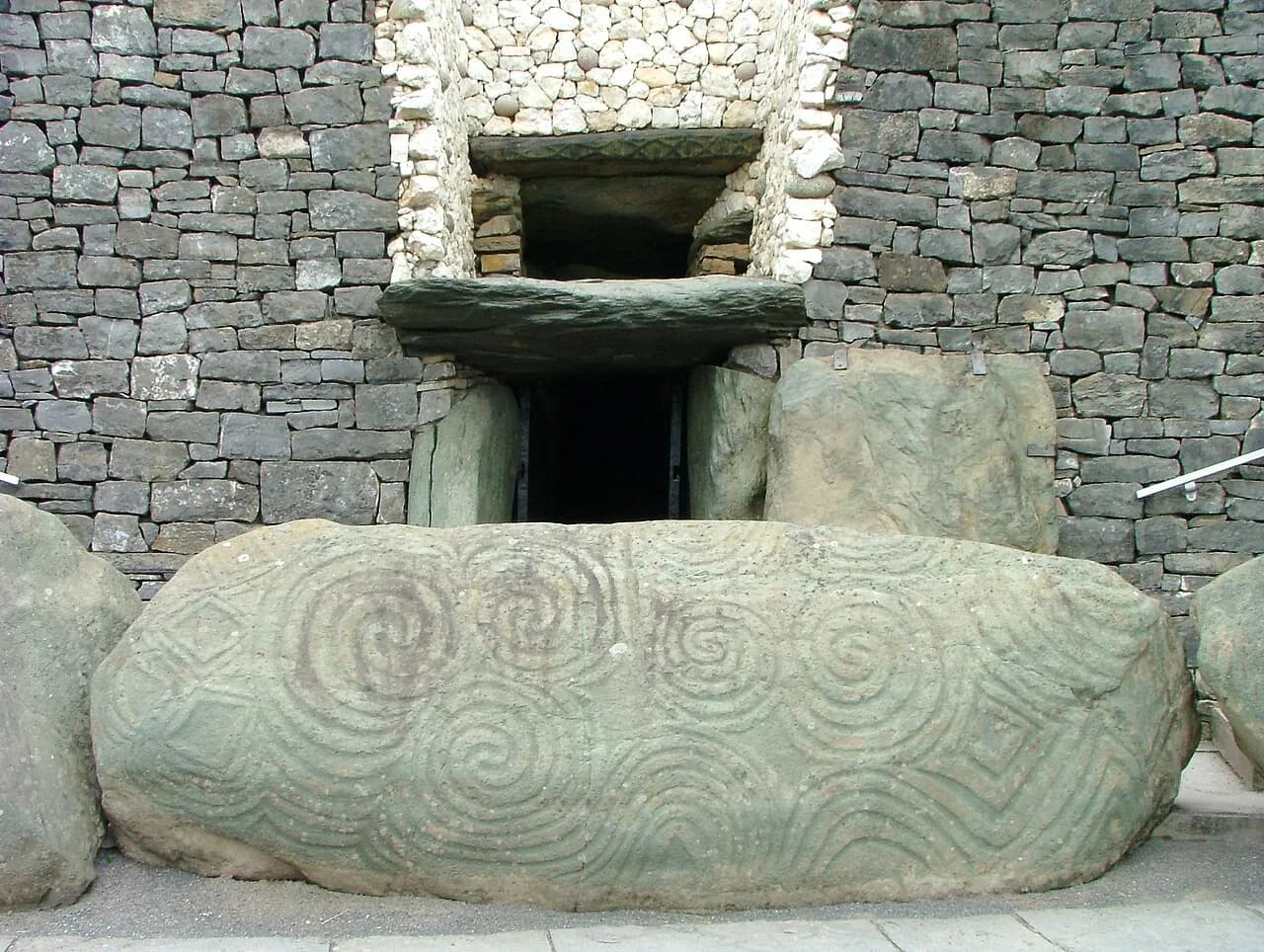
The Brú na Bóinne complex is a World Heritage property within a bend of the River Boyne, about 50 km north of Dublin in County Meath, and its three main passage tombs — Newgrange, Knowth and Dowth — are dated by the State heritage service to about 3200 BC. It holds a noted concentration of prehistoric megalithic art, and the monuments served social, religious, funerary and economic purposes. The site was inscribed by UNESCO in 1993.
The landscape is not a single monument but a spread of ceremonial structures, and the UNESCO listing stresses its conservation, including the repair and stabilisation of the passage tombs at Newgrange and Knowth. When you read the map, treat the three tombs as one cluster in a protected landscape rather than three separate stops that can be combined freely.
Visiting Brú na Bóinne Accurately: Booking, Shuttle and Tour-Only Access
The Brú na Bóinne Visitor Centre is the mandatory starting point for all visits to Newgrange and Knowth, and visitors are brought to the monuments by shuttle. Pre-booking is essential for every visitor, including children, and access to Newgrange and Knowth is by guided tour only. Arriving at the monuments directly will not gain you entry.
The operator warns that no third-party organisations are authorised to sell tickets for Brú na Bóinne, and that tickets bought from other sites or resale platforms will not be valid and holders will be refused entry. Book only through the official Heritage Ireland channel, and be wary of look-alike websites.
Accessibility and comfort need planning: universal access at the monuments is limited, the passage and chamber at Newgrange are low and narrow and may not suit visitors with claustrophobia or mobility issues, and the monuments are outdoor sites with no shelter. Photography is not permitted inside the Newgrange passage or chamber, and groups of 15 to 30 must pre-book a group slot by email.
Seasonal notices are listed rather than permanent: earlier opening on winter-solstice mornings from 19 to 23 December with regular tours suspended, closure from 24 to 27 December and on 1 January, and weather-dependent changes at short notice. Check the website before travelling, especially for winter dates, and note that pre-booking for the visitor centre alone is not required, though access to the monuments still requires a tour ticket.
North Mayo: Céide Fields, a Bog-Covered Stone-Walled Landscape
Beneath the blanket bog of north Mayo lies a system of stone-walled fields, dwelling areas and megalithic tombs that the Office of Public Works describes as the most extensive Stone Age monument in the world. The same page describes the fields as the oldest known globally, dating back almost 6,000 years; those are the operator's characterisations rather than independent verdicts. The stone walls extend over hundreds of hectares and the bog has its own vegetation and wildlife.
The visitor centre includes a viewing platform on the edge of a 110-metre-high cliff, and the operator advises protective clothing and sturdy footwear because the terrain and weather can be challenging. The site is presented as a Neolithic field system under open bog, not a covered ruin, so plan for wind and rain rather than indoor shelter.
Opening hours are seasonal: the page states daily 10:00 to 18:00 with last admission at 17:15, and a winter period from 5 November described as available for bookings. Treat those hours as subject to confirmation and check the operator's seasonal timetable before you set out, since the winter arrangement may differ from the main season.
County Sligo: Carrowmore, Listoghil and the Samhain Alignment
Carrowmore Megalithic Cemetery in County Sligo is described by the operator as the largest cemetery of megalithic tombs in Ireland, set along the Wild Atlantic Way. The central monument is Listoghil, a passage tomb where six upright stones support a massive roof-slab, and its capstone may show elusive prehistoric carvings in the right light.
At Samhain, the page records that the rising sun appears above a saddle feature in the Ballygawley Mountains, aligned with the direction of the Listoghil chamber, and that a shadow moves across the roof-slab as the sun climbs. The operator also advertises a sunrise gathering on 31 October; treat that as a listed event rather than a guaranteed annual fixture, and confirm details if you plan around it.
The Knocknarea and Cailleach Bhéara material on the same page is explicitly myth and legend, not history. It explains how the landscape was said to be shaped by a giant and how the tomb of Queen Maeve is said to sit atop Knocknarea. Read that material as cultural tradition, and keep it separate from the archaeological record of the tombs themselves.
Leinster Unguided Monument: Brownshill Portal Dolmen (County Carlow)
Brownshill Portal Dolmen stands about 3 km east of Carlow town and is a state-owned National Monument in the care of the Office of Public Works. Its granite capstone measures approximately 4.7 by 6.1 by 2 metres and is believed to weigh over 100 tonnes, resting on two portal stones, a door stone and a flat slab; it is reputed to be the largest of its kind in Europe.
The dolmen is estimated to be between about 4,900 and 5,500 years old and is classed as an Early Neolithic built structure. Its exact purpose remains a mystery, though it is widely thought to have served as a ceremonial site for religious rites, possibly including human cremation or burial — an interpretation, not an established fact.
The site has never been excavated, and the operator directs readers to comparable excavated tombs such as Poulnabrone for context on finds of pottery, flint tools and human remains. The monument is unguided and protected under the National Monuments Acts 1930 to 2014; the Office of Public Works warns that a level of care and caution is needed at the site, so treat it as an open monument rather than a staffed attraction.
Munster Unguided Monument: Drombeg Stone Circle (County Cork)
Drombeg Stone Circle, under state guardianship, stands less than 3 km east of Glandore and is described as one of the finest examples of a stone circle in Ireland. It has a north-east to south-west alignment that marks the setting sun at the winter and summer solstices, and the axial stone carries two shallow cup-marks, one with an oval motif.
The circle originally had seventeen upright stones, and its use has been dated from 1124 to 794 BC. Excavation in 1957 found five pits beneath the floor and a deposit of cremated human remains among fragments of shale and a fabric pot. Nearby are a multi-period hut site and a horseshoe-shaped fulacht fiadh; remains from the fulacht fiadh date to 109 to 349 AD, with a second analysis of the cooking pit giving 368 to 608 AD.
The stone-circle dates and the later fulacht fiadh dates should not be merged: they describe different phases of activity at the site. Like Brownshill, Drombeg is unguided and has a care-and-caution notice, with no guided tours or indoor facilities claimed. Read more about County Cork and this monument in our drombeg stone circle guide.
What Museum Collections Add: Objects from the Era of These Monuments
The Prehistoric Ireland exhibition at the National Museum of Ireland on Kildare Street, Dublin 2, displays a reconstructed passage tomb as a backdrop to Neolithic tools, pottery and personal objects, including a decorated flint mace head from Knowth. It also shows copper axes, daggers, shields, cauldrons and cast bronze horns, along with amber, glass and stone jewellery and a 4,500-year-old logboat from Lurgan, County Galway; check the museum's current opening and access before planning a visit.
The museum's Bronze Age collections page explains that from around 2500 BC knowledge of working gold and copper brought a new cultural period, and that hoards and burials preserved a rich record. The characteristic lunula neck ornament is represented by more than 50 examples in the museum's collection, and over 2,000 Early Bronze Age axeheads have been found, the vast majority held in the museum.
Named hoards give scale: the Dowris, County Offaly, hoard contained perhaps 218 bronze objects including swords, spearheads, cauldrons and horns, and the Mooghaun North, County Clare, gold hoard found in 1854 included most of an estimated 146 objects, largely bracelets. Peat bogs also preserved wooden wheels and a woollen garment, which help explain why so much prehistoric material survives in Ireland.
Practical Synthesis: Operator-Managed Sites Versus Unguided Monuments
The five places split into two clear groups. Brú na Bóinne and Céide Fields are operator-managed sites with visitor centres and, at Brú na Bóinne, pre-booking essential for monuments accessed by guided shuttle. Brownshill and Drombeg are unguided state monuments in the care of the Office of Public Works, with care-and-caution notices and no ticketing or guided tours to book.
All of these monuments are outdoor and unsheltered, so weather and footwear matter, and none should be treated as an indoor museum visit. Carrowmore is likewise an open cemetery with no indoor visitor building to depend on, and its 31 October gathering is a listed event rather than part of ordinary access. Where opening hours or seasonal notices are published, they can change, so confirm on the operator's page before travelling.
For another era-specific landscape that complements these prehistoric sites, our Hill of Tara, Ireland guide explains a later ceremonial complex and how to approach it on foot; it is a useful contrast rather than a substitute for the monuments above. If you are pairing prehistoric monuments with collections, the Cork heritage guide on museums in the city and county offers the same period-and-place approach in an indoor setting.
Use the Map as a Starting Frame
An ancient Ireland map works best when it is read as a set of regional groups within distinct eras, not as a single itinerary. The Boyne passage tombs and Céide Fields are Neolithic landscapes; Brownshill is an Early Neolithic dolmen; Carrowmore is a megalithic cemetery; Drombeg's circle dates from the late second and early first millennium BC with later activity around its fulacht fiadh.
Before travelling, verify seasonal access with each operator: at Brú na Bóinne, check that you are booking through the official Heritage Ireland channel because third-party tickets are refused; at Céide Fields, confirm current seasonal hours; at Carrowmore, check whether the Samhain gathering is running. At Brownshill and Drombeg, expect unguided monuments with care-and-caution notices rather than staffed facilities. For another heritage guide, read about Dun Aonghasa.
Explore more Ireland guides
Frequently Asked Questions
What does an ancient Ireland map actually show?
It shows a selection of named, documented prehistoric places grouped by region and era, not a single driving route. The examples here include Brú na Bóinne in County Meath, Céide Fields in County Mayo, Carrowmore in County Sligo, Brownshill in County Carlow and Drombeg in County Cork.
Which of these prehistoric sites need pre-booking?
Brú na Bóinne requires pre-booking for all visitors, including children, because Newgrange and Knowth are reached by guided shuttle tour from the visitor centre. Céide Fields has a visitor centre with published seasonal hours, so confirm its current arrangement. Brownshill and Drombeg are unguided state monuments without ticketing.
Can you enter Newgrange without a tour?
No. Access to Newgrange and Knowth is by guided tour only, and visitors are brought by shuttle from the Brú na Bóinne Visitor Centre. Going directly to the monuments will not gain entry, and tickets bought from unauthorised third-party sellers will be refused.
Where is the Knowth mace head described?
The decorated flint mace head from Knowth is described as part of the Prehistoric Ireland exhibition at the National Museum of Ireland, Kildare Street, Dublin 2. That is a museum exhibition context, not an object on view at the monument itself; check the museum's current access and opening details before planning a visit.
Is Brownshill dolmen a burial site?
Its purpose is not proven. It is widely thought to have been a ceremonial site for religious rites, possibly including cremation or burial, but the dolmen has never been excavated, so that remains an interpretation rather than an established fact.
What happens at Carrowmore at Samhain?
The operator describes the rising sun at Samhain appearing above a saddle in the Ballygawley Mountains, aligned with the Listoghil chamber, and advertises a sunrise gathering on 31 October. Treat that gathering as a listed event rather than a guaranteed annual fixture, and verify it before planning a trip.
Sources
- Prehistoric Ireland | Archaeology | National Museum of Ireland
- Bronze Age | National Museum of Ireland
- Brú na Bóinne Visitor Centre: Newgrange, Knowth and Dowth | Heritage Ireland
- Unesco Boyne
- Céide Fields Neolithic Site and Visitor Centre | Heritage Ireland
- Brownshill Portal Dolmen | Heritage Ireland
- Drombeg Stone Circle | Heritage Ireland
- Carrowmore Megalithic Cemetery | Heritage Ireland
You might also like



Continue reading
More guides you'll find useful





