
Irish Stained Glass: Where to See Harry Clarke's Work
Irish stained glass is best understood through Harry Clarke. See where original panels are on public view in Dublin and how the revival shaped them.
On this page
Irish stained glass is easiest to approach through Harry Clarke, whose panels are held in two separate Dublin collections rather than one combined display. The National Museum of Ireland at Collins Barracks runs a free, unbooked temporary exhibition of Clarke glass in collaboration with Crawford Art Gallery, while the National Gallery of Ireland holds works by Clarke in its permanent collection. Treat them as two distinct visits with different holdings and different access rules.
Clarke's work is not confined to Dublin: the museum notes that his glass survives in 16 counties, mostly in churches. That distribution matters for planning, because most of it sits in buildings with their own access arrangements. The Dublin collections are the reliable starting point for seeing original panels and understanding how they were made.
Harry Clarke in Brief
Clarke was born in Dublin in 1889 and worked from an early age in his father's design studio, later studying at night at the Dublin Metropolitan School of Art. A 1914 scholarship allowed him to study medieval glass in England and Paris, and he visited Chartres Cathedral. He died in 1931, at 42, of tuberculosis.
His principal career was stained glass for churches and religious houses, beginning with the Honan Chapel windows in Cork, with further commissions in Britain, the United States and Australia. The National Gallery of Ireland records forty church commissions from the Honan onward and fifteen overseas. He also made a small number of secular works in glass, which are the ones most often encountered in gallery settings.
For a wider view of how Clarke sits among Irish painters of the period, the country's art-museum landscape is mapped in the guide to Irish artists. That context helps explain why a glass artist is treated as a central figure rather than a craft specialist.
Reading the Medium Up Close
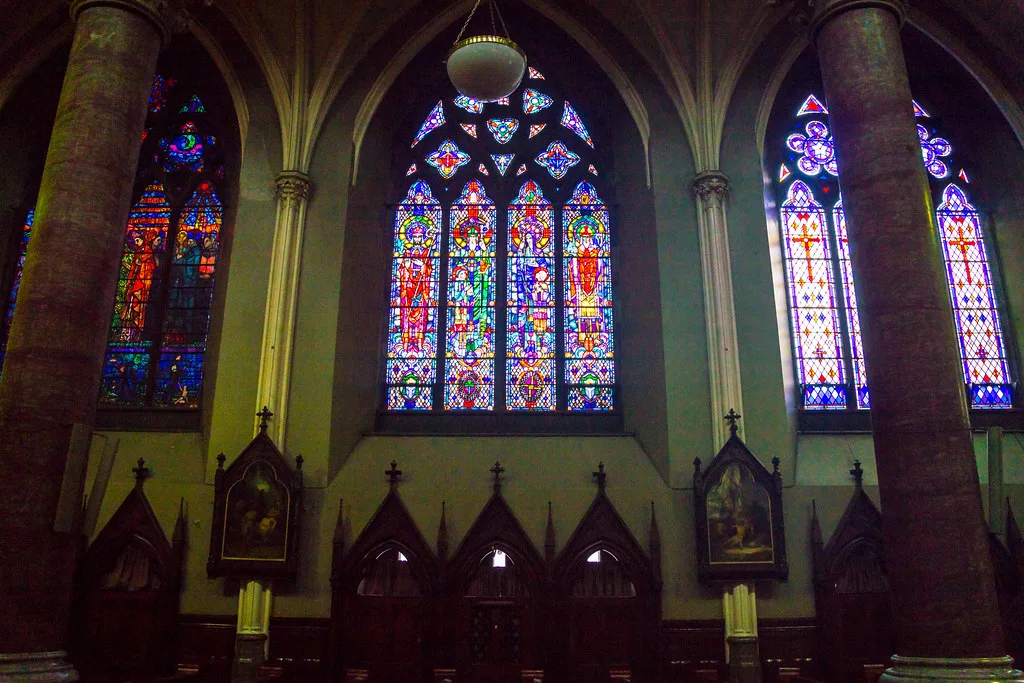
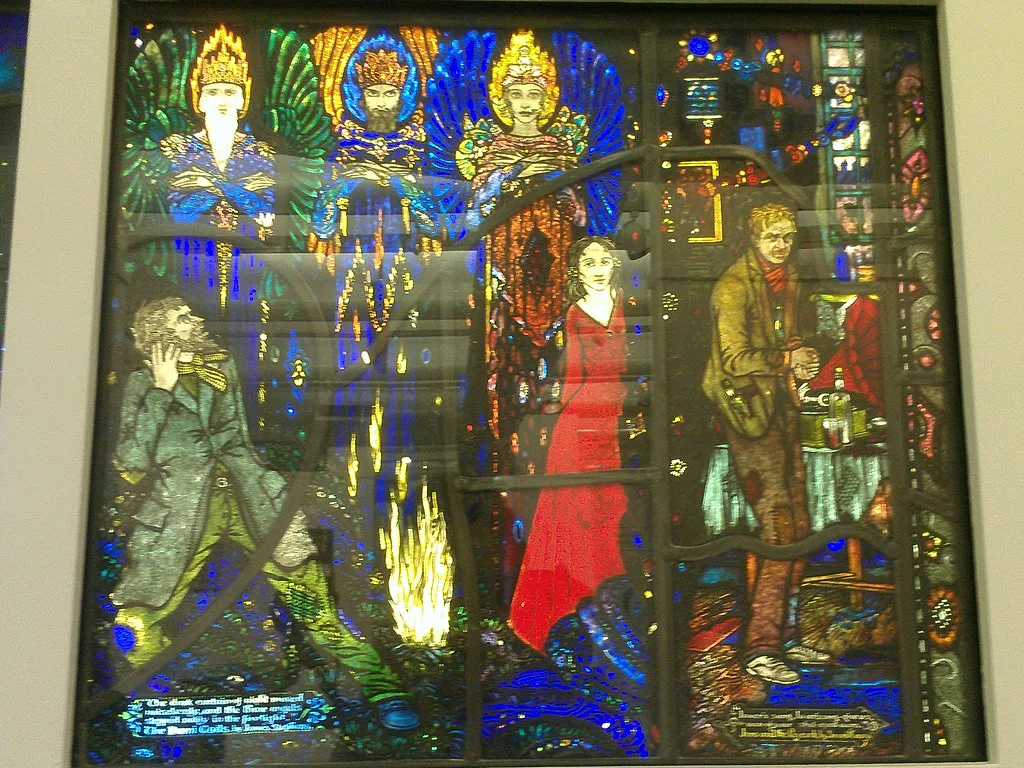
Clarke's colour is the first thing to notice. His teacher's notes describe bright greens and rich reds combined with blues, purples and pinks to produce sparkling contrasts, and note that he would fire a single piece of glass repeatedly until the colour and quality were right. When you stand in front of a panel, look for these layered shifts rather than a flat field of colour.
Drawing is the second element. The same notes describe beautifully modelled, elongated figures in elaborately decorated settings, unusually detailed for a precise technical craft. In a gallery, that means paying attention to faces, hands and costume detail as much as to the overall composition, since the panels were designed to be read at close range.
Scale is the trade-off. Church windows are experienced from below and at distance, while gallery panels are shown near eye level, which reveals technique but removes the architectural setting. Both ways of seeing are valid, and the Dublin displays give you the close view that church visits rarely allow.
An Túr Gloine and the Revival Workshop
The revival in Irish stained glass was organised as much as inspired. Sarah Purser founded the stained-glass co-operative An Túr Gloine, the Tower of Glass, in 1903, aiming to raise standards in a field then dominated by imported glass of lesser quality. Edward Martyn organised its first major project, the decoration of Loughrea Cathedral.
A.E. Child managed the studio and taught the stained-glass course at the Dublin Metropolitan School of Art, which Clarke attended from 1904 to 1913. Child's studio employed Evie Hone, Wilhelmina Geddes and Michael Healy, so the workshop was a network of makers rather than a single artist's enterprise. Keeping Purser and Martyn's founding roles separate from Child's management clarifies who did what.
Clarke's mature work grew out of this environment, and the UCD essay on the Geneva Window treats his glass as part of the broader Irish Revival alongside literature and painting. If your interest extends to painters of the same generation, the page on Jack B. Yeats in Ireland offers a parallel career to compare.
The Honan Chapel as Breakthrough
The Honan Chapel in Cork is the commission that established Clarke's reputation. He designed and made eleven of the chapel's nineteen windows between 1915 and 1917, while still in his mid twenties. The Hiberno-Romanesque building, designed by James F. McMullin, was completed in 1916 on the grounds of what is now University College Cork.
The chapel stands on the campus of what is now University College Cork, within a working university. Because it is a place of worship rather than a gallery, current access arrangements are not guaranteed and should be checked with the university before you plan a visit; the Dublin collections remain the reliable way to study Clarke's glass at close range, with the Honan windows best understood as the commission that made his name.
National Museum of Ireland at Collins Barracks
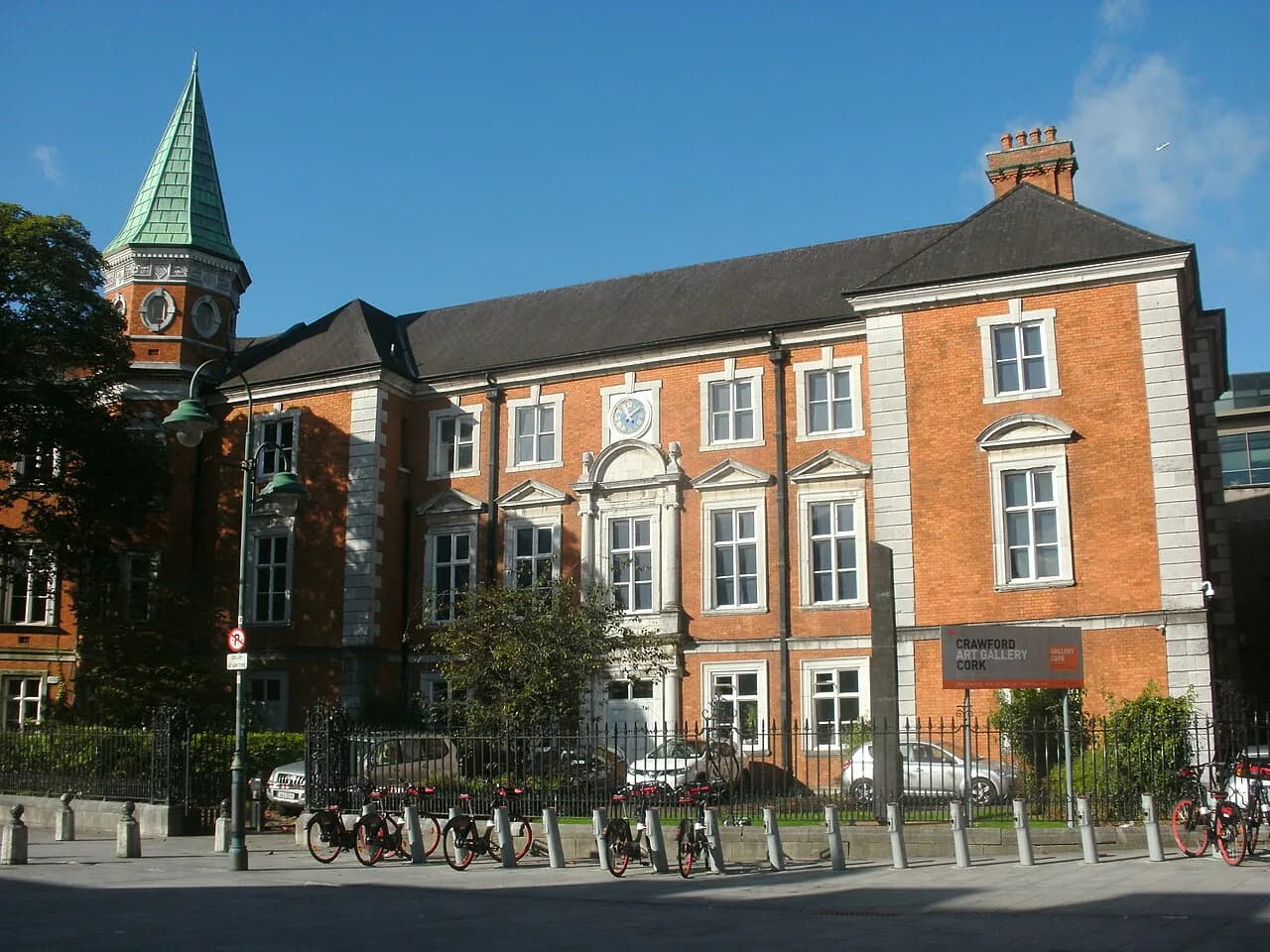
The museum's Harry Clarke's Stained Glass display opened on 5 December 2024 and is a temporary exhibition running into 2027, not a permanent collection. Admission is free and no booking is required. It is at Collins Barracks, Benburb St, Dublin 7, D07 XKV4.
The display is a collaboration with Crawford Art Gallery in Cork, which is closed for redevelopment; three panels travelled to Dublin from Cork as a result. Bringing these works together in one room is the point, since the museum states they have not previously been shown in the same place. The Crawford's teaching notes are useful scholarly context but are not an invitation to visit its galleries while it is closed.
Seven panels are now listed for the room, after the April 2026 addition of Harlequin, a loan from Bruce Yates displayed publicly for the first time since 1979. The others span 1910 to about 1925 and include The Consecration of St. Mel, Bishop of Longford, by St. Patrick, The Meeting of St. Brendan with the Unhappy Judas, The Godhead Enthroned, The Unhappy Judas, A Meeting and Richard Mulcahy.
Glazed panels are best read at an angle, so move along the room and watch how the leading and colour change as the light shifts. The early works here, made before the Honan Chapel commission, show a young artist working out the techniques that later defined his church windows.
National Gallery of Ireland: The Stained-Glass Room
The National Gallery of Ireland holds Clarke glass in its permanent collection, and entry to the permanent collection is free, though some temporary exhibitions carry a charge. The Gallery states that The Song of the Mad Prince, made in 1917, is on display in Room 20. Other Clarke works may move for conservation, so check the Gallery's own listings before relying on a specific panel being visible.
The Gallery's acquisition release describes a series of miniature literary panels Clarke made between 1917 and 1922, set into bespoke cabinets, several of them designed by the Dublin furniture maker James Hicks. Five of these panels survive, and they are the forerunners of larger works such as The Eve of St Agnes and The Geneva Window. The cabinets matter: they show glass conceived as a collectable object rather than an architectural fixture.
One of the five, Titania Enchanting Bottom, is the only Clarke glass work inspired by Shakespeare, drawing on A Midsummer Night's Dream. It was added to the national collection with support from the Patrons of Irish Art, and the Gallery said it would go on display in Room 20 following conservation. Current display should be confirmed with the Gallery rather than assumed. If it is up, it makes a useful comparison with the museum's religious panels.
The Gallery's self-guided tour on Irish art can help you place Clarke and his contemporaries within the collection's rooms. The page on William Orpen in Ireland is another route into the same period for visitors who want to compare painters and glassmakers side by side.
Beyond Clarke: Evie Hone
Evie Hone, born in Dublin in 1894, offers a second way into Irish stained glass. The National Gallery's tour notes record that she studied in London and Paris and produced more than 150 stained-glass pieces. She converted to Catholicism in 1937, after which her work became more religious.
Her visual sources differ from Clarke's. The tour notes cite cubism, early Italian painting, French cathedrals and medieval Irish carvings, and her Saint Christopher subject shows how she translated narrative into glass. The tour script mentions rooms, but those references should be treated as a guide rather than a promise that a given work hangs there today.
Hone is also a reminder that Irish stained glass was a workshop achievement, not one artist's invention. Seeing her work alongside Clarke's makes that clear, and it widens the story beyond a single celebrated name.
Practical Visiting Decisions
The two Dublin displays are separate institutions with separate rules, not a combined ticket. At Collins Barracks the Clarke exhibition is free and needs no booking. At the National Gallery entry to the permanent collection is free, while some temporary exhibitions carry a charge.
The Gallery's published hours are Monday 11am to 5.30pm, Tuesday and Wednesday 9.15am to 5.30pm, Thursday 9.15am to 8.30pm, Friday and Saturday 9.15am to 5.30pm, and Sunday 11am to 5.30pm. It closes on 24–26 December and Good Friday, and entry to the galleries stops 15 minutes before closing. Closing begins about 40 minutes before the advertised time, starting with the upper floors, so plan the Clarke room early in your visit.
Short-notice closures can occur, and the Gallery advises checking its own channels before travelling. The museum's page gives no opening hours for Collins Barracks, so confirm them with the museum directly. If you want a broader list of comparable collections across the island, the guide to art museums in Ireland helps you plan further stops.
Plan Your Visit
The practical sequence is simple: choose the museum for the loaned panels and the free temporary display, then the Gallery for the permanent holdings and the literary miniatures. Confirm the Gallery's hours and any short-notice closure, and check the museum's opening times separately since they are not published on the exhibition page.
For context before or after, read around Clarke's generation, including the page on Harry Clarke stained glass, which gathers the artist's story in one place. That preparation makes the individual panels easier to read when you are standing in front of them.
Explore more Ireland guides
Frequently Asked Questions
Where can I see Harry Clarke's stained glass in Ireland?
The most reliable places are in Dublin: the temporary Clarke display at the National Museum of Ireland, Collins Barracks, and the National Gallery of Ireland's permanent collection. Clarke's church windows survive in many counties, but those buildings set their own access conditions, so galleries are easier to plan around.
Is the Harry Clarke display at Collins Barracks free?
Yes. The museum states that admission to the exhibition is free and no booking is required. The exhibition page does not list opening hours, so confirm those with the museum before you travel.
What is the difference between the National Museum and National Gallery Clarke displays?
The museum display is a temporary loan exhibition, running into 2027 and bringing together panels from the Crawford Art Gallery and other lenders. The National Gallery holds Clarke works in its permanent collection, including miniature literary panels, and entry to that collection is free.
Why is Clarke's stained glass considered distinctive?
His teacher's notes emphasise rich, contrasting colour, repeated firing of individual pieces to achieve the right tone, and elongated, highly detailed figure drawing. Seen close up, the panels show layered colour and fine leading rather than a flat image.
Who else worked in the Irish stained-glass revival?
An Túr Gloine, founded by Sarah Purser, employed Evie Hone, Wilhelmina Geddes and Michael Healy under the management of A.E. Child. Evie Hone in particular built an independent career with more than 150 stained-glass pieces, drawing on cubism and medieval sources.
Can I visit the Honan Chapel to see Clarke's windows?
The chapel is a place of worship on the University College Cork campus, and Clarke made eleven of its nineteen windows between 1915 and 1917. Current access arrangements are not guaranteed, so check with the university before planning a visit.
Sources
- Harry Clarke’s-Stained Glass | Decorative Arts & History | National Museum of Ireland
- Harry-Clarke-bio.pdf
- National Gallery of Ireland acquires Harry Clarke artwork for national collection | National Gallery of Ireland
- https://www.ucd.ie/scholarcast/transcripts/Clarkes_Geneva_window.pdf
- Through a Lens tour: Irish art | National Gallery of Ireland
- Opening hours | National Gallery of Ireland
You might also like



Continue reading
More guides you'll find useful



