
Harry Clarke Stained Glass: Where to See It in Dublin
See Harry Clarke stained glass in Dublin at the National Museum and National Gallery, with panel highlights, craft context and admission basics.
On this page
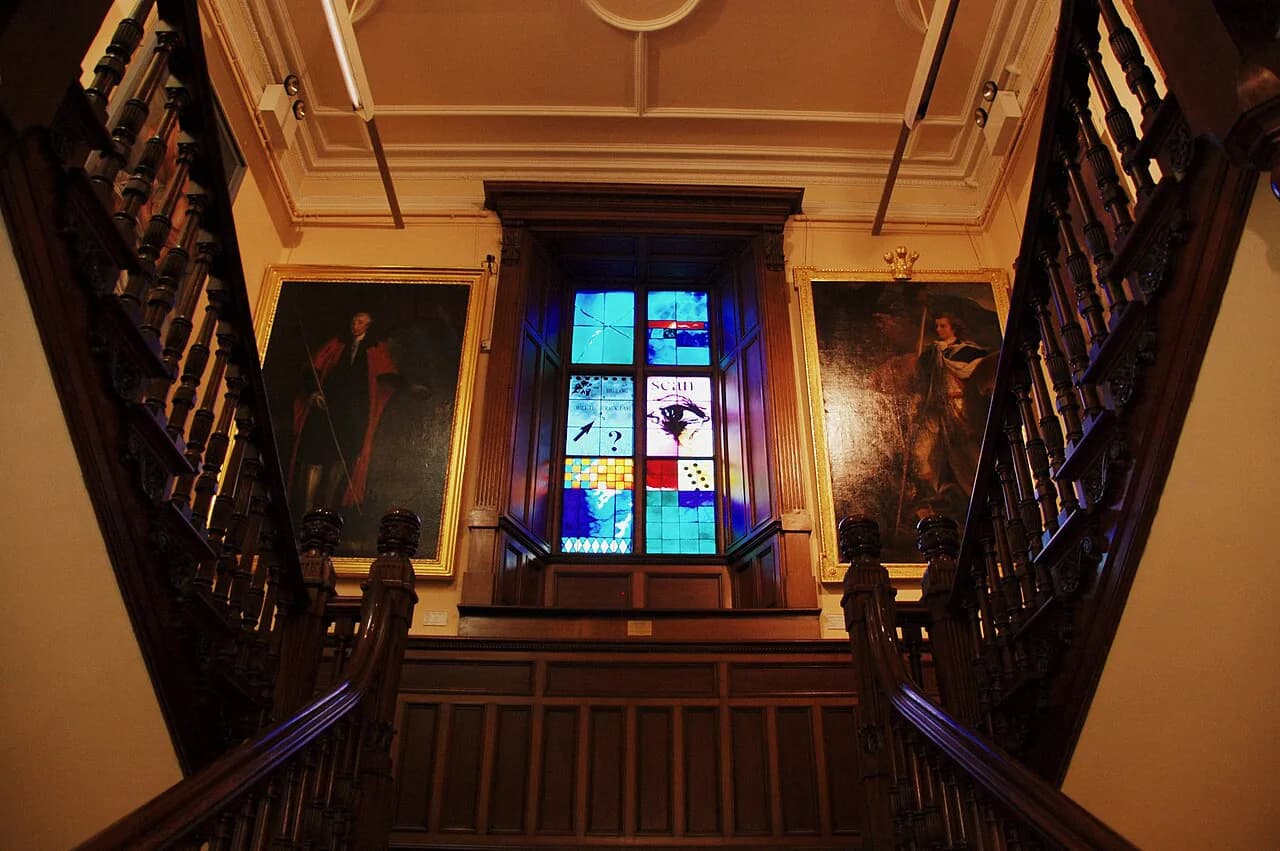
Harry Clarke's stained glass can be seen free in two Dublin collections. The National Museum of Ireland at Collins Barracks devotes a dedicated room to a seven-panel display that runs until at least 2027, and the National Gallery of Ireland holds miniature literature panels, including a Shakespeare work acquired in 2024. Neither display depends on a church visit, and the National Gallery of Ireland: A Visitor's Guide to the Dublin Collection covers the rest of that building's holdings.
Clarke was born in Dublin in 1889 and died in 1931. The National Gallery notes that his principal career was making stained glass, mainly for churches and religious houses in Ireland and abroad, with a smaller output of secular work. That split matters to a visitor: the ecclesiastical commissions established his reputation, while the miniature panels show him working at a different scale for private cabinets.
Training, An Túr Gloine and the Workshop Behind the Glass
Clarke trained at the Dublin Metropolitan School of Art, attending from 1904 to 1913. There he came under the influence of A.E. Child, an English Arts and Crafts glass worker who was also studio master at An Túr Gloine, the stained-glass co-operative Sarah Purser founded in 1903. Knowing this helps a visitor read the panels: Clarke emerged from a reform movement that wanted to raise the standard of Irish glassmaking by reviving traditional craft methods.
The Crawford Art Gallery's educational notes describe An Túr Gloine, the Tower of Glass, as following the ideals of the British Arts and Crafts Movement, managed by Child and employing artists such as Evie Hone and Wilhelmina Geddes. Clarke's talent developed under Child's instruction, and the same notes argue that the revival in medieval-style stained glass reached its fullest expression at this time. The panels in Dublin should be read as the product of a movement, not a lone genius.
Why Clarke's Glass Looks Different
The Crawford's notes single out Clarke's colour as unusual for the period. He mixed bright greens and rich reds with blues, purples and pinks, creating contrasts that sparkle rather than settle. They also record his habit of firing a single piece of glass repeatedly until the colour and quality were right, a technical choice with consequences for how the finished window catches light.
Draughtsmanship set his glass apart as much as colour. The Crawford describes his figures as elongated and expressive, set in elaborately decorated surroundings, with detail unusual for such a precise craft. That elongation and patterning relate to his parallel work as a book illustrator, whose Symbolist and Pre-Raphaelite sources he admired. Look for the same line quality in the panels as in any illustration from the same years.
At Collins Barracks: The Seven-Panel Display
The National Museum of Ireland's display, Harry Clarke's Stained Glass, opened in December 2024 and brings together panels not previously shown in the same place. It is free, needs no booking, and the museum states it will run for at least two years while the Crawford Art Gallery in Cork is closed for redevelopment, with the exhibition listed as on display until 2027. The room opened with six panels; following an April 2026 addition, seven are now on view, so plan for the larger group.
The display sits at Collins Barracks, Benburb Street, Dublin 7, D07 XKV4. Free admission and the address are confirmed on the museum's visitor information page, which also notes that some other galleries in the building are temporarily closed. Check which parts of the building are open on the day you go rather than assuming every exhibition is available.
Three of the panels travelled to Dublin on loan from the Crawford Art Gallery because its Cork building is closed for its redevelopment project. That is the practical reason a visitor sees them in Dublin now rather than in Cork. The display is a collaboration between two institutions, and the museum ties its run to the Crawford's anticipated reopening rather than to a fixed end date.
Reading the Panels One by One
The earliest work in the room is The Consecration of St Mel, Bishop of Longford, by St Patrick from 1910. The Crawford's notes explain that this piece won Clarke the gold medal in the Board of Education National Competition for Stained Glass, and that he would win the same medal three times. It is a useful starting point because it shows the young Clarke in a formal religious composition before the more fantastical works.
The group also includes The Meeting of St Brendan with the Unhappy Judas (1911), The Godhead Enthroned (1911), The Unhappy Judas (1913) and A Meeting (1918). The two Judas subjects reward comparison: viewing them together in one room reveals how Clarke revisited a single figure rather than treating each commission as an isolated job. The religious panels were his main line of work, and they carry the detail that made his reputation.
Richard Mulcahy, dated around 1925, shows Clarke applying the same glass technique to a named public figure. Liturgical commissions dominate his output, so a portrait panel stands out as a reminder that he did not work only for churches. The museum's listing gives the approximate date; treat it as a period piece rather than a precise portrait sitting.
Harlequin and the Case for a Return Visit
Harlequin, dated around 1914, joined the room in April 2026 on a two-year loan from Bruce Yates. The museum describes it as showing the character playing a stringed instrument in an elaborate yellow and black costume, and notes that it had not been on public display since 1979. For anyone who saw the display in its first year, this is the substantive change worth a second trip.
The loan period is finite, so the panel will not necessarily remain beyond its two-year term. Visitors planning a trip far ahead should confirm that Harlequin is still listed before travelling specifically for it. The rest of the display's run is stated only as at least 2027, which leaves the later schedule open.
At the National Gallery: Miniature Panels and Literature
The National Gallery of Ireland acquired Titania Enchanting Bottom in 2024. Made in 1922, it is the only Clarke glass work inspired by Shakespeare, depicting a scene from A Midsummer Night's Dream with characters including Bottom, Puck and Titania, framed by botanical detail. It belongs with the Gallery's stained glass holdings rather than a church setting, and it was acquired as a lasting part of the national collection. At the time of acquisition the Gallery noted the panel was undergoing conservation before going on display, so check whether it is on view rather than assuming it is hanging.
Between 1917 and 1922 Clarke made a series of miniature panels inspired by literature, fitting them into bespoke cabinets. The Gallery notes that several cabinets, including the one for Titania Enchanting Bottom, were designed by Dublin-born furniture maker James Hicks, and that only five panels from the series survive. Seeing a panel in its cabinet explains the scale: these were intimate objects, not windows for a nave.
The Song of the Mad Prince, made in 1917, is stated by the Gallery as on display in Room 20 and was acquired in 1987. It is the panel to seek out first if you want a confirmed location rather than a general collection reference. Together with the other miniatures, the Gallery presents it as a forerunner to The Eve of St Agnes and The Geneva Window.
The Geneva Window as Historical Context
UCD ScholarCast describes The Geneva Window as Clarke's last great work in stained glass, a commission that pays homage to the Irish Revival and its impact on modern Irish writing and drama. It is a secular piece uniting literature, art and craft, and Clarke hoped to illustrate work by Synge, whose poetry inspired one of his commissions. None of this makes it a viewing recommendation: the source does not place it on public display in Ireland.
The Revival context also explains the Honan Chapel commission in Cork, where Clarke designed and made eleven of the chapel's nineteen windows between 1915 and 1917 while in his mid twenties. UCD notes that the commission came through his Belvedere College connections and that it placed him in direct competition with Purser's An Túr Gloine. Treat the chapel as art-historical background rather than a visitor stop; this source does not publish access arrangements.
Reading Clarke alongside his contemporaries is useful because the Revival was a network rather than a single career. UCD lists George Russell, Jack B. Yeats and Beatrice Elvery among the artists who shaped Irish visual art in the same years, which helps place Clarke's glass within a wider movement. For a broader view of that generation, the guide to Irish artists sets out the main figures and where their work can be found.
Visiting the National Gallery Without Losing the Day
Admission to the National Gallery's permanent collection is free, while some temporary exhibitions carry a charge. Opening hours are Monday 11am to 5.30pm, Tuesday and Wednesday 9.15am to 5.30pm, Thursday 9.15am to 8.30pm, Friday and Saturday 9.15am to 5.30pm, and Sunday 11am to 5.30pm. The Gallery is closed from 24 to 26 December and on Good Friday, and short-notice closures can occur, so check before a dedicated trip.
The building begins to close about forty minutes before the published closing time, starting with the upper floors, and entry to the galleries stops fifteen minutes before closing. On a Thursday evening that means the wind-down starts around 7.50pm; on other days around 4.50pm. Go to the stained glass room early in your visit rather than leaving it for the final half hour.
Both stops are in Dublin and can be paired in a single day, but they are not next door to each other. Collins Barracks is west of the city centre in Dublin 7, while the National Gallery sits near Merrion Square. Allow for the walk or a short trip between them, and give the Clarke material at least an hour across both sites.
Plan Your Visit
Start with Collins Barracks for the seven-panel display, which is free, needs no booking and runs until at least 2027. Then go to the National Gallery for the miniature panels, looking first for The Song of the Mad Prince in Room 20 and asking staff about the stained glass room's current arrangement. Together they give a fuller picture of Clarke than either collection alone.
Do not plan a detour to the Crawford Art Gallery in Cork for Clarke's glass while its building is closed for redevelopment; the relevant panels are in Dublin on loan. If stained glass is your main interest, the wider guide to irish stained glass covers the craft beyond Clarke. Note that Harlequin's loan is time-limited, so confirm it is still on show if that panel is your reason for going. For other collections, read about William Orpen and Irish Landscape Paintings.
Explore more Ireland guides
Frequently Asked Questions
Where can I see Harry Clarke stained glass in Dublin for free?
The National Museum of Ireland at Collins Barracks has a dedicated Harry Clarke's Stained Glass display with free admission and no booking required. The National Gallery of Ireland also holds Clarke miniature panels, and entry to its permanent collection is free, though some temporary exhibitions carry a charge.
How many Clarke panels are at Collins Barracks and what are they?
Seven panels are currently on view after an addition in April 2026. They include The Consecration of St Mel, Bishop of Longford, by St Patrick, The Meeting of St Brendan with the Unhappy Judas, The Godhead Enthroned, The Unhappy Judas, A Meeting, Richard Mulcahy and Harlequin.
Why is Harlequin significant?
Harlequin, dated around 1914, is on a two-year loan from Bruce Yates and joined the display in April 2026. The museum notes it had not been on public display since 1979, making it the main reason for a repeat visit by anyone who saw the earlier hang.
Can I see Clarke's work at the Crawford Art Gallery in Cork?
Not at present. The Crawford Art Gallery is closed for redevelopment, and three of its Clarke panels are on loan to the National Museum display in Dublin. Check the Crawford's own announcements for reopening before planning a visit to Cork.
What Clarke glass is at the National Gallery of Ireland?
The Gallery holds Titania Enchanting Bottom, a 1922 Shakespeare-inspired miniature panel acquired in 2024, along with other miniature literature panels set in cabinets by James Hicks. The Song of the Mad Prince is stated as on display in Room 20; ask staff about the current stained glass room arrangement for the others.
Is the Geneva Window on public display in Ireland?
The available sources do not place it on public view in Ireland. UCD ScholarCast discusses it as Clarke's last great work in stained glass and a secular commission rooted in Irish writing, so treat it as historical context for his career rather than a viewing stop.
How long does the Collins Barracks display run?
The National Museum's exhibition page lists the display as on view until 2027, with the run of at least two years from its December 2024 opening tied to the Crawford Art Gallery's anticipated reopening. No later end date is published, and the Harlequin loan is finite, so confirm current listings before a trip planned far ahead.
Do I need to book for the National Museum display?
No. The National Museum's exhibition page states admission is free and no booking is required. It is worth checking the museum's visitor information for any temporary gallery closures elsewhere in the building on the day you visit.
Sources
- Harry-Clarke-bio.pdf
- Harry Clarke’s-Stained Glass | Decorative Arts & History | National Museum of Ireland
- National Gallery of Ireland acquires Harry Clarke artwork for national collection | National Gallery of Ireland
- https://www.ucd.ie/scholarcast/transcripts/Clarkes_Geneva_window.pdf
- Opening hours | National Gallery of Ireland
- Visitor Information | Decorative Arts & History | National Museum of Ireland
You might also like



Continue reading
More guides you'll find useful





