
John Lavery: Seeing His Work in Ireland's National Collection
John Lavery (1856-1941) is represented in the National Gallery of Ireland. See what the collection holds and how to plan a visit around his paintings.
On this page
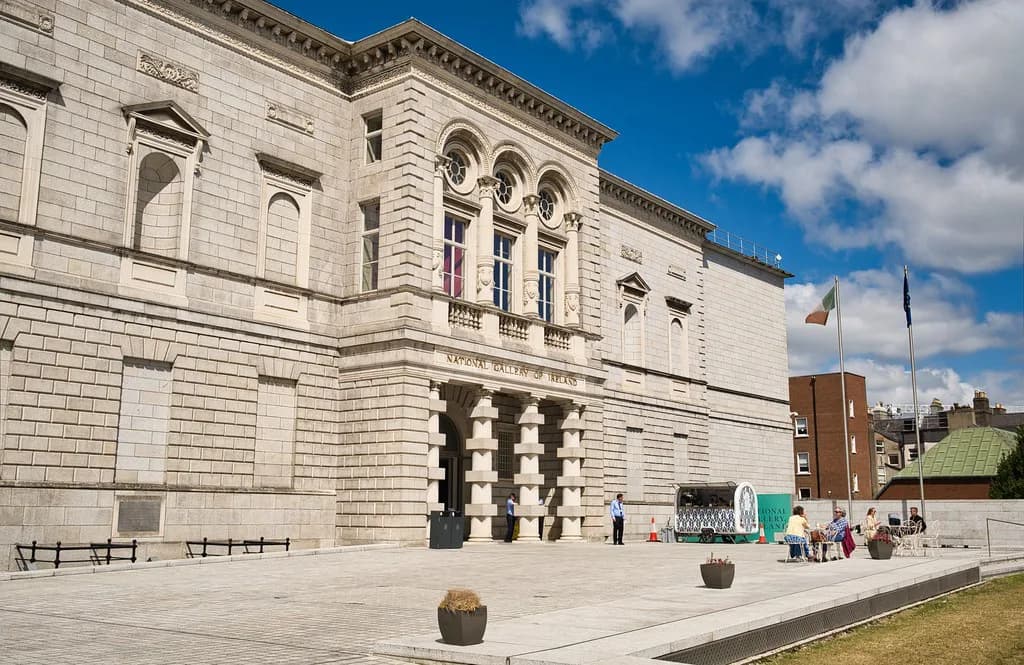
John Lavery (1856-1941) was born in Belfast, and the National Gallery of Ireland in Dublin is the public collection where you can study several of his paintings alongside the Gallery's own catalogue notes. Two of them, On the Bridge at Grez and Portrait of Lady Lavery as Kathleen Ni Houlihan, have online records you can read before you go. A third, The Bathing Hour, the Lido, Venice, was announced as a new acquisition and, at that moment, was said to be on view in Room 16.
Who Lavery Was: Belfast, Glasgow and the Route into Art
Lavery was born in Belfast in 1856, the son of a wine and spirit merchant. Orphaned at three, he moved to Scotland and lived with relatives in various places before taking a job with a photographer in Glasgow. That job led him to evening classes at the Haldane Academy of Art, the first step in a training that would carry him well beyond Scotland.
The progression is worth holding onto when you look at his paintings: Glasgow, then London, then Paris and the Académie Julian, then the artists' colony at Grez-sur-Loing. By the time he reached Grez he was already working in the manner the Gallery's catalogue calls Rustic Naturalism, a style he absorbed from the circle around Jules Bastien-Lepage. Reading the labels with this sequence in mind turns an apparently modest early canvas into a document of a specific training.
On the Bridge at Grez: An Irish Colony Abroad
On the Bridge at Grez is held by the National Gallery of Ireland, and its catalogue entry is unusually revealing about why the picture matters. The old bridge was the dominant feature of Grez-sur-Loing and a subject visiting artists painted again and again, but Lavery painted a view on the bridge rather than of it. The figure leaning on the wall with his artist's equipment beside him is almost certainly Carlow-born Frank O'Meara, an artist Lavery greatly admired and a key member of the village's artistic community.
The entry also explains the painting's quiet tonality: the subdued palette is characteristic of Rustic Naturalism, which spread through Europe, North America and as far as Japan in the late nineteenth century. Provenance records show the work came to the Gallery as a Heritage Gift from Lochlann and Brenda Quinn in December 2008, and the exhibition history includes Lavery on Location at the National Gallery of Ireland in Dublin, the Ulster Museum in Belfast and the National Galleries of Scotland in Edinburgh. For a visitor, this is the canvas that best shows Lavery as part of an Irish network working on the Continent rather than as a lone society painter.
The Portrait Career: A Royal Commission and Society Sitters
A turning point came in 1888, when Lavery was commissioned to paint Queen Victoria's visit to the Glasgow International Exhibition. Over the following decades he built a reputation as one of the leading portrait painters among Europe's social elite, and he travelled widely through Europe, North Africa and beyond. If you already know the work of Walter Osborne and the Dublin painters who recorded street life, Lavery's portraits offer a useful counterpoint: the same era, a very different clientele.
Lavery's portrait world overlapped with William Orpen's generation in Dublin, and Orpen himself taught at the Metropolitan School of Art before establishing a London career. Reading the two together, one as a travelling cosmopolitan and the other as a portraitist with a complicated Irish attachment, gives a fuller picture of how Irish painters moved between Dublin, London and the Continent.
Venice in 1912: The Bathing Hour at the Lido
Lavery arrived in Venice in September 1912 after a busy year that had included portraits of the Russian ballerina Anna Pavlova and a Royal Family group now in the National Portrait Gallery in London. At the Lido he set up under the awning of a fishing hut at the Excelsior Hotel to shield his work from the glare, and painted the scene the press release describes as the bathing hour, with children on the sands and swimmers in the water.
The Bathing Hour, the Lido, Venice is thought to be the latest of four Lido canvases Lavery is known to have completed. The composition sets white gowns and Hazel Lavery's parasol against a rippling tide, and the Gallery notes that the acquisition was enabled by Section 1003 of the Taxes Consolidation Act 1997, a tax relief for donations of important national heritage items. When the Gallery announced the acquisition, it stated that the painting was on display in Room 16. That was the position at the time of the announcement, not a standing guarantee, so check the current display before you build a trip around it.
Hazel Lavery as Kathleen Ni Houlihan: Reading a Title Carefully
The Gallery's online collection also lists a Portrait of Lady Lavery as Kathleen Ni Houlihan. Beyond the title and its subject, the public record gives little away: the page identifies the work but does not, in the form available to a general reader, supply a date, medium or description. Treat the title as a starting point and let the Gallery's own catalogue text, when you reach the work, do the interpreting.
The title carries meaning on its own, though. Personifying Ireland as a woman was an established convention among poets, writers and visual artists in the early twentieth century, and the Gallery makes that point explicitly when discussing Orpen's Young Ireland, a portrait of Grace Gifford in the same collection. Hazel Lavery as Kathleen Ni Houlihan belongs to that tradition of national personification, whatever the particular canvas looks like.
Planning a Visit Around Lavery
Published opening hours are Monday 11am to 5.30pm, Tuesday and Wednesday 9.15am to 5.30pm, Thursday 9.15am to 8.30pm, Friday and Saturday 9.15am to 5.30pm, and Sunday 11am to 5.30pm. Admission to the permanent collection is free, though some temporary exhibitions carry a charge. The Gallery is closed 24 to 26 December and on Good Friday, and entry to the galleries stops fifteen minutes before closing time. If you are weighing a visit, the National Gallery of Ireland: A Visitor's Guide to the Dublin Collection is a useful comparison for planning.
Two practical habits make a Lavery visit more reliable. First, look up the painting in the online collection before travelling, so you know the title and what the catalogue says about it. Second, check the Gallery's own notices shortly before you go, since it has warned that short-notice closures can occur. If your interest extends beyond Lavery, this guide to art museums in Ireland and this overview of the Gallery's Irish artists are sensible next reads for building an itinerary.
Two Misreadings to Avoid
The first is assuming that an acquisition announcement fixes a painting to a room permanently. Press releases describe the situation at the moment of publication, and the Gallery's display arrangements change with exhibitions and rotations. Use the announcement, including the mention of Room 16, as a record of where a work was shown at a particular moment rather than as a live floor plan.
The second is reading a portrait's title as though it described the image. A title such as Portrait of Lady Lavery as Kathleen Ni Houlihan tells you who is depicted and the role invoked; it does not tell you the date, the setting or the pose. Where the online record is thin, the honest move is to look at the actual label in the Gallery and take your cues from the text printed beside the work.
Lavery Alongside Other Irish Painters
Lavery's career is easier to place when set beside painters who took different paths. Jack B. Yeats and Paul Henry offer further contrasts with Lavery's Venetian and society subjects, and a comparison between them says as much about markets and travel as about style. Use each painter's page to find the public collection where you can see the work.
If you are planning a wider tour of collections, Ireland art galleries covers venues beyond Dublin, and Harry Clarke stained glass shows how another medium carried Irish visual culture in the same decades. Neither is a substitute for the Lavery canvases, but together they build a more complete picture of the period than any single painter can.
Plan Your Visit
Start with the Gallery's online catalogue for On the Bridge at Grez and the Portrait of Lady Lavery as Kathleen Ni Houlihan, note the published hours, and confirm current display before you travel. The permanent collection is free, and the Thursday evening opening gives you a longer window than most days. For another heritage guide, read about Mary Swanzy.
Explore more Ireland guides
Frequently Asked Questions
Where can I see John Lavery's work in Ireland?
The National Gallery of Ireland holds examples of Lavery's work, including On the Bridge at Grez and the Portrait of Lady Lavery as Kathleen Ni Houlihan, both of which have online collection records. The Bathing Hour, the Lido, Venice was announced as a new acquisition and was said at the time to be on display in Room 16. Confirm current display on the Gallery's own channels before travelling, since rooms and rotations change.
Was John Lavery born in Belfast?
Yes. The National Gallery of Ireland's announcement on its Lavery and Orpen acquisitions gives his dates as 1856 to 1941 and describes him as a native of Belfast. It also notes that he was orphaned at three and moved to Scotland, where he took a job with a Glasgow photographer before attending evening classes at the Haldane Academy of Art.
What is On the Bridge at Grez and why does it matter?
It is a Lavery painting in the national collection showing a view on the old bridge at Grez-sur-Loing, with a figure the catalogue identifies as almost certainly the Carlow-born artist Frank O'Meara. The Gallery describes it as celebrating the Irish presence in the village's artistic community and links its subdued palette to the style known as Rustic Naturalism.
Why is Hazel Lavery painted as Kathleen Ni Houlihan?
The Gallery's collection lists a Portrait of Lady Lavery as Kathleen Ni Houlihan. Personifying Ireland as a woman was an established convention among writers and visual artists at the beginning of the twentieth century, as the Gallery notes in discussing Orpen's Young Ireland. The available collection record for the Lavery portrait gives the title but little descriptive text, so the label at the Gallery is the best place to learn more.
Is the National Gallery of Ireland free to enter?
Admission to the permanent collection is free. Some temporary exhibitions carry a charge, so check the Gallery's own pages for the particular exhibition you want to see. The Gallery also warns that opening arrangements may change, so it is sensible to look at its notices shortly before a visit.
What should I check before travelling to see a specific painting?
Look the work up in the Gallery's online collection first, then check the Gallery's current notices for display and opening information. Press releases describe the position at the time of publication, so a room named in an announcement should not be treated as permanent. Galleries often advise checking social channels for short-notice changes.
Sources
- Press Release: Two new artworks acquired | National Gallery of Ireland
- Portrait of Lady Lavery as Kathleen Ni Houlihan – Explore the National Gallery of Ireland's collection: – National Gallery of Ireland
- On the Bridge at Grez – Explore the National Gallery of Ireland's collection: – National Gallery of Ireland
You might also like



Continue reading
More guides you'll find useful




