
Ireland Art Galleries: A City-by-City Visitor Guide
Plan an art gallery route across Ireland by city, from Dublin's national collection to Cork, Galway, Athlone and Drogheda, with published hours and closures.
On this page
Ireland's art galleries reward planning by city rather than by ranking. Dublin holds the national collection and a contemporary museum on a historic campus, Cork combines a university gallery with a society gallery, and smaller cities such as Galway, Athlone and Drogheda each support a distinct publicly accessible space with its own building history.
One closure should shape your route before anything else. Crawford Art Gallery in Cork closed to the public in autumn 2024 for redevelopment, and the gallery anticipates reopening in late 2028, with a further update expected in mid-2027; treat that as an expectation, not a fixed date, and plan Cork around the venues that are open.
Dublin: The National Collection as Context
The National Gallery of Ireland publishes a self-guided Through a Lens tour of Irish art in the national collection, and it is best read as a map of themes rather than a guaranteed hang. The tour gathers artists who changed Irish art across different decades, styles and genres, and the gallery describes the selection as a starting point rather than a complete list.
The tour's range is genuinely broad. Jack B. Yeats appears through expressionist brushwork and literary sources, while Walter Osborne is presented as an en plein air painter influenced by Impressionist techniques and by time in Brittany and Antwerp. Mainie Jellett and Evie Hone are shown as close collaborators who studied in Paris, with Jellett working a single-angle version of cubism and Hone moving between painting and stained glass; the tour also covers Paul Henry's Achill years and Mary Swanzy's role in championing Modernism in Ireland. For Yeats beyond the national collection, see our guide to Jack B. Yeats in Ireland.
Read the room references as orientation, not as a live display list. The tour points to specific rooms and to related online material about individual works, so the sensible approach is to use it to decide which artists you want to pursue, then check the gallery's own current visitor information for hours, admission and what is actually hanging on the day.
Dublin: IMMA at Royal Hospital Kilmainham
The Irish Museum of Modern Art occupies the Royal Hospital Kilmainham site in Dublin 8, spread across 48 acres that include galleries, formal gardens and meadows as well as the historic buildings. A visit can be a gallery stop or a longer campus walk, and the museum frames its programme as extending beyond the exhibition rooms into the grounds.
Access is unusually straightforward for a museum of this scale. IMMA opens Tuesday, Thursday, Friday and Saturday from 10am to 5.30pm, Wednesday from 11.30am to 5.30pm, and Sunday and bank holidays from 12 noon to 5.30pm, with last admission to any individual exhibition gallery at 5.15pm; the museum is closed on Mondays except bank holidays. General admission is free and most exhibitions are also free, which makes it a low-risk addition to a Dublin day.
Practical details matter at a campus site. The grounds and buildings are served by lifts, adapted toilets are available in the main building and elsewhere on site, and parking is paid rather than free. If you want context on the contemporary work, the Visitor Engagement Team in blue lanyards answers questions in the galleries, and tours are arranged through the front-of-house contact rather than booked on a whim.
Cork: The Glucksman on the UCC Campus
The Glucksman sits in the lower grounds of University College Cork, reachable on foot from the ceremonial gates at the corner of Western Road and O'Donovan's Road, on the right as you walk up the main avenue. The gallery describes itself as about a ten-minute walk from Cork city centre, with bus routes 205 and 208 serving the campus and public parking at the UCC Perrots Inch car park.
Its published pattern is Tuesday to Sunday, 11am to 5pm, closed Mondays. Admission is free with a suggested donation, so a visit fits easily into a campus walk, but the gallery advises checking its information desk or social channels for closures before you set out. That caveat is worth taking seriously if the exhibition is the main reason for the trip.
Cork: Lavit Gallery and the Cork Arts Society
Lavit Gallery is the trading name of Cork Arts Society, founded in 1963 to promote interest in art in the city and now a not-for-profit organisation and registered charity. Its programme exists to let artists exhibit work for public patronage, and its non-commercial activity includes artist talks, exhibition tours and two annual graduate awards for students at MTU Crawford College of Art & Design.
The building is part of the appeal. The gallery occupies a former maltings and grainstore purchased by Cork City Council in 1998 and converted for artistic use alongside Backwater Artists Group and Cork Printmakers, and it moved to Wandesford Quay in 2018. Low ceilings, beams and pillars survive from the malting process, and the ground-floor gallery is the space that still reflects the original layout; the distinctive vaults once used for burning smokeless coal to dry malt are also part of the fabric.
Hours are Tuesday to Saturday, 10.30am to 6pm, with a specific exception: the gallery closes on the Tuesday after a bank holiday Monday. If your Cork days fall around a long weekend, that single rule is the one most likely to catch you out, since the other Cork options on this route also close on Mondays.
Galway: Galway Arts Centre at 47 Dominick Street
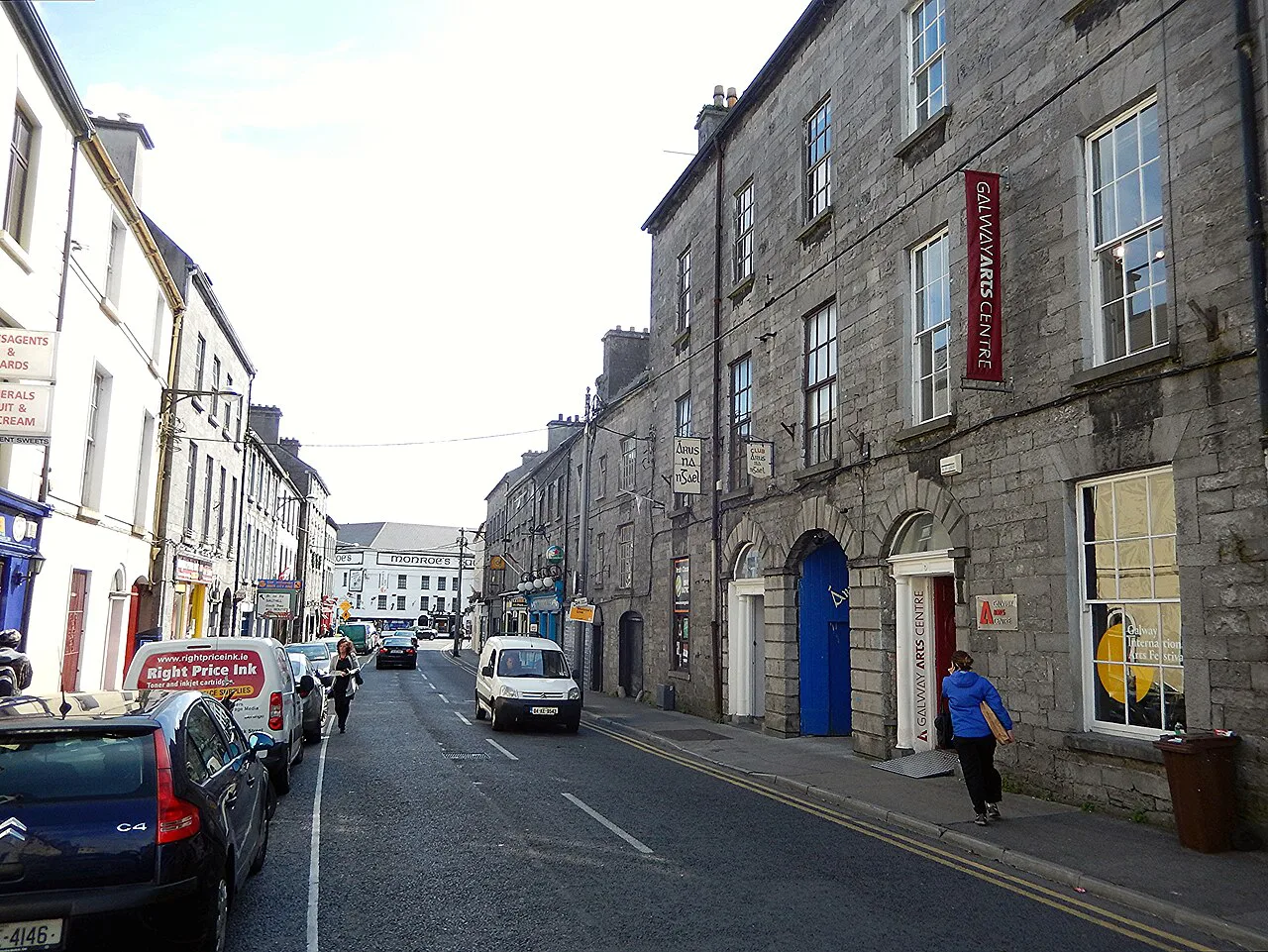
Galway Arts Centre traces its origins to the Galway Arts Group, a collective formed to support artists that founded the Galway Arts Festival in 1978 and opened the arts centre at the former Presbyterian church on Nun's Island in 1981; the organisation was constituted in 1985 with an emphasis on a gallery for the visual arts. It runs two venues, the gallery at 47 Dominick Street and the 82-seat Nun's Island Theatre, and its visual art programme covers exhibitions, residencies and commissions by Irish and international artists rather than a fixed collection.
The Dominick Street building carries its own history. It was built in the 1840s as a residence for the Persse family, whose most famous member was Lady Augusta Gregory, the playwright, Abbey Theatre founder and patron of the Irish Literary revival, and it has operated as the arts centre since 1988. The centre describes its galleries there as Galway's de facto municipal gallery, which is a useful way to understand the scale: this is a city gallery, not a national museum.
Entry to the galleries is free, and published hours are Tuesday to Friday 10am to 5pm with a Thursday evening opening to 9pm, Saturday 10am to 5pm and Sunday 12 noon to 5pm, closed Monday. The centre also warns that 47 Dominick Street may close to the public during exhibition installation periods and advises contacting reception before travelling, so a quick call or email is the difference between a visit and a locked door.
Athlone: Luan Gallery on the Shannon
Luan Gallery opened in November 2012 as the first purpose-built dedicated municipal visual art gallery in the midlands, adapting Athlone's 1897 Father Mathew Hall with a new wing designed by Keith Williams Architects. The result is a riverside gallery that mixes historic architecture with a contemporary addition, and it won the RIAI Best Cultural Building in Ireland award in 2013.
The hall's earlier life explains the setting. Built in 1897 as a temperance venue, it later became Athlone's first cinema and, after being gifted to the town in 1947, served as town hall and the town's first public library until the library moved in 2004. Performers from the tenor John McCormack to Percy French appeared on its stage, and the gallery's name was chosen through a public competition drawing on the element 'Luan' in the Irish name for Athlone, Áth Luain, the ford of Luan.
For visitors, the gallery publishes an Elliott Road address on the west bank of the Shannon, beside Athlone Castle and Ss. Peter and Paul's Church and a short walk from the town centre and train station. It is fully wheelchair accessible with lift access to all levels and accessible toilets, guide and support dogs are welcome, and visits are free during normal opening hours; groups of more than eight must book in advance.
Drogheda: Highlanes Gallery and the Municipal Collection
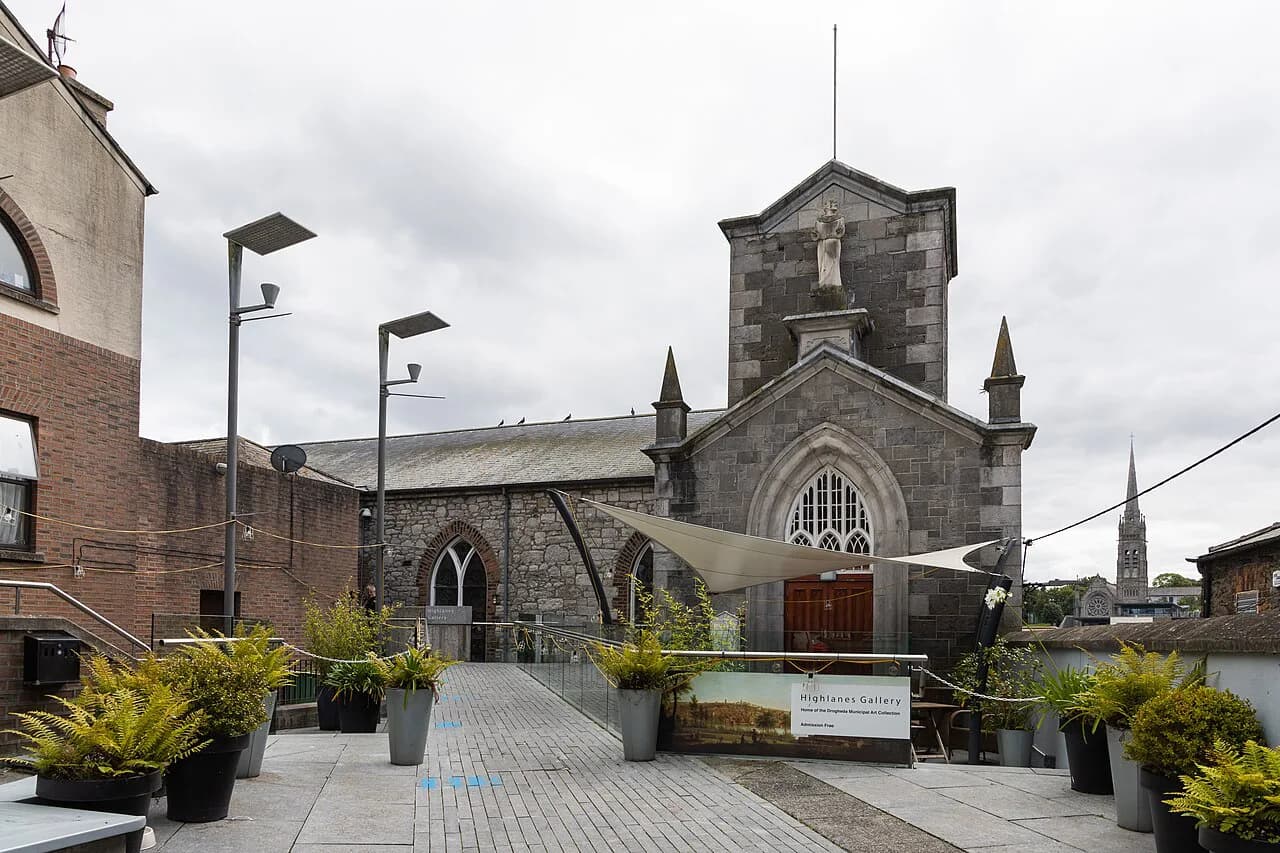
Highlanes Gallery opened on 4 October 2006 as Drogheda's public art gallery and visual arts centre, and it holds the Drogheda Municipal Art Collection. That collection was originally developed by the artist Bea Orpen, her husband Terry Trench and the 1947 Museum Committee, and it has grown to more than 100 artworks ranging from 18th-century paintings to modern sculpture.
The building shapes the visit. Highlanes' own visitor information is candid that converting a building of this age was logistically difficult: universal accessibility has largely been achieved, but some areas need care, floor staff can assist, and courtesy manual wheelchairs are available at reception. Admission is free, and the gallery asks groups to book in advance by email or phone.
Published opening is Tuesday to Saturday, 10.30am to 5pm, and the gallery flags those times as subject to change. It shares a main entrance on St Laurence Street with an adjoining café whose hours are set separately, so do not assume the café follows the gallery's timetable. Crawford Art Gallery has also partnered with Highlanes on a touring exhibition during its closure, but a partnership does not guarantee any particular work is on view there on a given day; for wider context, see our guide to Irish landscape paintings.
Sequencing a Route and Where Closures Bite
Monday is the common fault line. IMMA, the Glucksman and Galway Arts Centre all publish Monday closures, with IMMA excepting bank holidays, so a Monday is best used for walking the grounds at Kilmainham or for a city with a different pattern such as Highlanes in Drogheda, which opens Tuesday to Saturday. The National Gallery tour page does not publish opening days, so check its own visitor information before relying on it for a Monday.
Cork needs the most careful sequencing. With Crawford closed for redevelopment, the Glucksman and Lavit carry the city's publicly accessible gallery visits on this route, and their patterns mean Tuesday to Saturday is the safer window; Lavit's bank-holiday Tuesday closure then removes one option at the start of a long weekend.
Outside Dublin and Cork, the trade-off is scale against setting. Galway Arts Centre and Luan Gallery are compact municipal spaces where the building and riverside or street context count for a good part of the visit, while IMMA and the National Gallery can absorb half a day. Pairing a small gallery with a walk, rather than stacking several small venues, usually makes a better day.
Crawford's Collection While the Building Is Closed
Crawford began life as a Custom House in 1724 and has since served as a school of art, a municipal gallery and a national cultural institution. It closed to the public in autumn 2024, and the building was fully vacated by 12 January 2026 as construction began; the gallery anticipates handover in mid-2028 followed by a late-2028 opening.
During the closure, works from the collection have been touring. Crawford has partnered on exhibitions at Uillinn: West Cork Arts Centre, the F.E. McWilliam Gallery in Banbridge and Highlanes Gallery in Drogheda, and other works are on loan to institutions including the Irish Museum of Modern Art and the National Museum of Ireland. For more on Irish artists, see our guide to irish artists.
Treat those loans as context, not as a promise. A touring partnership does not guarantee that a particular work is on view at a given venue on a given day, so if seeing a specific Crawford piece matters, ask the host gallery directly before you travel rather than assuming it is hanging.
Plan Your Gallery Route
Build the route around cities, not rankings: Dublin for the national collection and IMMA's campus, Cork for the Glucksman and Lavit while Crawford is closed, Galway for the Dominick Street gallery, Athlone for Luan on the Shannon and Drogheda for Highlanes in the former friary church. Each venue publishes its own access details, and those pages are the ones to trust over any summary — though the National Gallery tour page covers collection themes only, so its hours and admission need checking on the gallery's visitor pages.
Two checks do most of the work before you travel: confirm the day's opening hours, and confirm that the gallery is not mid-installation or otherwise closed. Bank holidays and Mondays deserve particular attention, and any reopening date should be treated as the institution's expectation until its own updates confirm otherwise.
For another heritage guide, read about Dublin Art Galleries.
Explore more Ireland guides
Frequently Asked Questions
Which art galleries in Ireland are free to enter?
Several venues on this route state free admission on their own pages: IMMA, where most exhibitions are also free, the Glucksman, which suggests a donation, the galleries at Galway Arts Centre, Luan Gallery during normal opening hours and Highlanes Gallery. Others, including the National Gallery of Ireland, should be checked directly for current admission arrangements rather than assumed.
Is Crawford Art Gallery in Cork open to visitors?
No. Crawford closed to the public in autumn 2024 for redevelopment and the building was fully vacated by January 2026. The gallery anticipates reopening in late 2028, with a further update expected in mid-2027, but that is an expectation rather than a confirmed date. Plan Cork around the Glucksman and Lavit instead.
Which galleries close on Mondays?
IMMA, the Glucksman and Galway Arts Centre all publish Monday closures, with IMMA open on bank holidays instead. Lavit Gallery closes on the Tuesday following a bank holiday Monday. Highlanes opens Tuesday to Saturday; check the National Gallery of Ireland's own visitor pages for its days.
How do I reach Luan Gallery in Athlone?
Luan Gallery is on Elliott Road on the west bank of the Shannon, beside Athlone Castle and Ss. Peter and Paul's Church, a short walk from the town centre and train station. It is served by regular train and bus services from Dublin, Galway and surrounding areas, with parking nearby at St Peter's Square, on-street and at O'Connell Street car park.
Is the National Gallery of Ireland tour a fixed display list?
No. The self-guided Irish art tour is presented as a starting point covering many artists, styles and decades, and it references rooms and related online material. Use it to choose which artists to pursue, then check the gallery's own current visitor information for hours, admission and what is on display when you go.
Do I need to book for groups?
Some venues do. Luan Gallery requires advance booking for parties of more than eight, and Highlanes Gallery asks groups to book ahead by email or phone. For smaller groups, checking current hours and any installation closures is more important than booking.
What should I check before travelling to a smaller Irish gallery?
Confirm the current opening hours on the gallery's own site and check whether the space is closed for exhibition installation or other reasons. Galway Arts Centre explicitly warns that 47 Dominick Street may close during installation and advises contacting reception first, and the Glucksman directs visitors to its desk or social channels for closure updates.
Sources
- Through a Lens tour: Irish art | National Gallery of Ireland
- Visitor Info - IMMA
- Visitor information | The Glucksman
- About - Lavit Gallery (https://lavitgallery.com/about/)
- About Galway Arts Centre | Galway Arts Centre
- Visitor Information | Galway Arts Centre
- About Us - Luan Gallery
- Visit - Luan Gallery
- Highlanes Gallery – Drogheda's Municipal Art Gallery
- Visit Us – Highlanes Gallery
- Transforming Crawford Art Gallery - Crawford Art Gallery
You might also like



Continue reading
More guides you'll find useful





