
Louis le Brocquy: Seeing His Work in Irish Collections
Louis le Brocquy was a self-taught Dublin-born painter. This guide covers the two documented Dublin anchors for his work and how to check access before visiting.
On this page
Louis le Brocquy was a Dublin-born, self-taught painter who died in 2012, and the documented way to encounter his work in Ireland runs through two Dublin institutions. IMMA's retrospective record sets out the shape of his career, and a report in Art History News describes how his painting A Family reached the National Gallery of Ireland in 2002. Neither source confirms that a particular work hangs today, so treat both as starting points to check before you travel.
This guide is for travellers who want to look at a specific artist rather than browse a national collection aimlessly. It covers what to look for in the head studies, what the earlier paintings add, and how to plan around two stops without assuming either will have a canvas on the wall when you arrive.
Who Louis le Brocquy Was
Le Brocquy was born in Dublin in 1916 and worked without formal art-school training, a detail repeated across institutional and commercial records. The auction house Adam's notes that he left a laboratory job in 1938 to paint, which places his commitment to art at the end of that decade rather than after a conventional education. That self-taught route is worth holding onto when you look at the work, because his development reads as restless experiment rather than a tidily mapped progression.
IMMA's exhibition record describes him as one of Ireland's best-known artists and frames his central preoccupation as capturing an aspect of the body as an image of the human being. That phrase is useful for a visitor: it tells you to expect bodies that are reduced, compressed or suggestive rather than polished likenesses. Adam's calls him the most important Irish artist of the second half of the twentieth century, though the directory frames that as a considered assessment rather than a neutral fact.
For a culture-focused trip, he rewards attention because his subject matter sits at the meeting point of literature and visual art. His head studies take named writers as their starting point, so a gallery visit can connect to reading you might already be doing on an Irish trip. The wider index of irish artists sets out the field he belongs to if you want to pair him with other painters.
The Head Studies: What Changed From 1974
According to IMMA's retrospective record, from 1974 le Brocquy became concerned with the Celtic concept of the human head. The page names the writer heads as his best-known body of work, citing studies of Beckett, Yeats, Joyce and Lorca. That date marks a shift in emphasis rather than a change of medium: the head becomes the vehicle for a much older interest in the human image.
IMMA's record also notes that the writer heads were made in various media, and that the retrospective placed this later work in the context of earlier painting to amplify his total practice. The heads were never presented as an isolated series but as one layer of a longer enquiry. Looking at them with that in mind changes what you notice: repetition across media, the way a single head is revisited, and the difference between a recognisable face and a head used as an idea.
The literary names give you a practical way in. If you know Beckett's pared-back prose or Yeats's poetry, you can ask whether the painted head carries any of that austerity or grandeur, and whether Lorca, a Spanish poet, is treated differently from the Irish writers. That is a more productive exercise than hunting for an exact likeness. Individual hangings vary between displays, so which heads you encounter needs to be confirmed with the venue.
Beyond the Heads: Early Work and Retrospective Scope
IMMA's record of the retrospective states that it comprised more than 90 paintings, covering early works, group portraits, procession series and human presences. That list is a checklist for anyone wanting to understand him rather than just recognise one famous series. It shows a painter moving between single figures, grouped bodies and sequences in which figures appear to move across a surface.
In front of an early painting, look for the same question the head studies pose later: how much of a person can survive abstraction. The group portraits and procession works let you test that at larger scale, where individual faces matter less than rhythm and arrangement. Because the retrospective was a past exhibition rather than a standing display, use its scope to read whatever you do see, not as a promise of what is hanging now.
A Family and the National Gallery of Ireland
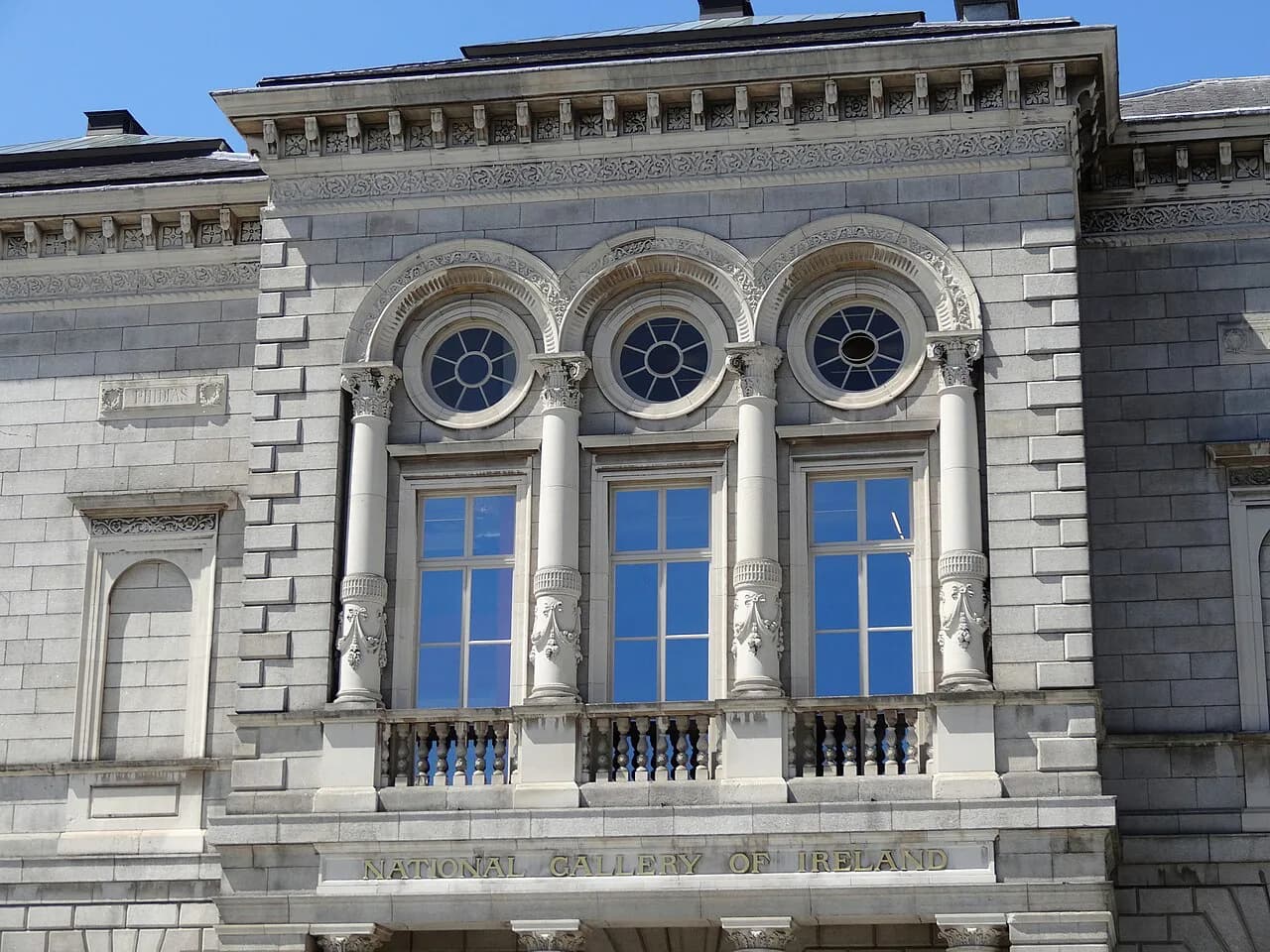
The strongest single reason to look for le Brocquy in Dublin is the reported history of A Family, painted in 1951 and exhibited that year at his London gallery, Gimpel Fils. As reported by Art History News, a group of patrons offered to buy it for the city's municipal gallery in 1952, and the art advisory committee rejected it. The painting later took a prize at the Venice Biennale, was bought by the Nestlé Foundation, and hung at its Milan headquarters until 2001.
The same report states that the businessman Lochlann Quinn then bought the painting from Agnews in London and, with his wife Brenda, presented it to the National Gallery of Ireland; the article's 2002 date for that presentation is the date the report ties the gift to. On that acquisition, according to the report, le Brocquy became the first living Irish artist to have a painting in that collection. Acquisition and presentation are documented, but the sources do not say the canvas hangs continuously, so check the Gallery's own information before building a visit around it.
Career Context in Brief
Adam's directory records that he moved to London in 1947 and used it as a base for roughly ten years, showing work in Paris, New York and Italy during that period. It also notes his co-founding role in the Irish Exhibition of Living Art in 1943, and his marriage to Anne Madden in 1958, after which he divided his time between France and Ireland. These details explain why his work circulates internationally while remaining central to Irish art history.
The same source mentions honorary doctorates from Trinity College Dublin and University College Dublin, and retrospectives held in France, Spain, Japan, Australia and the United States. Read as a career outline, it suggests an artist recognised well beyond Ireland in his lifetime, a useful counterweight to the rejection story attached to one painting.
Media Beyond Painting
Adam's lists tapestries, prints and illustrations alongside his paintings, which matters when you scan a collection display. A tapestry after his design, a print or a book illustration may sit in a different room or a different kind of institution from an oil painting, and it may be shown under conservation conditions unrelated to its importance. For a related guide to another Irish medium, the article on irish stained glass covers how a craft tied to architecture can be studied in its own right.
This range also tells you not to judge a collection's holdings by a single visit to one painting. A gallery might hold works on paper while another shows a canvas, and no source establishes that any Irish institution holds a complete representation of his output. The practical move is to ask each venue what it holds and what is currently on view rather than assuming one room tells the whole story.
Planning the Dublin Visit
Build the trip around two confirmed institutions rather than a route of assumptions. IMMA's retrospective page is an exhibition record, not a live listing, so check the museum's current programme directly to see whether any le Brocquy work is on show. The National Gallery of Ireland is the institution named in the 2002 presentation of A Family, so check its own collections information for present display status. If that Gallery stop is the main draw, the National Gallery of Ireland: A Visitor's Guide to the Dublin Collection sets out how to plan the rest of a visit there.
Two checks are enough to plan responsibly: IMMA's current exhibitions and the National Gallery of Ireland's display information. The sources used here establish no opening hours, admission terms, tour availability, room numbers or facilities, so ask the venues rather than relying on a secondary summary. That leaves room for whatever else each collection is showing when you arrive.
To widen a Dublin art day beyond these two stops, pair the visit with other figure-based Irish painting rather than treating le Brocquy as a lone curiosity. The profile of jack b yeats offers a very different approach to the Irish figure and landscape, and the survey of irish landscape paintings shows how subject matter shifted across generations. Reading one painter against another is often more memorable than seeing a single canvas in isolation.
A Focused Way to See Le Brocquy
You can approach le Brocquy responsibly in Ireland by starting with IMMA's documented retrospective scope and the National Gallery of Ireland's reported acquisition of A Family, then confirming what each institution currently displays. Go for the head studies of Beckett, Yeats, Joyce and Lorca, but give equal time to the early paintings and group works that IMMA's record places alongside them. The result is a fuller reading of a self-taught Dublin painter than one famous name on a wall. For another heritage guide, read about Harry Clarke Stained Glass. For another heritage guide, read about Paul Henry Artist.
Explore more Ireland guides
Frequently Asked Questions
Who was Louis le Brocquy?
He was a Dublin-born painter, born in 1916, who died in 2012. Adam's artist directory records that he was self-taught and left a laboratory job in 1938 to paint, later basing himself in London from 1947 and helping to found the Irish Exhibition of Living Art in 1943. IMMA's exhibition record describes his enduring subject as the body, with the head treated as an image of the human being.
What is Louis le Brocquy best known for?
IMMA's retrospective record identifies his long series of writer head studies as the best-known part of his output, naming Beckett, Yeats, Joyce and Lorca. It dates his concern with the Celtic concept of the human head to 1974 and notes that the studies were made in various media. The same record shows the heads were shown alongside earlier paintings, group portraits and procession series rather than alone.
Where can I see Louis le Brocquy's work in Ireland?
Two Dublin anchors are documented. IMMA's record describes a retrospective of more than 90 paintings from his career, and Art History News reports that the National Gallery of Ireland was presented with A Family in 2002. Neither source guarantees a particular work is hanging now, so confirm current displays directly with each institution before travelling.
Why is A Family significant?
Painted in 1951, the canvas was offered to Dublin's municipal gallery in 1952 and rejected by its art advisory committee, as reported by Art History News. It later won a prize at the Venice Biennale, was bought by the Nestlé Foundation and hung in Milan until 2001, then bought by Lochlann Quinn and presented with Brenda Quinn to the National Gallery of Ireland in 2002. That report links the gift to le Brocquy becoming the first living Irish artist represented in the collection.
What should I look for in the head studies?
Look for repetition rather than likeness: the same writer's head revisited across different media, and scale used to push a face toward an idea. IMMA's record places the series in the context of his earlier painting, so compare a head with an early figure or group portrait and ask what has been stripped away. Which heads are on view in any display changes, so check the venue.
Do I need to check whether works are on display?
Yes. The sources cited here document past exhibitions and an acquisition, not a permanent hang. Check IMMA's current programme and ask the National Gallery of Ireland about A Family before planning a trip around either. The same sources give no information on hours, admission, tours or facilities, so those questions are best put to the institutions themselves.
Sources
You might also like



Continue reading
More guides you'll find useful



