
Museums in Ireland: A Practical Guide by Collection and Region
A practical guide to museums in Ireland, from the National Museum's Dublin branches to county and specialist collections, with tips on choosing and checking details.
On this page
Museums in Ireland fall into three rough groups: the national collections in Dublin, city and county museums that interpret local history, and specialist independents devoted to a single story, craft or figure. The venues below are a representative sample drawn from published features, not a complete inventory, so treat them as starting points rather than a checklist. The practical rule is to pick by collection type first and location second, because Dublin alone could absorb several days.
One timing decision shapes any Dublin itinerary. The National Museum of Ireland's archaeology branch on Kildare Street and its natural history branch on Merrion Street sit close together, so they pair naturally in a single day, while the decorative arts branch at Collins Barracks sits further out near Phoenix Park. Trying to add all three plus a major art gallery in one day leaves little room to actually look at anything.
How to Choose Which Museums Fit Your Interests
Match the subject to your curiosity instead of chasing a ranked list. Archaeology suits anyone interested in prehistoric metalwork and Viking finds; decorative arts covers silver, ceramics, glass and furniture; fine art galleries reward slow looking; rural-life and emigration museums explain how people lived and left. A maritime or industrial collection suits travellers who want engineering and transport rather than glass cases.
Geography is the second filter. Some visits cluster tightly, such as the Kildare Street and Merrion Street museums, or Waterford's Viking Triangle, where several venues sit within walking distance of each other. Others, like the Museum of Country Life in County Mayo or the Jackie Clarke Collection in Ballina, are deliberate detours that need their own half-day. Build the day around one cluster rather than scattering across a city.
If your trip has a wider historical frame, the island's story-based sites outside the museum sector help set context, and the Irish History You Can Visit collection covers monuments and battlefields that museums often only introduce.
The National Museum of Ireland's Four Premises
The National Museum of Ireland operates four distinct premises, and each has a different collection. On Kildare Street in Dublin, the archaeology branch holds prehistoric gold and Viking artefacts in a Victorian-Palladian building. Nearby on Merrion Street, the natural history branch, locally nicknamed the Dead Zoo, keeps its old cabinet-style atmosphere and displays giant deer skeletons and other zoological specimens.
At Collins Barracks near Phoenix Park, the decorative arts and history branch covers weaponry, silver, ceramics and glassware, and includes an exhibition devoted to furniture designer Eileen Gray alongside the Fonthill Vase, described as the earliest documented piece of Chinese porcelain in Europe. The fourth branch is far from Dublin: the Museum of Country Life in County Mayo, which opened in 2001 and interprets rural life between roughly 1850 and 1950. That Mayo branch is why a Dublin-only plan misses part of the national collection entirely.
Treat the branches as separate visits rather than one institution. Opening arrangements can differ between premises, and no single published feature establishes current hours for all four, so check each branch's own page before you set out.
The National Gallery of Ireland and Dublin's Art Collections
The National Gallery of Ireland was founded in 1854 and holds the national collection of Irish and European art, running to roughly 14,000 works across paintings, drawings, prints and sculpture. Works by Caravaggio, Monet and Picasso are displayed alongside Irish artists, and one visitor source reports that admission and the audio guide are free, with talks, tours and a smartphone app also available. Confirm current arrangements on the gallery's own site before relying on that.
Beyond the national gallery, Dublin's art and special collections reward different moods. The Hugh Lane Gallery holds contemporary Irish and international works and is described as among the first galleries of modern art in the world. IMMA, housed in the seventeenth-century Royal Hospital Kilmainham, focuses on modern and contemporary practice across photography, portraiture and installations. The Chester Beatty Library, on the grounds of Dublin Castle, holds Islamic and Far Eastern manuscripts, Japanese scrolls, biblical papyri and prints by Dürer; it was named European Museum of the Year in 2002, a dated award rather than a current ranking.
Emigration is the theme at EPIC in the Dublin Docklands, where twenty themed galleries trace why people left Ireland and how they influenced the places they settled. It suits travellers who want narrative and interactive exhibits rather than objects in cases, and it makes a sensible pairing with any of the docklands heritage sights.
Glasnevin Cemetery Museum offers a different kind of collection: the life stories of people buried on the site, including Daniel O'Connell, Michael Collins and Constance Markievicz, presented in a Milestone Gallery covering around 200 individuals. It is a cemetery museum rather than an artefact hall, so go for biography and political history.
City Museums Outside Dublin
Cork's Crawford Art Gallery is described as home to more than 2,500 works from the eighteenth century onward, including a group of Greek and Roman sculpture casts brought to the city from the Vatican Museum in 1818. The building's scale suits a half-day visit rather than a full one. If you are comparing options across the city, the wider guide to museums in Cork sets the Crawford beside other collections.
In Limerick, the Hunt Museum occupies the Georgian Custom House by the River Shannon and displays the collection amassed by John and Gertrude Hunt. Its range runs from Irish Mesolithic material and ancient Egyptian pieces to paintings by Jack B. Yeats, Renoir and Picasso and work by fashion designer Sybil Connolly. The breadth is the point: this is an antiquarian's cabinet rather than a single-theme display.
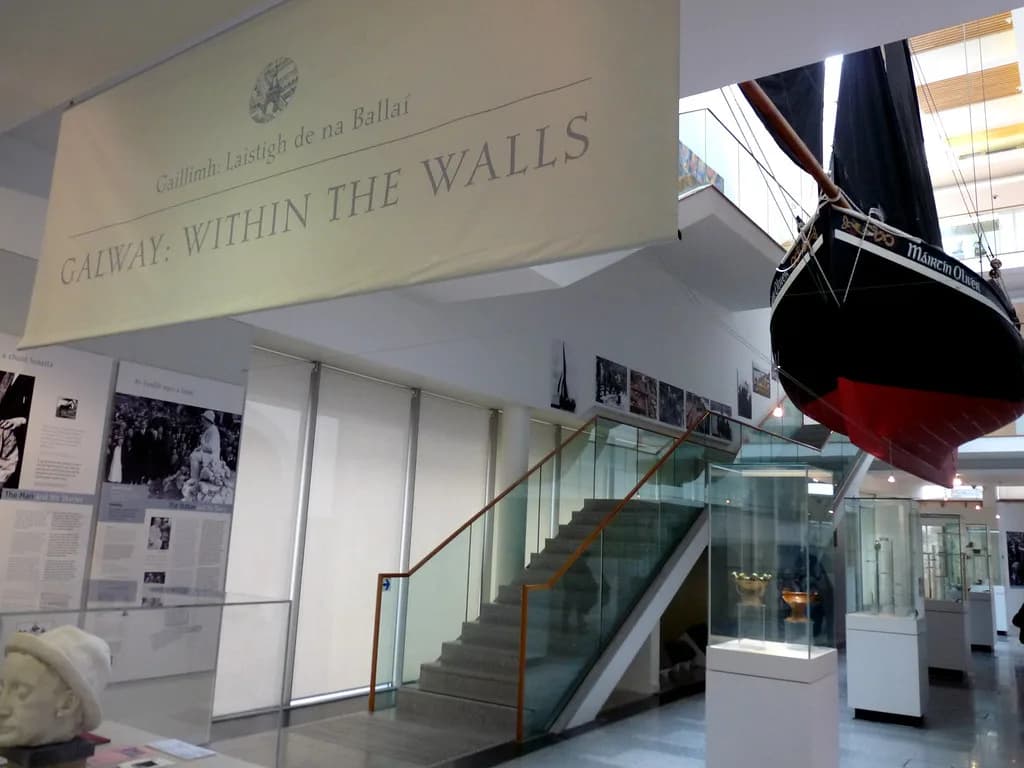
Galway City Museum stands on the banks of the River Corrib overlooking the Spanish Arch, its modern building holding archaeology and history collections donated by the people of Galway. The contrast between the contemporary structure and the historic quayside is part of the appeal. For other collections in the city, see the guide to museums in Galway.
Waterford's Viking Triangle in One Walk
Waterford's Viking Triangle concentrates several venues in a compact area, which makes it the easiest cluster to cover on foot. The Medieval Museum holds the Great Charter Roll of Waterford of 1373 and a complete set of medieval cloth-of-gold vestments, with two original medieval chambers reached by a thirteenth-century spiral staircase. The Bishop's Palace, an eighteenth-century townhouse, and Reginald's Tower, described as Ireland's oldest civic building at around 800 years, sit in the same quarter; published features do not confirm separate admission arrangements for them, so check before building them into a day.
A single ticket or combined arrangement may be offered locally, but published features do not establish current terms, so ask at the first venue you enter. The Waterford Treasures Medieval Museum guide covers that building in more detail for anyone planning the cluster.
Northern Ireland: Belfast and Beyond
Belfast's museums sit in a different jurisdiction from the Republic, and the practical details that follow reflect that. The Ulster Museum, in Belfast's Botanic Gardens, combines art, natural science and history collections. Titanic Belfast, opened in 2012 on the shipyard site where the ship was built and launched, presents galleries, interactive exhibits and an ocean exploration centre; booking ahead is advised.
For emigration history, the Ulster American Folk Park traces the movement of Ulster people to America in the eighteenth and nineteenth centuries. Its reconstruction includes thatched cottages, an emigrant sailing ship and log cabins of the American frontier, so expect much of the storytelling to be tied to moving between buildings rather than a single display hall, and check its own site for how the grounds are arranged and what is open.
Travellers following the Titanic story south of the border can add the Titanic Experience Cobh, which interprets the ship's White Star Line connection with the Cork harbour town.
Smaller and Specialist Museums Worth the Detour
The Jackie Clarke Collection in Ballina, County Mayo, occupies a former Provincial Bank building designed by Thomas Manly Deane, who also designed the National Museum in Dublin. Clarke's lifetime of collecting produced letters from Michael Collins, Douglas Hyde and O'Donovan Rossa, rare books, posters and maps up to 400 years old. Admission has been reported as free with donations welcome, but confirm locally before travelling.
In County Laois, the Mountmellick Embroidery and Heritage Museum tells how Johanna Carter taught the town's poorer residents a white-on-white embroidery in 1825 that became known as Mountmellick Work, used on bed coverlets, tablecloths and dresses. The Butter Museum in Cork explains butter production and the nineteenth-century Cork Butter Exchange, while the Quiet Man Cottage Museum in Cong recreates a cottage set from the 1951 film and holds newspaper material about its making. Reported hours and prices for these small venues date from 2024 and should be verified directly.
Where a story site sits near a museum, pairing them makes a fuller day: the Irish National Heritage Park in County Wexford covers reconstructed early settlement, including a fulacht fiadh cooking site, and complements indoor collections on the same period.
Reported Closures and Dated Notices
Two operational notices deserve care. A 2024 travel feature reported that the Little Museum of Dublin, which holds more than 5,000 objects donated or loaned by city residents, had been temporarily closed for renovation since April 2024, with a pop-up museum at Pembroke Street in its place. The same feature noted that Cavan County Museum's outdoor World War I trench exhibit had closed for winter maintenance, which is a seasonal measure rather than a permanent closure. Check each museum's own channels before planning around either.
Historical displays that once marked the 1916 Rising centenary were added at Collins Barracks in 2016, and some were still running when one source was written. Temporary exhibitions rotate, so treat any specific display mentioned in older features as a possibility to check, not a certainty.
County museums exist in every county, with examples ranging from the oldest man-made object in Ireland said to be held in Monaghan to an 1835 gallows trapdoor in Carlow. Their holdings vary widely, so ask what the local collection actually covers rather than assuming a standard format.
Before You Go: What to Confirm
Book ahead where the operator advises it, most notably Titanic Belfast, and assume nothing about walk-up availability at small private museums. Opening hours, admission charges and tour times change with the season and with staffing, and the published features used here do not establish current terms for most venues.
Plan by location so you are not crossing a city twice. Pair Kildare Street with Merrion Street, keep Collins Barracks for a separate outing near Phoenix Park, and give stand-alone venues such as Ballina or Cong their own travel time. Finally, use the museum's own website as the authority on hours, prices and exhibition schedules; secondary articles, including this one, go out of date.
Plan Your Museum Days
The strongest approach to museums in Ireland is to choose by subject, group by location, and verify the practical details at the source. That way a visit to the archaeology branch, a county collection or a specialist museum rests on what the institution publishes today rather than on a feature written months or years earlier.
If your interests reach beyond museum walls, historic sites help set context for the collections above. The Battle of the Boyne Visitor Centre at the Oldbridge Estate is one such site where a single historic event is interpreted for visitors, and it pairs naturally with a wider historical itinerary. If you want to plan a broader heritage route, read the Battle of the Boyne guide.
Explore more Ireland guides
Frequently Asked Questions
What is the difference between the four National Museum of Ireland sites?
Each premises has a distinct subject. The Kildare Street branch covers archaeology, including prehistoric gold and Viking material; Merrion Street holds natural history collections in an old cabinet-style building; Collins Barracks covers decorative arts and history, from silver and ceramics to the Eileen Gray exhibition and the Fonthill Vase; and the Museum of Country Life in County Mayo interprets rural life from about 1850 to 1950. Check each branch's own page for current opening arrangements.
Which museums suit a short Dublin visit?
For a single day, pair the archaeology branch on Kildare Street with the natural history branch on Merrion Street, since they are close together. If art is your priority, choose one of the National Gallery of Ireland, the Hugh Lane Gallery or IMMA at Kilmainham rather than attempting all three. Collins Barracks works better as a separate outing near Phoenix Park.
Are there good museums outside Dublin and Belfast?
Yes. Cork's Crawford Art Gallery, the Hunt Museum in Limerick's Custom House and Galway City Museum by the Spanish Arch all hold substantial collections. Waterford's Viking Triangle clusters the Medieval Museum, the Bishop's Palace and Reginald's Tower within walking distance, and smaller venues such as the Jackie Clarke Collection in Ballina and the Mountmellick Embroidery and Heritage Museum reward a detour.
Do I need to book museums in Ireland in advance?
Booking ahead is specifically advised for Titanic Belfast, and it is sensible for small private museums with limited capacity. Most larger national collections do not require advance tickets according to the published features reviewed here, but that is not a guarantee. Check the individual museum's website for ticketing and tour arrangements before you travel.
Is the Little Museum of Dublin open?
A 2024 travel feature reported that the museum had been temporarily closed for renovation since April 2024, with a pop-up museum operating at Pembroke Street instead. That report is dated and the situation may have changed since. Check the museum's own website or social channels for its current status before making plans around it.
Sources
You might also like



Continue reading
More guides you'll find useful




