
Bunratty Castle: History, Restoration and Planning a Visit
Bunratty Castle is a restored tower house and National Monument in County Clare. Learn its layered history and what the castle and Folk Park visit involves.
On this page
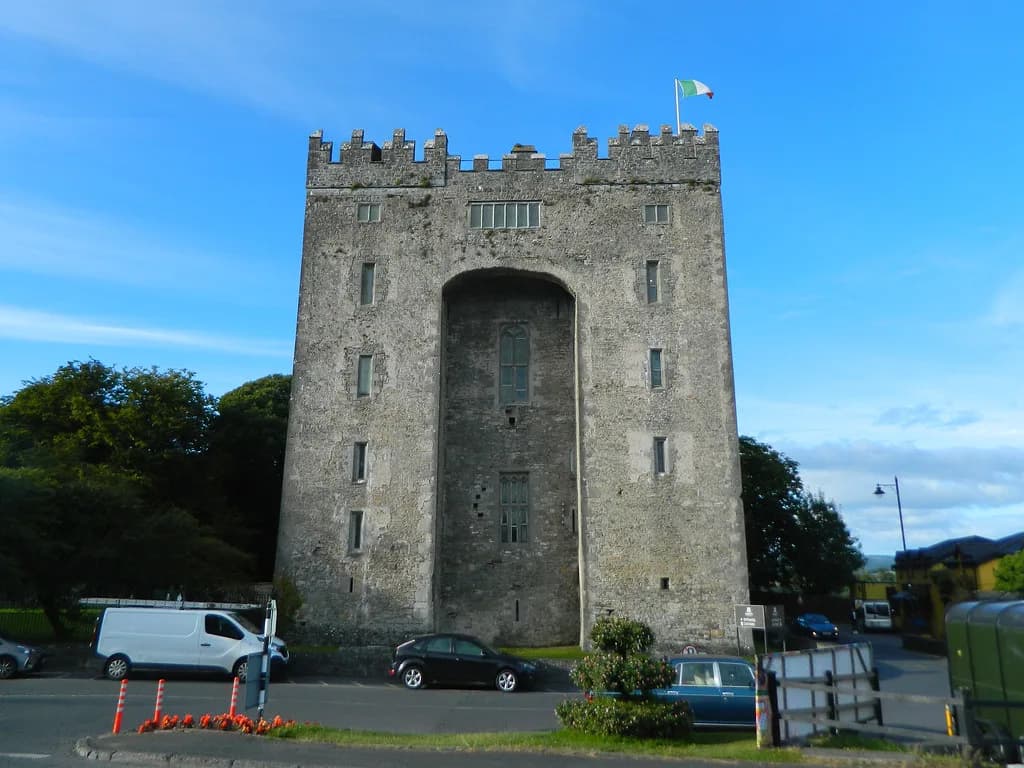
Bunratty Castle is a National Monument in state guardianship in south County Clare, and the structure visitors enter is largely the result of a mid-20th-century restoration rather than continuous medieval survival. Heritage Ireland, the Office of Public Works record, describes a tower house built in the 15th century for Maccon MacNamara, incorporating earlier fabric, and later remodelled and refurnished after Viscount Gort bought it in 1953 and 1954. A visit today pairs that repaired castle with Bunratty Folk Park, a separate open-air experience sharing the grounds.
The practical detail worth settling before you travel is who runs what. Heritage Ireland lists Bunratty among its unguided sites and states plainly that OPW Heritage Cards are not accepted there because the visitor service is not managed by the OPW, so this is not a standard free state site. The operator publishes current opening arrangements, admission terms, banquet scheduling and any closure notices; check those directly rather than relying on secondary descriptions.
Layered Origins: The Castles Recorded Before the Tower House
Heritage Ireland notes that Bunratty was originally one of four castles recorded at the site in the 13th century, which makes the present building the survivor of a crowded earlier landscape rather than a single continuous construction. One of those castles was built for Robert de Muscegros in 1251 as an earth and wood structure with an oak palisade, in character closer to a ringfort than a stone tower. Another, built for Thomas de Clare in 1290 and refortified for Thomas de Rokeby in 1353, is described as now part of the fabric of the present castle.
That detail matters when reading the walls. The fortress is a palimpsest in which 13th- and 14th-century work sits inside a later shell, so a short visit rewards attention to thresholds, lower walls and the parts of the structure that predate the rooms most visitors photograph. If your interest is the wider evolution of Irish fortification, compare it against other towers and keeps gathered in the medieval castles of Ireland overview before deciding how much time to allot here.
Maccon MacNamara and the O'Briens of Thomond
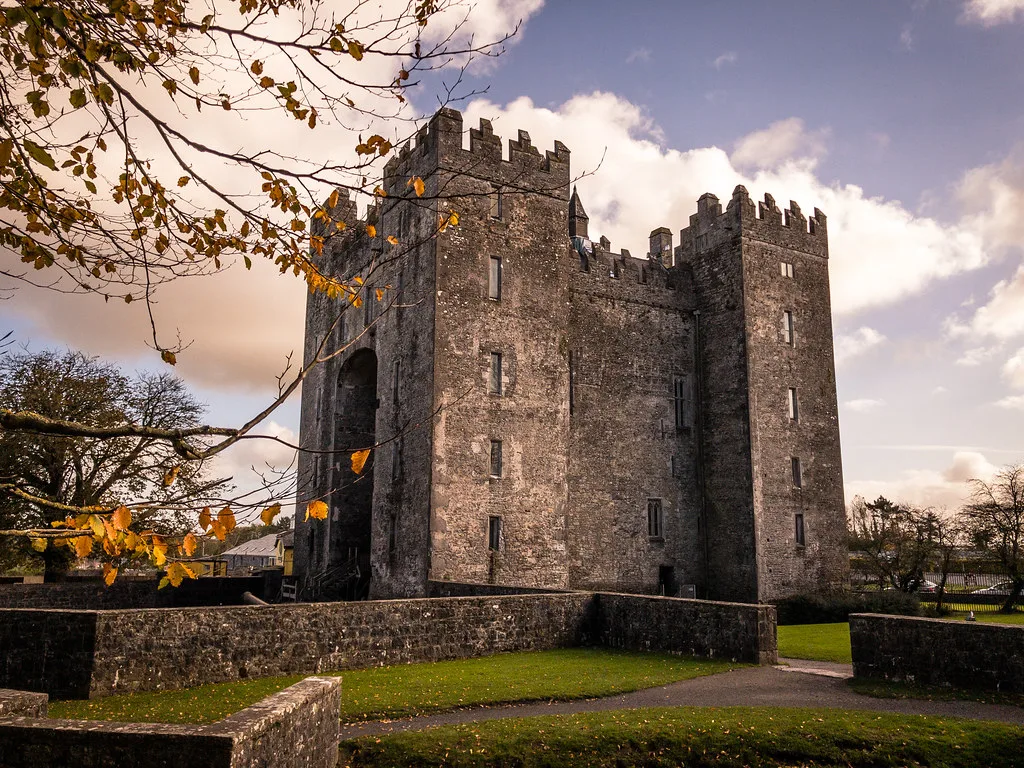
The standing castle was built in the 15th century for Maccon MacNamara, a figure the OPW record describes as noted for his piety and as the recipient of a papal letter of thanks from Pope Eugenius IV. In the very early 16th century much of the MacNamara estate, Bunratty included, passed peacefully to the O'Briens of Thomond, so the family association most visitors expect was a transfer rather than a foundation.
Donough O'Brien, known as the Great Earl, made Bunratty his headquarters from 1583 onwards. His modifications during the Tudor period included vaulting the corner towers and decorating walls and ceilings with elaborate plasterwork, which is the layer to look for if you want to see what a resident earl actually commissioned. A national tourism feature dates the present castle to 1425 and treats a recent anniversary as a 600th birthday, framing that is promotional rather than OPW chronology, so treat the precise year with caution while the ownership sequence remains reliable.
Surrender, Plantation Possession and the Studderts
During the Cromwellian period Barnaby O'Brien, 6th Earl of Thomond, surrendered Bunratty to parliamentary forces in March 1646. The O'Briens later built at Dromoland nearby, and the castle was granted to a succession of Plantation families, with the Studderts in possession by 1725. That date marks the start of the domestic phase most visitors overlook, when a fortress began being adapted as a house.
Under the Studderts, remodelling included a multi-storey house attached to the external north face and a police station built into the west face, which later became an RIC barracks and was burned during the War of Independence. In the mid-19th century the family attempted conservation by inserting concrete floors and tarring felt roofs, an intervention that reads today as an early and imperfect attempt to hold a medieval structure together. In 1915 Thomas Studdert gave the castle to the Board of Works.
Viscount Gort's Restoration
In 1953 or 1954 Standish Vereker, 7th Viscount Gort, bought the castle on the advice of John Hunt, whose collection underpins The Hunt Museum, and the architect Percy Le Clerc, with the Board of Works, the Irish Tourist Board and Shannon Development also involved. Gort's restoration removed most later additions, including the Studdert house and barracks, and inserted fireplaces, wood panelling and furniture along with 100 panels of stained and heraldic glass. He is commemorated by portraits of himself and his wife Bessy and a plaque near the portcullis. If Hunt's collecting eye interests you, the Hunt Museum, Limerick: A Visitor Guide to the Custom House Collection follows that collection in Limerick.
The castle opened to the public in the 1960s and is protected under the National Monuments Acts 1930 to 2014. Understanding the restoration is what makes the interior legible: you are looking at a considered mid-20th-century reconstruction of a Gaelic and Tudor residence, assembled with scholarly advice, not at rooms that survived unchanged through four centuries of occupation.
Reading the Interior Honestly
The furnishings and heraldic glass are best understood as an assembled collection placed to evoke the castle's 14th-to-17th-century heyday, which is exactly why the rooms feel coherent rather than shabby. A third-party activity listing describes a substantial holding of period furnishings, tapestries and works of art; treat the scale and any figure attached to it as promotional detail rather than an official inventory, and check with the operator if a specific object or room is central to your visit.
Visit Clare lists internal spaces to look for, including the banquet hall, the Earl's bedroom and the South Solar study, plus views over the Shannon Estuary. Stairs are integral to a tower house, and no authoritative source here extends accessibility guarantees to upper levels or spiral steps. If you need an accessible visit, ask the operator about which interiors are reachable before booking, and plan to spend your time on the ground-level rooms and the park if the stairs prove too much.
The Folk Park: A Different Kind of Visit
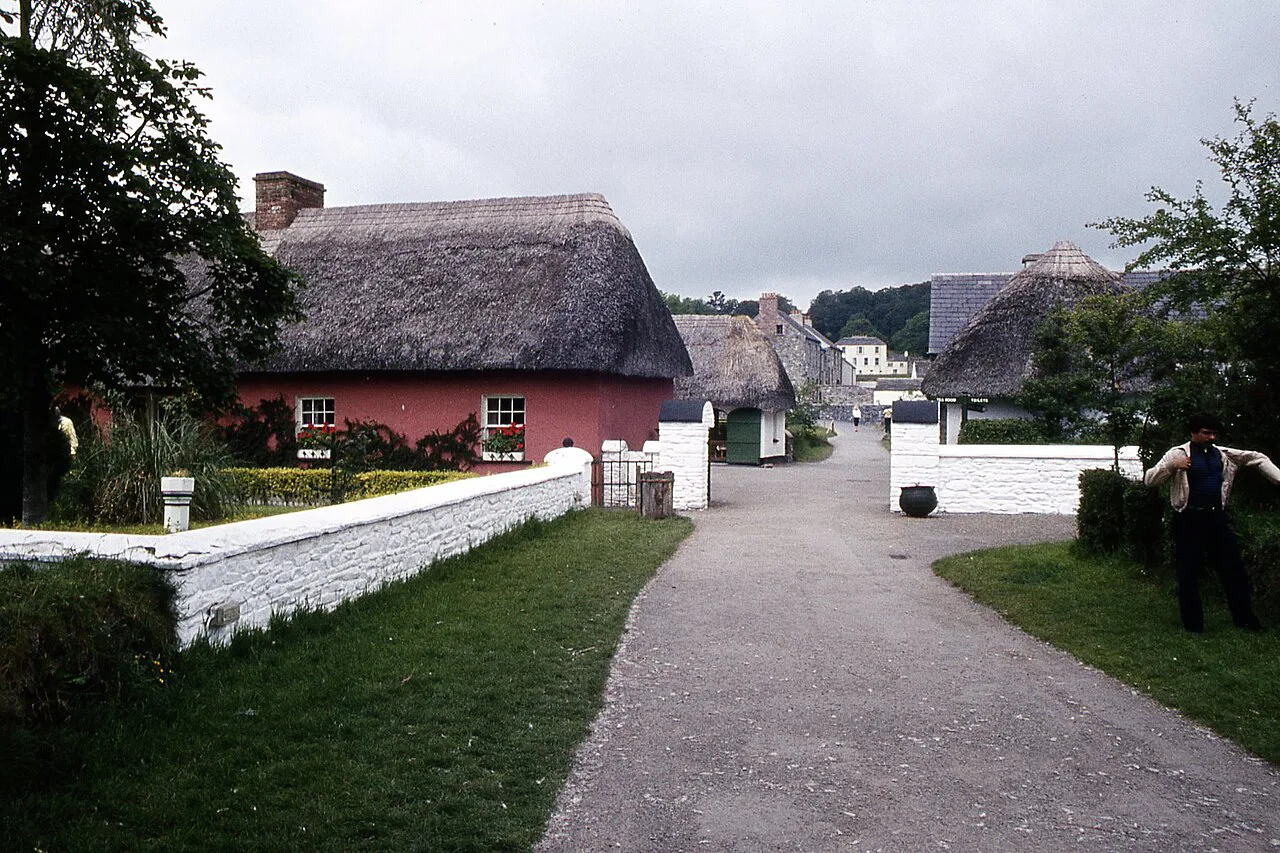
Bunratty Folk Park is a 26-acre open-air museum rather than an extension of the castle interior, and Visit Clare presents it as part of the same combined attraction. Its recreated village street includes a school, doctor's house, pawnbrokers, pub, drapery, printworks, grocery, hardware shop, pottery and post office, with village characters reflecting what life would have been like in the early 1900s. Farmhouses represent a range of early 20th-century building types, from landowners' residences to single-room labourers' dwellings, and native breeds on site include Irish red deer, Connemara ponies, pigs and goats.
There is also an interactive Fairy Trail in the upper part of the park, a Viking-themed playground, and a regency walled garden where heritage plants are grown. A third-party listing says the walled garden survives from the original demesne and served as the house's kitchen garden; treat its claimed 1804 origin and size as promotional detail rather than confirmed fact. None of this is folklore presented as history: the fairy material is a children's attraction, while the buildings and garden are the historical substance.
Banquets and Bunratty House
Tourism Ireland describes a long-running medieval banquet in the Great Hall with costumed performers, harp and fiddle music, and mead and roast meats, presented as a theatrical treatment of Gaelic hospitality; that feature is a dated anniversary piece, so treat banquet details as illustrative rather than current. The same feature names Bunratty House, a Georgian manor built in 1804 by the Studdert family, and notes that many Folk Park buildings were relocated from Clare and Limerick. These are useful markers of what the park is: partly reconstructed, partly moved, and openly presented as such.
Do not assume any event is running on the strength of an old announcement. That tourism feature was written around a 2025 anniversary programme that included a medieval tournament, and that framing has passed; check the operator's own listings for what is actually scheduled during your dates. Banquet frequency, menus and booking requirements are likewise matters for the operator rather than for an archived article.
Who Manages What, and Why It Affects Your Visit
Bunratty is a National Monument in state guardianship, yet the visitor experience is explicitly not OPW-managed, and OPW Heritage Cards are not accepted there. If you hold a Heritage Card and are touring state sites, budget separately for Bunratty rather than assuming it is included, and do not read the card exclusion as evidence that the interior is bare or uncurated. The distinction is managerial, not a comment on the quality of the collection.
Heritage Ireland places Bunratty on its list of unguided sites, so plan on exploring under your own direction using the interpretation provided on site. Some third-party pages mention guided tours, but that is not the operator's own statement and scheduling may change, so ask at the entrance if a guided option matters to you. The operator publishes current opening hours, admission prices and last entry on its own site; confirm them there before you travel.
Practical Orientation and Time Trade-offs
Bunratty sits in south County Clare near the Shannon Estuary, a location that makes the castle a natural stop for travellers touring Clare and the wider Munster region. Because the castle and the 26-acre park are sold and experienced as one attraction, the realistic question is not whether to see both but how long to give each. A rushed castle-only stop leaves the village street, farmhouses and garden unseen, while a full half day lets you climb the tower and still walk the park without hurrying.
Accessibility is stated only in limited terms: Visit Clare describes the attraction as partially wheelchair accessible with accessible toilets. That does not promise step-free access inside the tower house, so visitors with mobility needs should confirm the specific rooms and routes available. If a furnished castle interior is a priority, the guide to Blarney Castle in County Cork offers a further comparison point for planning a castle day.
Nearby Context in the Same Tradition
Bunratty belongs to a wider group of Irish towers and keeps that reward comparison: some are bare ruins in fields, others are furnished and interpreted, and the experience differs sharply between them. Heritage Ireland's own nearby-site list for Bunratty includes Adare Castle, Askeaton Castle, Ennis Friary, Lough Gur Visitor Centre and Lakeshore Park, Desmond Castle Newcastlewest, and Scattery Island Monastic Site and Visitor Centre, which makes a Clare-and-Limerick loop feasible for travellers with a car and an interest in layered sites. If you want to see how much variety that group contains, the guide to ancient sites in Ireland covers the prehistoric and early Christian monuments that often sit close to these castles.
For separate castle guides, read about Donegal Castle and Ross Castle. Their pages provide the historical and visitor information for those places. Keep each stop distinct when planning: the descriptions here concern Bunratty and its Folk Park, rather than establishing what another castle offers.
Plan Your Visit
Bunratty Castle rewards visitors who arrive knowing what they are seeing: a 15th-century tower house holding earlier fabric, remodelled by the Studderts and then rebuilt and furnished by Viscount Gort's mid-20th-century restoration. The Folk Park adds a separate, open-air dimension covering 19th- and early 20th-century rural life. Book or check directly with the operator for current hours, admission, banquet availability and accessibility, and treat anniversary-year material as historical context rather than current programming.
For more heritage reading, see our guides to Roscommon Castle, Cloughoughter Castle, and Ferns Castle. For another heritage guide, read about Knappogue Castle.
Frequently Asked Questions
Is Bunratty Castle original or restored?
It is a genuine medieval structure that has been substantially restored. Heritage Ireland records a 15th-century tower house built for Maccon MacNamara that incorporates earlier 13th- and 14th-century fabric, followed by Studdert-era remodelling, a 1915 transfer to the Board of Works, and a restoration after Viscount Gort's purchase in 1953 and 1954. Most later additions were removed and period fireplaces, panelling and stained glass were inserted, so the interior you see reflects that mid-20th-century campaign.
Are the furnishings inside Bunratty Castle original to the building?
Treat them as an assembled collection rather than as furniture that stood there in the Middle Ages. The Gort restoration inserted fireplaces, wood panelling, furniture and 100 panels of stained and heraldic glass to evoke the castle's earlier use. Descriptions of the collection's size vary between sources, so ask on site if a particular object or room matters to you.
Is Bunratty Castle managed by the OPW?
It is a National Monument in state guardianship, but Heritage Ireland states that the visitor service is not managed by the OPW, and lists Bunratty among its unguided sites. That means you explore under your own direction using on-site interpretation, and practical arrangements such as opening hours and admission are set by the operator rather than by the OPW.
Is the OPW Heritage Card accepted at Bunratty Castle?
No. Heritage Ireland states that OPW Heritage Cards are not accepted at Bunratty because the visitor experience is not OPW-managed. If you are touring state sites with a card, plan to pay separately here and check the operator's current admission terms before you go.
What is the difference between Bunratty Castle and Bunratty Folk Park?
The castle is a restored tower house with furnished rooms, heraldic glass and views over the Shannon Estuary. The Folk Park is a 26-acre open-air museum beside it, with a recreated early 20th-century village street, farmhouses of different social levels, native animals, a walled garden, a fairy trail and a playground. Visit Clare presents them as one combined attraction, so allow time for both.
How much time should I allow at Bunratty Castle and Folk Park?
The operator does not publish a recommended visiting duration. The tower house involves stairs and several floors, and the park covers 26 acres with a village street, farmhouses, a walled garden and animal enclosures. A half day suits most independent visitors who want both; a short stop will only cover part of the site. Check the operator's own site for current opening times before you plan a schedule.
Is Bunratty Castle wheelchair accessible?
Visit Clare describes the attraction as partially wheelchair accessible with accessible toilets, but does not address the castle's stairs or upper levels. Because tower houses have narrow spiral steps, confirm with the operator which interiors can be reached before booking, and plan to spend time in the park if the upper floors prove impractical.
Where is Bunratty Castle located?
It stands in south County Clare, close to the Shannon Estuary, within the castle-and-Folk-Park attraction of the same name. That makes it practical as a stop on a wider Clare or Munster itinerary, though no public transport arrangements are confirmed here, so organise your own onward travel.
Sources
You might also like



Continue reading
More guides you'll find useful



