
Roscommon Castle: A Closed Anglo-Norman Ruin in Roscommon Town
Roscommon Castle is currently listed as closed by Heritage Ireland. Learn its Anglo-Norman history, what the ruins show and how to plan around the closure.
On this page
Roscommon Castle is a ruined Anglo-Norman castle on the northern edge of Roscommon town, and Heritage Ireland currently lists the site as closed. That notice is the first thing to act on: check the operator's page before you travel, and plan on viewing the ruin rather than entering it. Admission is recorded as free, but free status does not override a closure or guarantee access to any part of the standing remains.
Why this castle matters
The castle's interest lies in where it was put as much as in what survives. The official account describes a royal castle planted beside Loch na nÉan, next to a crannóg that had served as a traditional Ó Conchobair power base, in a landscape already associated with myth and legend. Siting an Anglo-Norman stronghold on the doorstep of Connacht's ruling family was a deliberate statement, not a matter of convenient ground.
Legends attached to the lake include the burial of Fergus Mac Róich on its shores and a reputed entry to the Otherworld; these are traditions recorded in the official narrative, not documented events. Treat them as the cultural baggage that made the site politically charged. The same logic explains why Connacht was contested so late: the official page notes that it was among the last Irish kingdoms to fall under Anglo-Norman rule.
Current status and admission
The operator's page carries a Site Closed notice and records admission as free. Read those together rather than separately: free admission is the stated tariff, while closed is the stated operational position, and there is no reopening date published. Third-party guides that describe the castle as open to visitors predate this notice and should not be relied on for current access.
No visitor facilities at the castle itself are documented: no guides, tickets, café, toilets or shop appear in the official information. The practical consequence is simple. Build your day around confirmed bookings elsewhere in the county and treat the castle as a landscape feature to be seen from public ground, subject to whatever barriers or signage are in place when you arrive.
Getting there and getting your bearings
From Roscommon town, the official directions send you north from the square, onto Castle Street and then down Castle Lane, where parking is available; the castle is a short walk from there. By rail, Roscommon station is a little over twenty minutes on foot, with the Dublin Heuston to Westport and Ballina service calling at least three times a day in each direction through the week. For a broader survey of comparable Norman fortifications before you go, see our guide to medieval castles ireland.
Allow time to walk the outside of the walls rather than treating the stop as a quick photograph. Historic masonry, uneven ground and loose stone are normal at a ruin of this age, and a third-party account mentions ramps into the structure, which may or may not be in usable condition during the closure. Waterproof footwear is sensible in any season.
Reading the standing remains
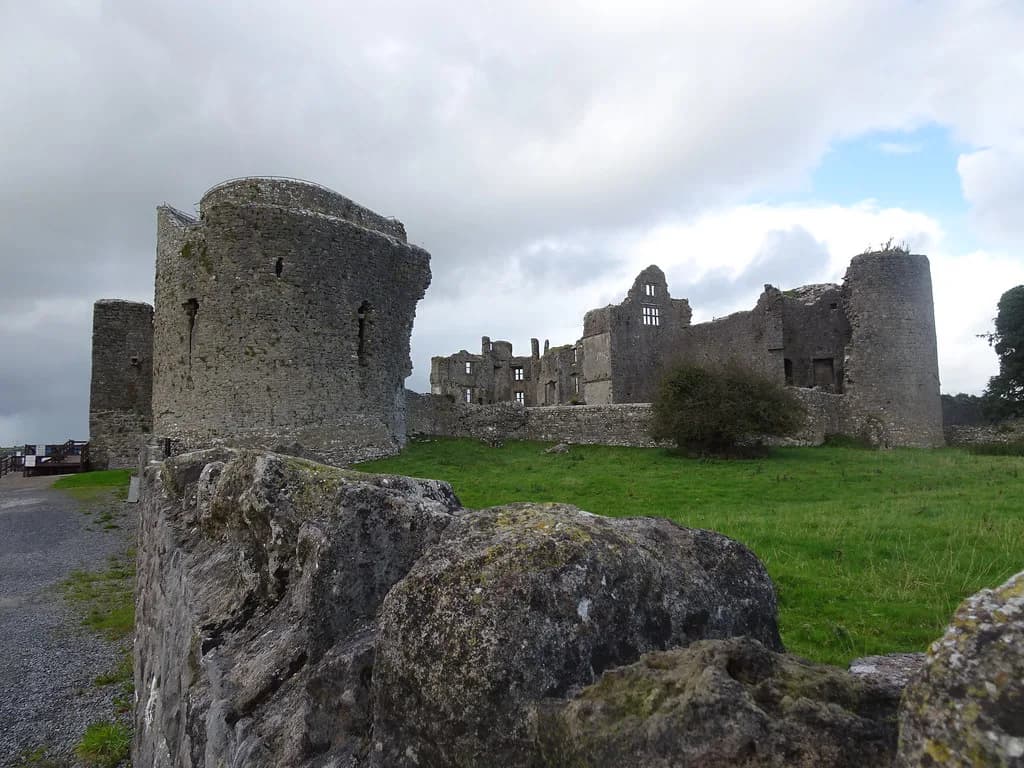
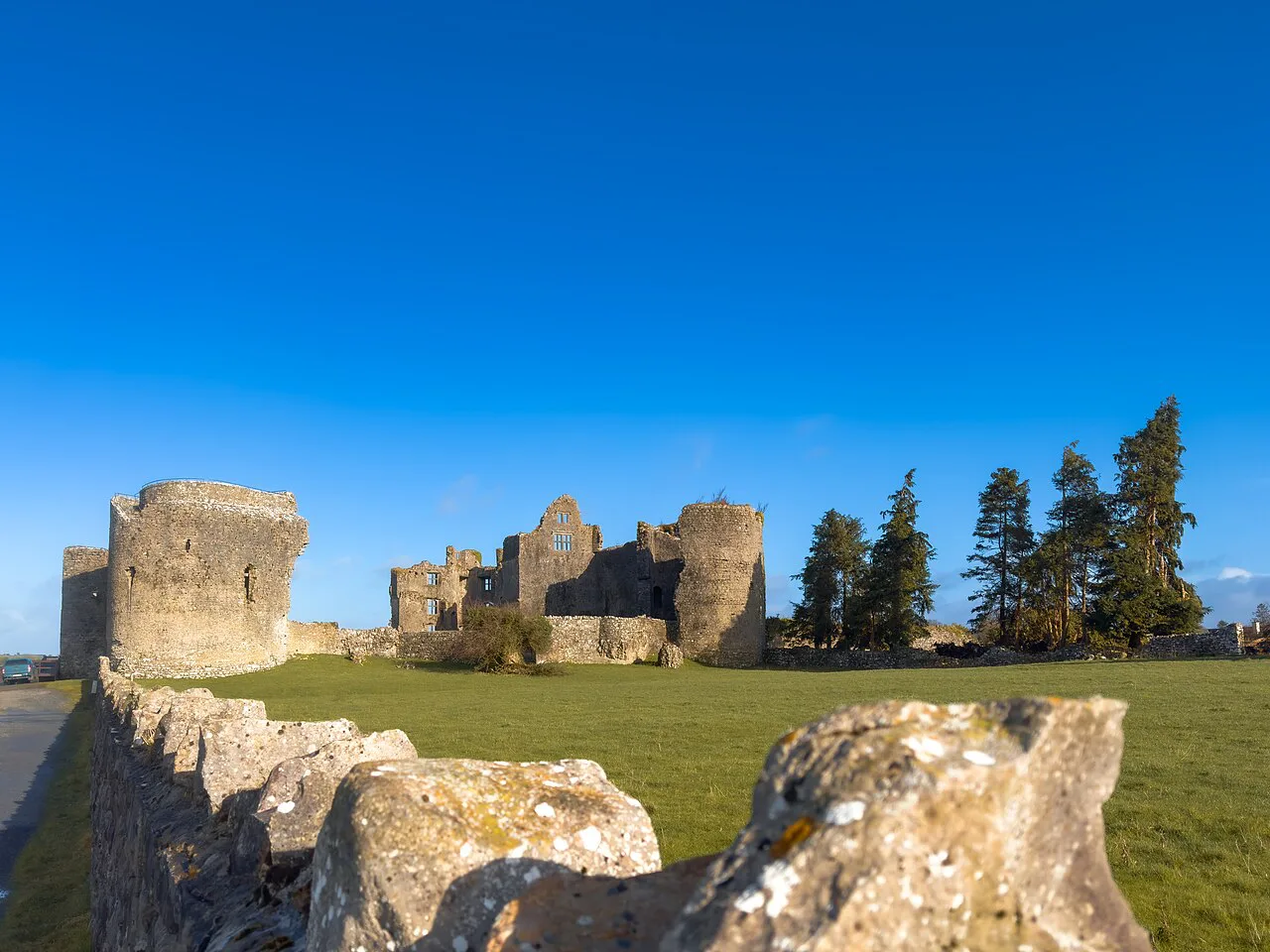
Third-party descriptions agree on the broad outline: a rectangular plan with round towers and prominent mullioned windows, its walls partly standing and partly collapsed. Those proportions are the quickest way to tell this apart from the smaller tower houses that dot the Irish countryside. If you want to compare structural types before or after your visit, our guide to Medieval Castles in Ireland sets out the main families of fortification.
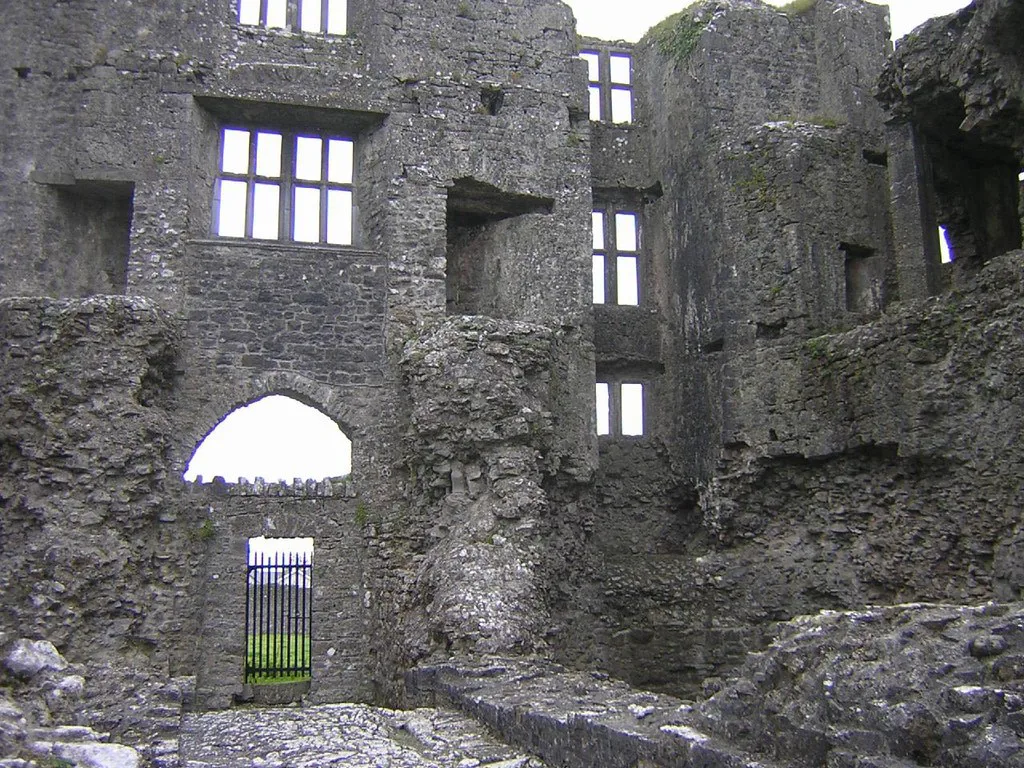
The large windows on the upper levels are the most legible surviving evidence of Sir Nicholas Malby's late sixteenth-century modernisation, visible especially in the north-east range according to Heritage Ireland. Malby also laid out a walled garden, fishponds and a tree-lined avenue toward the town, none of which survives as built form. Reading the windows as a Tudor comfort upgrade, rather than as original medieval fabric, changes how the ruin looks.
A contested castle: foundation, recovery and refit
Third-party guides date construction to 1269 and name the founder as de Ufford, spelled Robert in one and Roger in another; the variation is worth noting rather than smoothing over. The official account ties the siting to the Ó Conchobair crannóg on Loch na nÉan. Attacks by Aedh Ó Conchobair followed during and after the building work. By 1340 the O'Conors had taken possession and held the castle for nearly two centuries, an unusually long reversal for a royal plantation castle.
The O'Conor hold ended in 1569 when the castle was surrendered to the English, and in 1578 it was granted to Malby, who spent heavily on making it fit for a member of the Tudor elite. The building thus carries two identities in one shell: a thirteenth-century Anglo-Norman fortress and a sixteenth-century refurbished residence. Most of the visible openings belong to the second phase. For the wider urban story behind these phases, our Dublin heritage guide sets out the city's key sites chronologically.
From siege to ruin
Hugh O'Donnell besieged the castle during the Nine Years War in 1596 and again in 1599, and it was attacked once more during the Confederate Wars of the 1640s. Cromwellian forces seized it in 1652 and destroyed the fortifications; a fire in 1690 did further severe damage, and the building was left to decay through the following two centuries. That sequence, rather than any single blow, explains why the castle is a shell today.
Some local accounts give different years for the castle's fall, including a capture in the 1560s and a burning in the early 1690s. Where those conflict with the operator's chronology, follow the operator. Do not expect interpretation panels or a staffed presence to resolve the question on site; read up beforehand if the phases matter to you.
Beyond the castle: two bookable heritage sites
Rathcroghan Visitor Centre in Tulsk holds the museum for a landscape of more than 240 archaeological sites including Stone Age tombs, royal burial mounds and ringforts, and it is where the Queen Medb tradition is interpreted. It opens year-round Monday to Saturday from 09:00 to 17:00, with last museum admission at 16:30, and the operator suggests an average visit of about two and a half hours.
Guided tours at Rathcroghan run at 12:00 from September to April and at 12:00 and 14:00 from May to August, with Saturday tours by appointment only; the site tour requires weatherproof clothing and shoes for uneven terrain. Those details apply to Rathcroghan, not to Roscommon Castle. Book and confirm separately, because a confirmed tour at Tulsk does not imply anything about castle access.
Corlea Iron Age Roadway and Visitor Centre near Kenagh in County Longford preserves a togher built in 148 BC, with an 18-metre stretch of the wooden trackway displayed indoors; the operator lists Roscommon Castle at roughly 23.1 km away. For the 2026 season it runs from 14 March to 4 November, daily 10:00 to 18:00, with last admission and final tour at 17:00, and access is by guided tour only. Both Rathcroghan and Corlea fit naturally into a wider survey of ancient sites ireland, but each keeps its own hours and booking rules.
Practical cautions before you set out
Check the Heritage Ireland listing on the day you plan to go, and again if you are travelling any distance, since the closure is the only current status published. If the castle remains closed, the town stop becomes a brief exterior look at best; if what you want is guaranteed interior access and a staffed reception, plan that around a site with published opening hours instead. For context on comparable sites, see our Medieval Castles in Ireland guide.
Keep expectations proportionate to a monument without visitor infrastructure, and do not treat free admission as permission to climb walls, cross barriers or enter unstable spaces. Photographs taken from public ground are the realistic record of a visit under the current notice.
Roscommon Castle in Context
Roscommon Castle rewards preparation more than spontaneity. Its value is in the story the fabric carries: a royal castle set deliberately against the Ó Conchobair heartland, a two-century Irish recovery, a Tudor refit and a seventeenth-century destruction that left the shell you see. Read the official notice as the controlling fact and the third-party descriptions as background.
For further reading, explore our guides to bunratty castle, ross castle and Knappogue Castle. Each guide treats a separate site and its visitor arrangements. These links do not establish that another castle is open; confirm the arrangements for each place independently before making travel plans.
A contrasting stop on the same theme is Blarney Castle in County Cork, where the stone itself is the draw for visitors rather than a closed shell. That contrast tells you nothing about Roscommon's current status, so keep that question separate and settle it on the operator's page.
Explore more Ireland guides
Frequently Asked Questions
Is Roscommon Castle open to visitors?
Heritage Ireland currently lists the site as closed. No reopening date is published, so check the operator's listing immediately before travelling and do not rely on older travel articles that describe the castle as open.
How much does it cost to visit Roscommon Castle?
The operator records admission as free, but that tariff sits alongside a closure notice and is not an assurance of access. Check the official listing for the current position before you plan a stop.
How do I get to Roscommon Castle from the town or station?
From the town square, head north for Castle Street and turn down Castle Lane, where parking is available and the castle is a short walk away. Roscommon station is a little over twenty minutes on foot, served by the Dublin Heuston to Westport and Ballina line at least three times daily in each direction.
What survives of Roscommon Castle today?
Standing and collapsed walls, round towers and large mullioned windows on a rectangular plan. The windows, especially in the north-east range, record Sir Nicholas Malby's late sixteenth-century modernisation; the walled garden, fishponds and avenue he laid out do not survive as built features.
Who built Roscommon Castle and when?
Construction is dated to 1269 and attributed to de Ufford, spelled Robert in one guide and Roger in another. The castle was attacked during its early years by Aedh Ó Conchobair and was taken by the O'Conors in 1340.
Why was the castle built beside Loch na nÉan?
The site bordered a crannóg used as a traditional Ó Conchobair power base in a landscape already carrying myth and legend. Placing an Anglo-Norman royal castle there was a symbolic assertion of authority over Connacht's ruling family, not simply a choice of defensible ground.
What else can I visit near Roscommon Castle?
Rathcroghan Visitor Centre at Tulsk and Corlea Iron Age Roadway near Kenagh in County Longford are separately operated sites with their own hours and booking rules. Rathcroghan opens Monday to Saturday year-round, and Corlea's 2026 season runs 14 March to 4 November with guided-tour-only access, so confirm each directly.
Sources
You might also like



Continue reading
More guides you'll find useful



