
Carrigaholt Castle: A MacMahon Tower House on the Shannon
Carrigaholt Castle is a 15th-century MacMahon tower house in County Clare. It can be viewed from outside only, as internal access is not permitted.
On this page
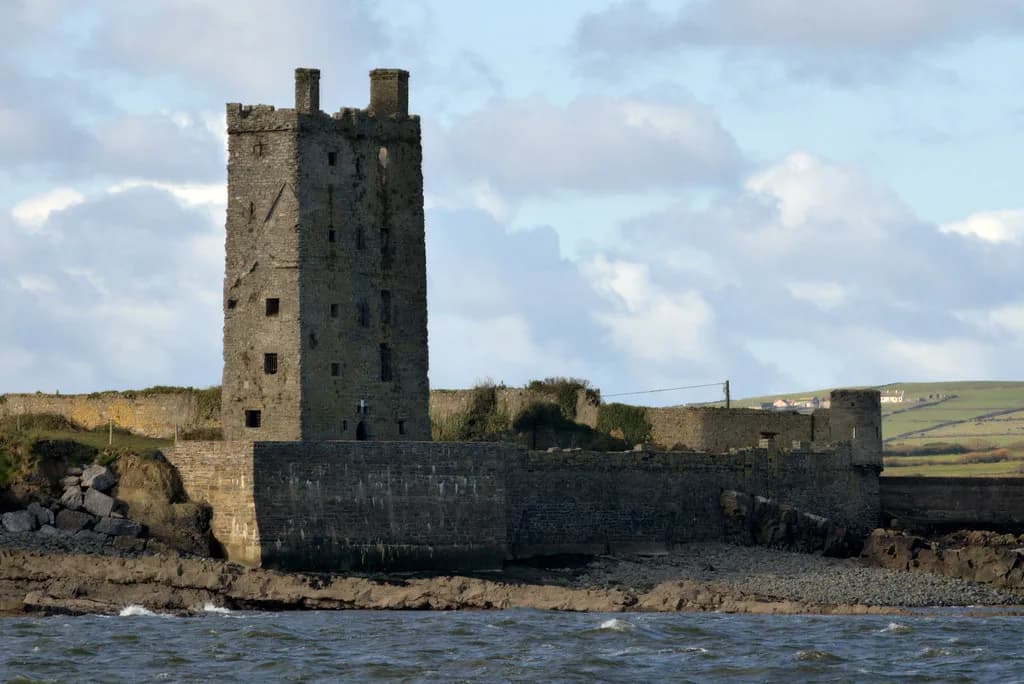
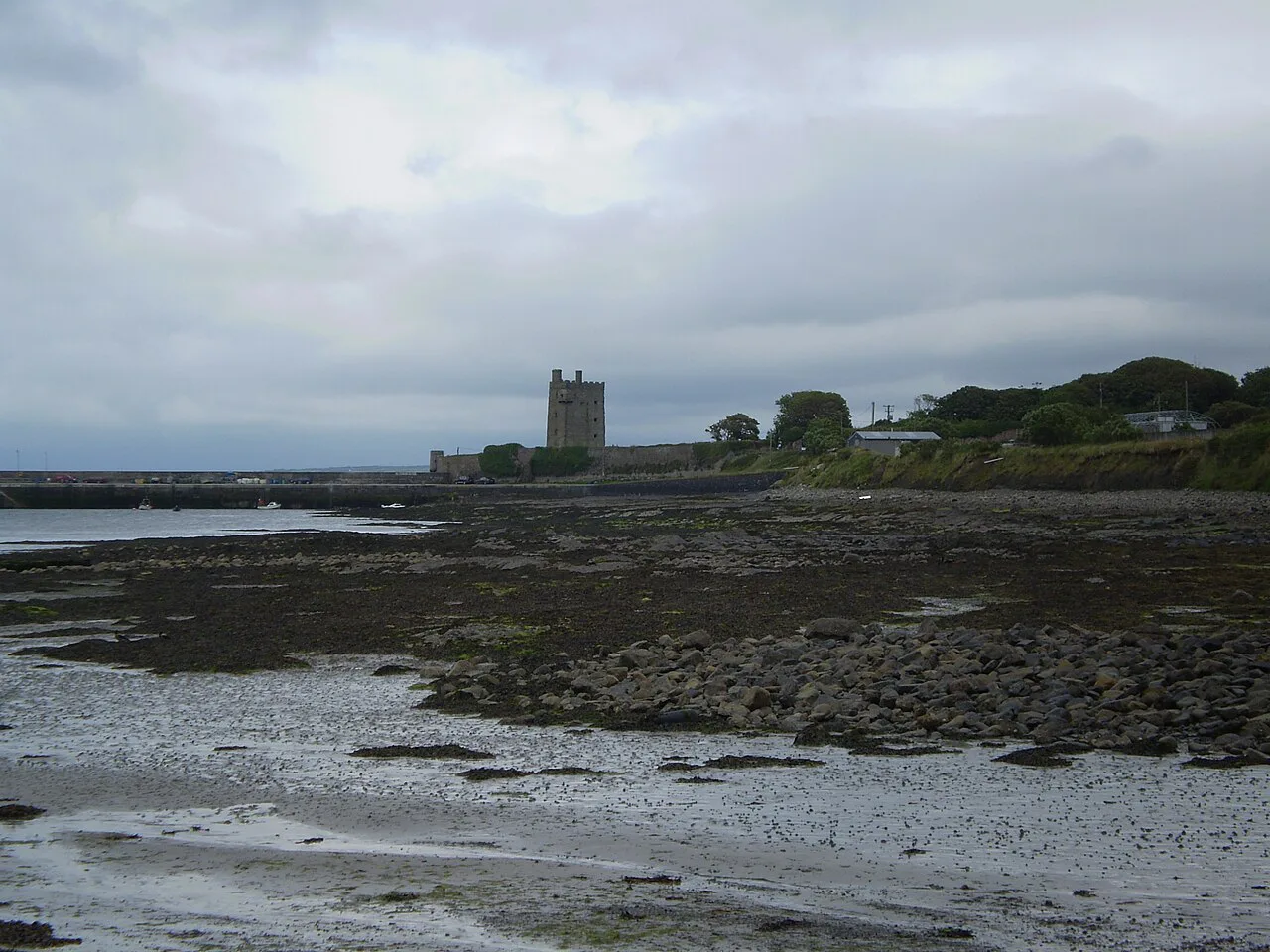
Carrigaholt Castle is a five-storey tower house standing above the River Shannon and Carrigaholt Bay on the Loop Head Peninsula in County Clare. It is a National Monument in state guardianship, and the essential planning fact is simple: it is for external viewing only, with internal access not permitted.
That limit shapes the whole visit. You are not planning a tower climb or a look at the fireplace inscription; you are planning a short stop to read a fortified MacMahon residence from the ground, with the bawn and sea wall framing the view.
Access and Status Today
The guardian of the site, the Office of Public Works, lists Carrigaholt Castle as a National Monument in state guardianship and states plainly that it is for external viewing only, with internal access not permitted. The same notice treats it as an unguided site and asks visitors to take care while they are there.
No opening hours, admission charges, guided tours or visitor facilities are published for the castle, so do not build an itinerary around any of them. Where those details matter to your plan, check the Heritage Ireland page again close to your trip rather than relying on secondhand summaries.
Treat the stop as a viewpoint rather than a full attraction. The reward is the building's outline and its setting on the estuary, and the honest trade-off is that you will not see the vaulted floors or the inscribed fireplace at close range. If you are weighing this against older monuments elsewhere on the island, our guide to ancient sites ireland covers tombs, forts and trackways where the access is different again.
Reading the Exterior
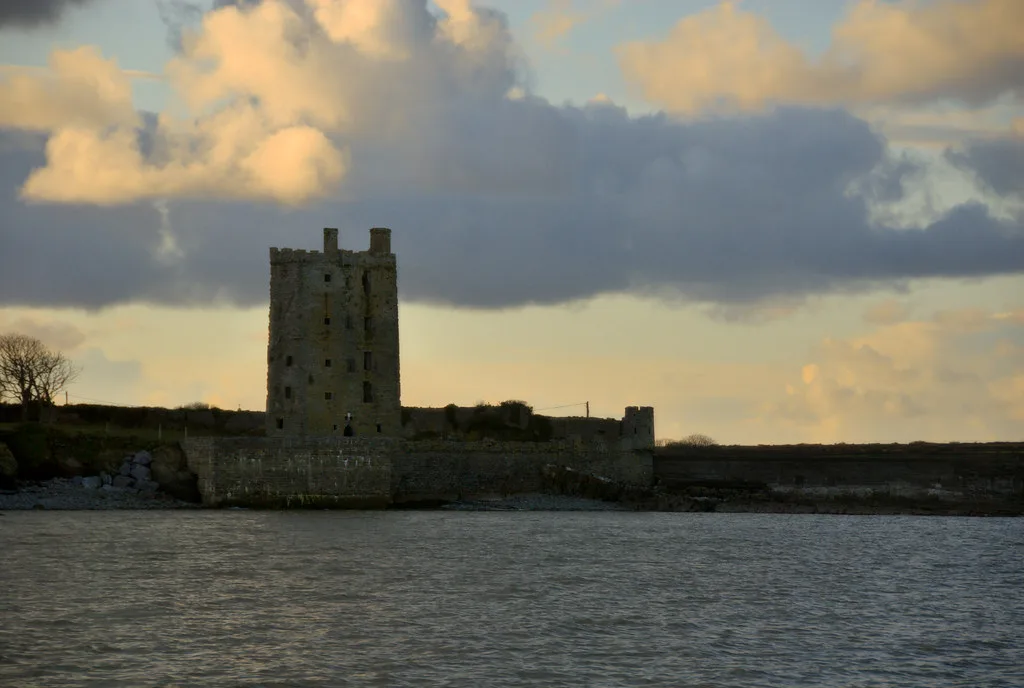
The recorded description is worth carrying with you, because from outside it explains what the mass of stone is doing. The tower rises five storeys in the south-west corner of an enclosing bawn, built of local flagstone and limestone, with a base batter that widens the wall foot and a central pointed doorway in the east wall as the main entrance.
Above that entrance the guardian records a murder-hole, with gun-loops and a bartizan covering the approach. These are defensive features concentrated on the door side, so the east wall is the face to study first when you walk the exterior.
The same record notes that later occupation left its mark in the fabric: alterations made with red brick up to the 19th century show where the building was adapted rather than simply abandoned. Look for the contrast in the masonry as a way of reading those phases without entering.
What Lies Inside, as Recorded
The interior is described by the guardian, not shown to visitors. Twin-light windows and narrow slits light the floors, the ground and third floors have vaulted ceilings, and the other floors are carried on corbels.
The fourth-floor limestone fireplace carries the only inscription recorded within the estate, reading D.B. 1603, which is read as Daniel O'Brien, brother of the 4th Earl of Thomond, who took control of the tower house in the very early 17th century. Treat this as archival description: the fireplace is not something a visitor can inspect from the permitted exterior position.
MacMahon Origins
Heritage Ireland identifies the castle as the former fortified residence of the Mac Mahons, chiefs of West Corkavaskin, dated to the 15th century. That is the authoritative framing for the building's origin.
A narrower building date is reported rather than official. Local newspaper the Clare Echo describes the castle as built around 1480 by the MacMahons, whom it presents as the last Gaelic chieftains to rule West Corca Baiscinn, the area now known as the peninsula, and it identifies Tadhg as the last of the MacMahons, banished at the end of the Tudor period.
Read those two accounts together rather than choosing one. The guardian's 15th-century dating is the safe baseline, while the around-1480 figure and Tadhg's fate belong to the newspaper's account of local history.
A Change of Hands
Ownership moved from the MacMahons to the O'Briens, and the Clare Echo records that Cromwell's forces took the castle in 1651, with the O'Briens reinstated after the Restoration of the monarchy in 1660. The same report says the O'Briens left for France in the Flight of the Wild Geese, and records that the estate was granted to the Earl of Albermarle in 1697 and quickly sold.
These dates come from journalism drawing on local authority and councillor statements rather than from the official monument record, which is why they are attributed here. What they give a visitor is a sequence: a Gaelic tower house, a contested mid-17th century, and a new ownership regime at the end of that century.
The Burton Era and After
The Burton family then held the castle, living there until the late 19th century, and Richard Burton was the last of the family to reside in it. Around 1919 the estate was sold to the McGrath family, a later chapter distinct from the Burton period.
Keeping those two periods separate matters because the red-brick alterations in the walls belong to occupation up to the 19th century, not to the 1919 sale. The building you see is the cumulative result of long domestic use, not a single medieval shell.
Proposals, Not Present Facilities
Local discussion about the castle's future should not be mistaken for visitor provision. The Clare Echo reports that Clare County Council was requested to include a newly created access path into the castle under its insurance policy, that an engineering inspection would follow, and that councillors described the site as a potential heritage project for West Clare.
None of that establishes a confirmed facility, a reopening or any interior access, and no completion date is given. Plan on the published position, which remains external viewing only, and treat the path and project talk as reported aspiration. If you want a western castle where published access details are settled, our guide to castles in county galway covers several tower houses you can still walk through.
Fitting Carrigaholt into a Loop Head Drive
The castle sits in the Loop Head Peninsula, a landmark on the Shannon Estuary rather than a room-by-room museum stop. Budget a short exterior pause and spend the rest of the day on the wider estuary landscape that gives the tower its setting. From the peninsula you can follow a coastal route along the estuary toward the medieval castles ireland overview, which sorts fortified sites by the access each one allows.
If you are comparing Irish tower houses and want interiors you can actually enter, plan those separately. Our guide to medieval castles ireland sorts the country's fortified sites by what each one allows, so you can balance an exterior-only stop like Carrigaholt against sites with internal access.
For contrast, the Blarney Castle page covers a very different visitor experience built around a single famous stone, and our guide to castles in county galway sets out several western tower houses you can still walk through. Bunratty Castle is also in County Clare, so if you want an enterable castle in the same county, research it on its own terms before committing a day.
Plan Your Visit
Carrigaholt Castle rewards a short, well-informed stop: a five-storey MacMahon tower house at the south-west corner of its bawn, read from outside with the guardian's description in hand. Internal access is not permitted, so no tower climb, vaulted chamber or fireplace view belongs in your plan.
Before setting out, re-check the official page for any change in status and take the unguided-site caution seriously. For a broader itinerary through comparable sites, our medieval castles overview helps you place an exterior-only monument in a realistic day alongside sites you can actually enter.
For another heritage guide from the same medieval castles series, read about Ross Castle. For another heritage guide, read about Knappogue Castle. For another heritage guide, read about Athlone Castle.
Explore more Ireland guides
Frequently Asked Questions
Can you go inside Carrigaholt Castle?
No. The castle is a National Monument in state guardianship and the Office of Public Works states that it is for external viewing only, with internal access not permitted. It is also an unguided site, so visitors should take care while viewing the exterior.
What kind of building is Carrigaholt Castle?
It is a five-storey tower house of local flagstone and limestone, set in the south-west corner of an enclosing bawn with a sea wall. It was the fortified residence of the Mac Mahons, chiefs of West Corkavaskin, and is dated to the 15th century in the official record.
Who built Carrigaholt Castle and when?
The official record identifies it as the MacMahon stronghold, dated to the 15th century. A local newspaper report gives a narrower date of around 1480 under the MacMahons, last Gaelic chieftains to rule the area now known as the Loop Head Peninsula; treat that figure as reported rather than official.
What does the D.B. 1603 inscription refer to?
The inscription appears on the fourth-floor limestone fireplace and is the only one recorded within the estate. It is read as Daniel O'Brien, brother of the 4th Earl of Thomond, who took control of the tower house in the very early 17th century. Visitors cannot inspect the fireplace, since internal access is not permitted.
Who held Carrigaholt Castle before state guardianship?
After the MacMahons it passed to the O'Briens, who were reinstated after the Restoration of 1660 following Cromwell's capture of the castle in 1651. The Burton family lived there until the late 19th century, Richard Burton being the last resident, and the estate was sold to the McGrath family around 1919.
Is there an access path or heritage project at Carrigaholt Castle?
There has been local discussion of a path and of the castle as a heritage project, including a council request that a newly created access path be covered by the council's insurance policy and a forthcoming engineering inspection. No confirmed facility, reopening or interior access follows from that, so plan on external viewing only.
How long does a visit take?
Expect a short stop. The castle is viewed from outside, the official record lists no tours, hours or facilities, and the visit is essentially about reading the tower, bawn and sea wall in their estuary setting before continuing along the Loop Head Peninsula.
Sources
You might also like



Continue reading
More guides you'll find useful



