
Carlingford Castle: Norman Stronghold Above the Lough
Carlingford Castle anchors a medieval town of narrow lanes and surviving merchant houses. Here is how to see the Norman ruin and the sites around it on foot.
On this page
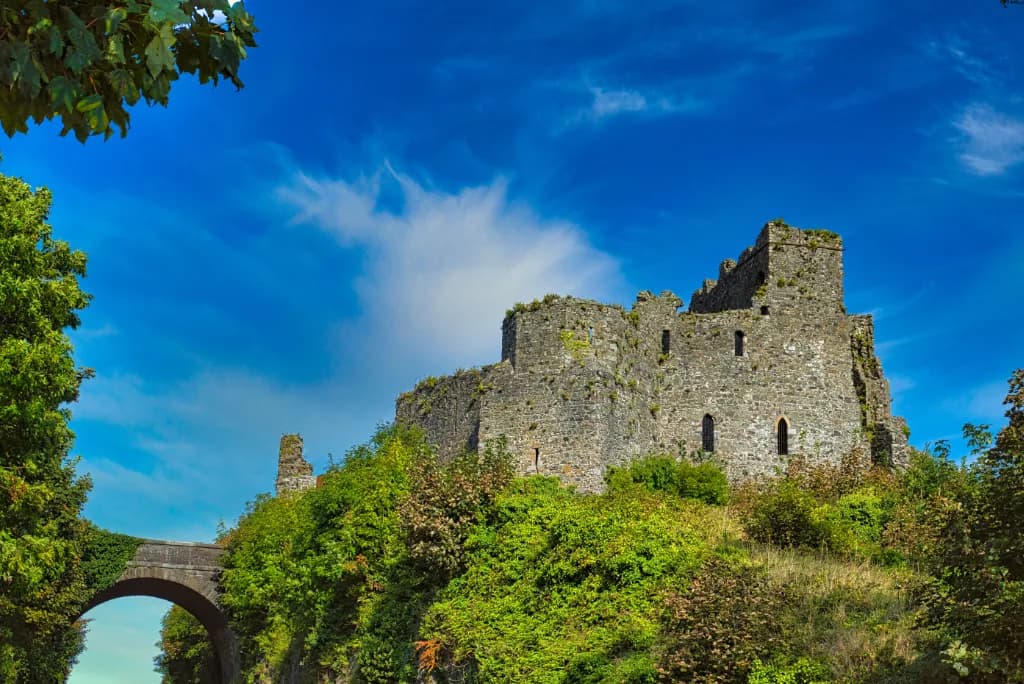
Carlingford Castle is the Norman monument that gives the town of Carlingford its shape: a ruined stronghold on a rocky outcrop above the lough harbour, with the mountain of Slieve Foy rising behind the streets. Heritage Ireland describes it as commanding the town and watching over the harbour, which is the right way to begin, because the castle explains why a settlement grew in this narrow place at all.
It is best treated as the opening stop on a walk rather than an isolated sight. Around the castle, Carlingford keeps a genuine medieval fabric of gate, merchant houses and friary ruins, and those remains are close enough together to read in a single morning. If you want the wider context of similar sites, the guide to medieval castles ireland helps place a Norman enclosure like this beside later tower houses and fortified mansions.
Where the Castle Stands
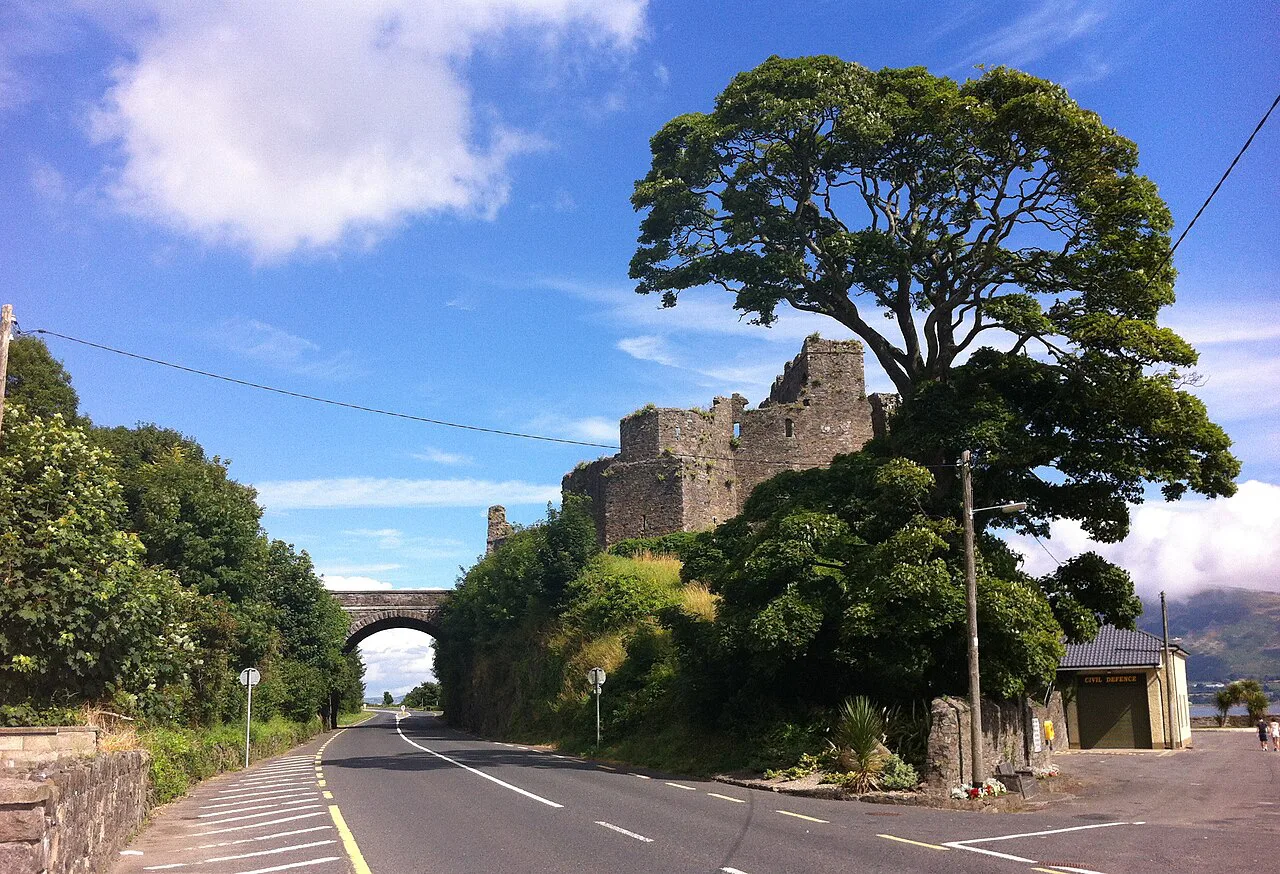
The castle occupies a rocky outcrop overlooking Carlingford Lough, in the medieval town of Carlingford on the Cooley Peninsula in County Louth. Heritage Ireland notes that it dominates the town and looks out over the lough harbour, and that Carlingford itself sits in the shadow of Slieve Foy, the mountain that, in legend, takes its name from the sleeping giant Finn MacCumhaill. The legend is worth knowing as a legend, not as history.
That position is the practical reason to start here: standing at the castle base, you can see the harbour below, the Mourne Mountains across the water and the hilly core of the town behind you. It gives you a mental map before you walk into the lanes. A third-party route page describes the site as a D-shaped enclosure castle on its low rocky rise, which is a useful way to picture the footprint while you are looking at it; the same page reports that the interior cannot be entered at present.
Origins Around 1190
Heritage Ireland dates the castle to around 1190 and attributes it most likely to the Norman baron Hugh de Lacy, so the builder is probable rather than certain. That wording matters: the site is a Norman foundation of the late twelfth century, not a documented single-handed commission. By this period Hugh's family had grown powerful enough to unsettle King John of England, which is the political background to everything that followed.
The castle's history is therefore a story about lordship and royal suspicion rather than about architecture alone. When you look at the surviving walls, you are looking at a frontier statement by a family whose local strength eventually drew the crown's attention. Across Ireland, that pattern of Norman ambition and royal response recurs, which is why the wider survey of medieval castles is a useful companion to this one site.
King John and the Seizure of 1210
In 1210 King John forced the de Lacys into rebellion and seized their property, and Heritage Ireland records the tradition that he then stayed in the castle himself. Treat the stay as a reported tradition rather than a documented itinerary. What the source does establish is the seizure, which transferred a powerful Norman stronghold into royal hands and changed the castle's standing.
The royal association is a way into the castle’s history, but it should not blur the distinction between the reported visit and the documented seizure of property. Keep those two claims separate when interpreting the site. The surviving building has a longer history than any one royal episode.
Jacobites, Williamites and Later Conflict
The castle saw later military use in far different circumstances. Heritage Ireland notes that the Jacobites fired on it in 1689, and that William of Orange is said to have accommodated wounded soldiers there after the Battle of the Boyne. Both statements are reported traditions about the castle's seventeenth-century role, and both are worth repeating with that caution attached.
By this stage the castle was an old structure being reused in a new war, which is a common fate for Irish fortifications. The contrast with a castle built as a residence in the same centuries is instructive, and donegal castle offers a useful comparison for anyone tracing how Irish strongholds shifted from defence toward domestic comfort.
What You Can See Today
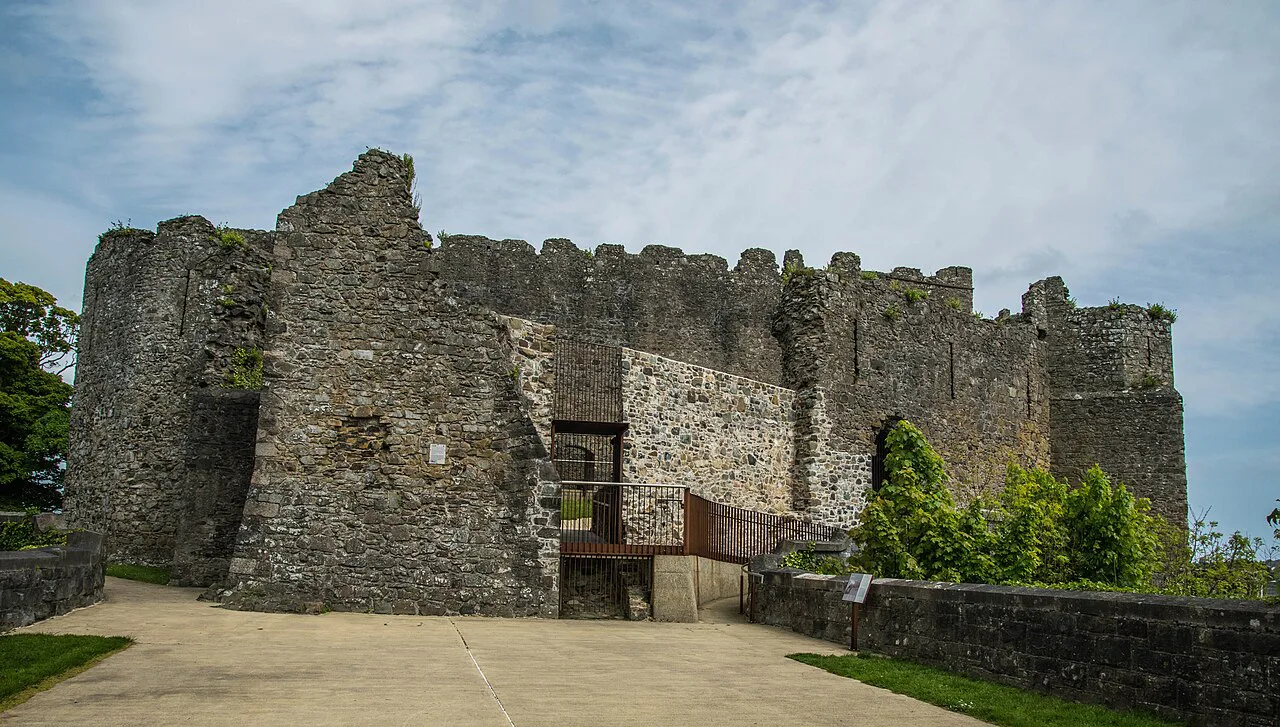
A third-party outdoor route page reports that the castle interior is currently closed to visitors because of falling-masonry safety concerns, while the exterior perimeter can still be walked. That is not an official dated notice, so treat it as the reported situation and confirm before you travel. What the same description makes clear is that the exterior circuit is short, and that the real value of the stop is the setting: the scale of the walls, the harbour below and the crossing views to the Mournes.
That makes Carlingford Castle a place to read with your eyes rather than a monument to tour room by room. Give it time at the base and along the harbour path, then move into the town, where the surviving medieval buildings carry the visit. A comparison with ross castle on Lough Leane shows how differently Irish castles can present themselves when interiors and lakeside settings are part of the experience.
Booking, Tickets and the Heritage Card
Heritage Ireland directs bookings to Carlingford Heritage Centre by phone or email, and notes that tickets can also be bought near the site at the Visit Carlingford Tourist Office in Station House. It also states that OPW Heritage Cards are not accepted at Carlingford Castle, because the visitor service is not OPW-managed. Pass holders should plan accordingly rather than assume the card covers this stop.
Admission runs through that booking and ticket pathway, and the official page does not publish a fixed price or a standard daily schedule in the material available here. Check directly with the heritage centre for current arrangements. Visitors used to OPW-run sites such as ferns castle, where Heritage Ireland publishes the visitor information, will notice that Carlingford works differently.
Guided Tours From March to October
The official page states that Carlingford Lough Heritage Trust provides guided tours of the castle from March to October, and that additional tours may be available on enquiry through the heritage centre. That is the tour operator's season, so a visit outside those months should not be assumed to include a guided option. It also does not promise that a tour takes you inside the castle, given the separate report of an interior closure.
The sensible approach is to ask two separate questions when booking: whether a tour is running on your date, and what part of the site it covers. Asking both avoids arriving with the wrong expectation. Elsewhere in Ireland, guided access is often the only way into a monument, as at bunratty castle, but that is a different arrangement from the one described here.
Walking Into the Medieval Town
Carlingford retains much of its medieval character, with buildings from the thirteenth to the sixteenth century surviving in streets that Heritage Ireland describes as dark, hilly and narrow in places. Walking them is the point: the town reads as a sequence of structures rather than a single monument. Start at the castle and let the lanes pull you uphill and back down toward the harbour. For a similar town-scale reading of medieval fabric, our Museums in Galway City: Two Places Worth Your Time guide shows how a compact heritage stop can anchor a walk.
A good first stop is the Carlingford Heritage Centre, which holds an exhibition of historical records, maps and drawings on the town's past. The building itself began as a thirteenth-century structure, was extended repeatedly and served as a Church of Ireland church before a 1992 renovation turned it into a heritage and community venue. Seeing the maps before the streets makes the later walk far easier to follow.
The Tholsel and the Mint
The Tholsel is the only surviving town gate in Carlingford and one of the few of its type left in Ireland. Heritage Ireland places it within the fifteenth-century walls, where it collected tolls, and notes that in the eighteenth century it served as a place of detention. It is a compact reminder that a medieval town's defences were also its customs posts and its lock-up.
The Mint carries a misleading name. Carlingford gained the right to mint coinage in 1467, but Heritage Ireland judges it unlikely that the building was ever used for that purpose; the fifteenth- or sixteenth-century house was most likely a wealthy merchant family's residence. Its five limestone windows, carved with sixteenth-century patterns, are the detail to look for, since they show continental and Renaissance influence in a small Irish port town.
Taaffe's Castle and the Dominican Friary
Taaffe's Castle was built in two phases in the sixteenth century and belonged to the Taaffe family, who became earls of Carlingford in 1661. Heritage Ireland suggests that trade was conducted on the lower level while the family lived above, which fits the pattern of later Norman merchant houses in the town. Look for it as a piece of commercial architecture, not a purely military one.
The friary dedicated to St Malachy was established in Carlingford in 1305 and dissolved in 1540 under Henry VIII. Its ruins retain a nave and chancel divided by a tower, with a mill, mill race and mill pond to the south-east, and the site was finally abandoned in the eighteenth century when the Dominicans moved to Dundalk. Heritage Ireland lists it among the town's surviving remains; treat the ruins as a historic site seen from outside rather than an equipped visitor attraction, and check locally if you want to know whether any part is open.
Extending the Walk: Greenway and Hills
If you have more time, the Great Eastern Greenway runs for seven kilometres from Carlingford Marina along the line of the old railway to Omeath, skirting the lough beneath Slieve Foy with the Mourne Mountains across the water. Heritage Ireland describes it as suitable for all grades of walker, including families and novices, which makes it the natural extension of a castle and town visit.
For something more demanding, the Táin Way offers a challenging route across the Cooley Mountains with views toward Dundalk Bay and the Mournes, and Heritage Ireland describes the gentler Commons loop as climbing above the town to open mountainsides. Heritage Ireland warns specifically about narrow roads on the way out and back from the Commons loop, so take care with children on those stretches. Choose the greenway if time is short and treat the hill routes as separate outings that need a full day and suitable footwear.
Ireland's castles vary widely in how much of the original fabric survives and how much later building sits alongside it, and comparing a few sharpens your eye for what is genuinely Norman at Carlingford. A visit to blarney castle involves a much-altered tower house whose later reworking and grounds now shape the experience, which makes the bare, roofless shell above Carlingford Lough look strikingly austere by comparison. Read it as a contrast in survival and reuse rather than as a parallel foundation.
Planning a Half-Day Visit
A workable sequence is castle first, while the light and the harbour view are unobstructed, then the heritage centre for the maps, then the Tholsel, the Mint, Taaffe's Castle and the friary on foot, with the greenway as an optional stretch at the end. Allow more time than the castle alone requires, because the town is the main event and the walking is what ties it together.
Two things are worth confirming before you set out: the current tour arrangements and what part of the castle they include, and the reported interior closure. The heritage centre is the right place to ask both. Visitors who enjoy comparing medieval Irish towns will find further material in ancient sites ireland and in the castles of county galway, where town defences and later fortifications tell related stories.
For more heritage reading, see our guides to Roscommon Castle, Carlow Castle, and Cloughoughter Castle. For another heritage guide, read about Parkes Castle.
Explore more Ireland guides
Frequently Asked Questions
Can you go inside Carlingford Castle?
A third-party outdoor route page reports that the interior is closed to visitors because of falling-masonry safety concerns, while the exterior perimeter remains walkable. That report has not been matched by an official dated notice on the Heritage Ireland page, so confirm the position with Carlingford Heritage Centre before travelling. Do not assume that booking a guided tour includes entry to the interior.
Who built Carlingford Castle and when?
Heritage Ireland dates the castle to around 1190 and attributes it most likely to the Norman baron Hugh de Lacy. The builder is therefore presented as probable rather than certain, and the castle is best understood as a late twelfth-century Norman foundation tied to de Lacy family power in the region.
How do you book a visit or tour of Carlingford Castle?
Heritage Ireland directs bookings to Carlingford Heritage Centre by telephone or email, and notes that tickets can also be bought near the site at the Visit Carlingford Tourist Office in Station House. Carlingford Lough Heritage Trust guided tours are stated to run from March to October, with additional tours by enquiry. Ask whether the tour covers the interior or the exterior.
Is the OPW Heritage Card accepted at Carlingford Castle?
No. Heritage Ireland states that OPW Heritage Cards are not accepted at Carlingford Castle because the visitor service is not OPW-managed. Holders of the card should budget separately for this site and should not expect the usual card arrangements to apply.
What else is there to see in medieval Carlingford?
Within a short walk you can see the Tholsel, the only surviving town gate, the Mint with its decorated sixteenth-century limestone windows, Taaffe's Castle, built in two sixteenth-century phases, and the Dominican Friary dedicated to St Malachy, established in 1305. The Carlingford Heritage Centre adds maps, drawings and records that make sense of the streets.
How long does a walk around the castle and town take?
The exterior circuit of the castle is short, and the town's medieval monuments are close together, so a half day is a realistic allowance for the castle, the heritage centre and the main street monuments at an unhurried pace. Add extra time for the seven-kilometre Great Eastern Greenway or for a hill walk, which are separate outings rather than add-ons to a quick stop.
Sources
You might also like



Continue reading
More guides you'll find useful





