
Carlow Castle: A William Marshal Keep in Carlow Town
Carlow Castle is an unguided OPW national monument where the Barrow and Burren meet. See why only two towers and a wall survive of this Norman keep.
On this page
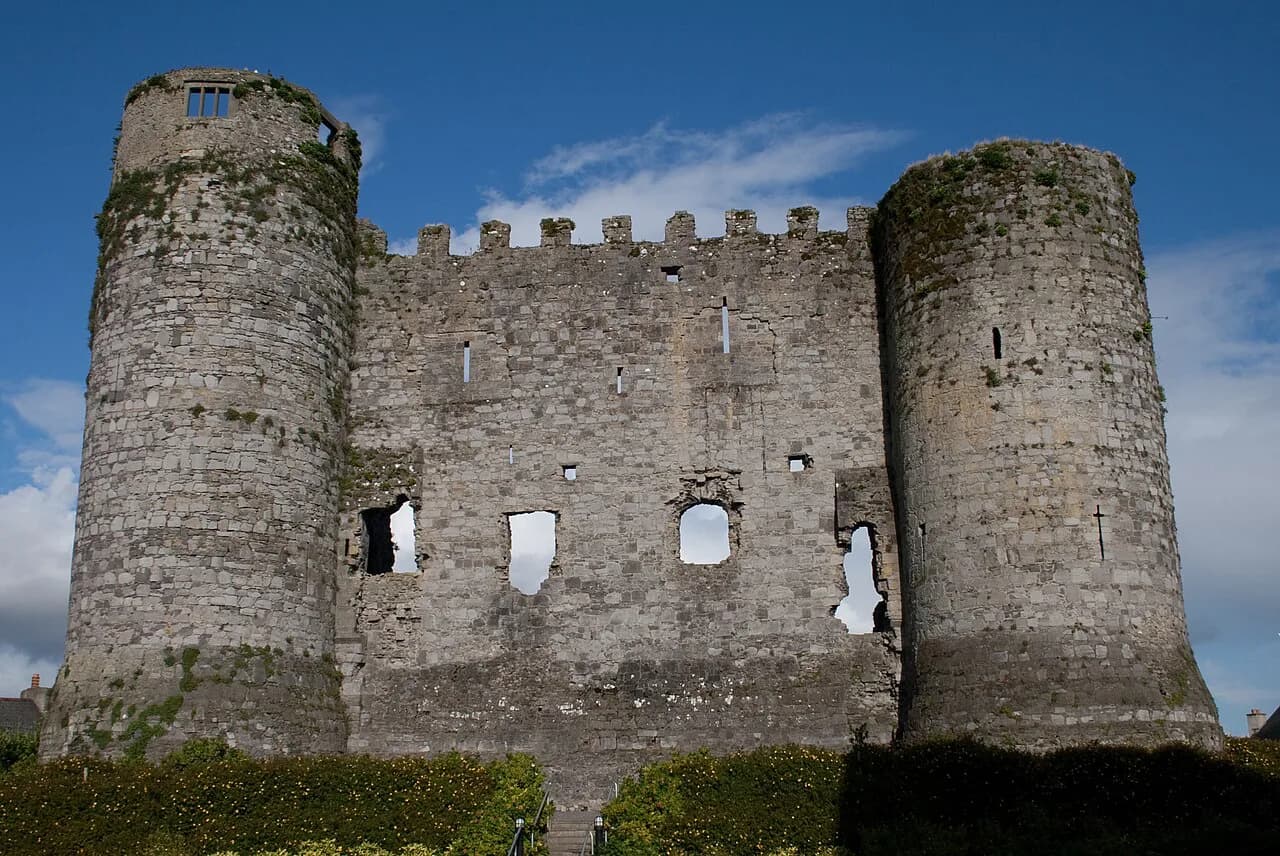
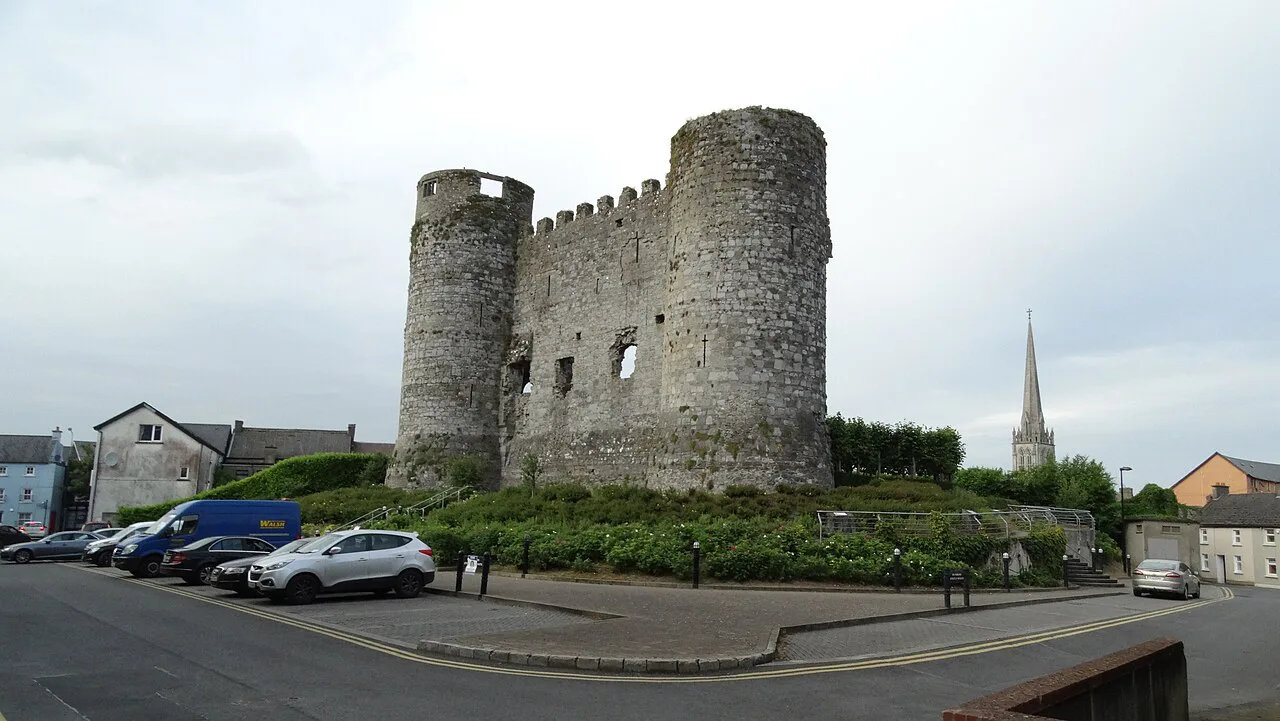
Carlow Castle is a state-owned National Monument in the care of the Office of Public Works, sitting at the meeting of the Rivers Barrow and Burren in Carlow town. What stands today is a fragment: two towers joined by an intervening wall, the rest lost after an explosion in the early nineteenth century.
The official page classifies the monument as an unguided site, which shapes how you should plan. It describes no staffed reception, and the OPW asks visitors to maintain care and caution at all stages of a visit. Treat it as a short outdoor stop and check the official page for current arrangements before travelling.
Setting and Origins: A Hill Above Two Rivers
The castle occupies an artificially flattened rocky hill where the Burren flows into the Barrow, a position that gave it water on three sides. To the east, a bog known as Moneen is reported to have restricted the remaining approach.
The OPW states that the stone castle replaced an earlier Norman earthwork fortification on the same ground, but does not name its builder. The independent site links that earlier phase to John de Clahull, a knight granted Carlow lands, while presenting the attribution as a possibility; the surviving stone castle attributed to William Marshal is the monument you see.
William Marshal and the Four-Towered Keep
The Office of Public Works dates the stone castle to between 1208 and 1213 and attributes it to William Marshal, who held the Lordship of Leinster through his wife Isabel de Clare. Because Marshal spent much of his early life in France, the OPW suggests that western French architecture of the period influenced the design — a parallel offered as likely influence rather than proven fact.
Carlow belongs to a small group of early stone castles called four-towered keeps, with cylindrical drum towers at each corner and cross-shaped arrow loop windows. The same group, all credited to Marshal, includes Ferns Castle in County Wexford, Lea Castle in County Laois and the original Kilkenny Castle. Comparing another member of the group helps make sense of what Carlow once looked like, and the wider tradition is covered in our guide to medieval castles in Ireland.
Reading the Ruins: What Excavation Revealed
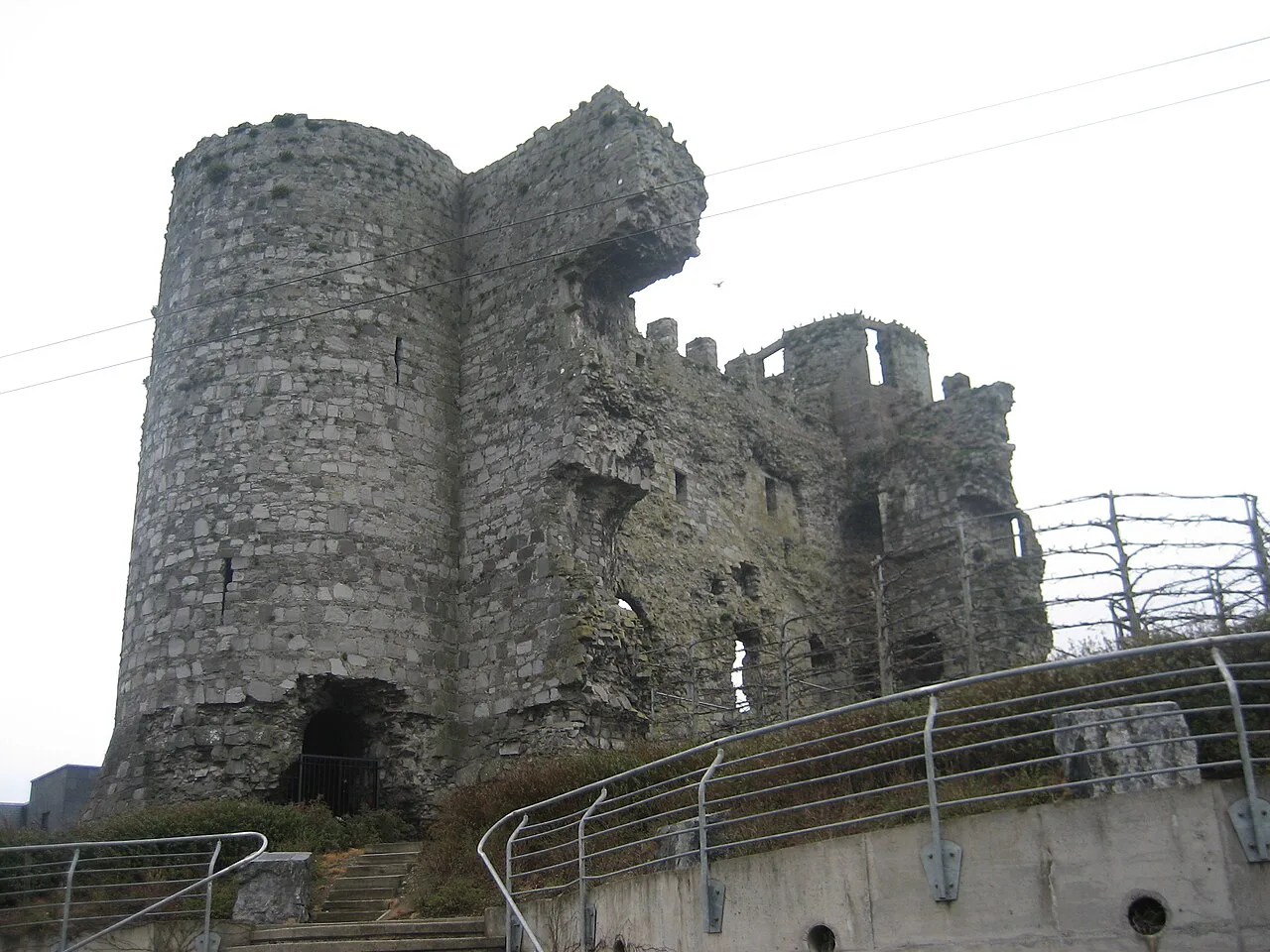
The visible fragment gives little sense of the original building, so the 1990s excavation findings reported by the OPW are the best guide. They indicate a castle originally two storeys high, with walls about 2.7 metres thick rising from a battered plinth, timber floors and roof, and stone stairs built into the walls to reach the upper levels and roof. Read these as excavation results, not as features still legible in the ruin.
The entrance was not at ground level: a doorway in the north wall gave access at first-floor level, with some outer walls extending above roof level. The independent account adds architectural detail such as coursed rubble masonry, slit openings and cross loops, useful vocabulary for looking closely at the surviving stonework.
Interior access is not established by the evidence, so plan to examine the standing wall and towers from outside rather than to climb them. The independent account notes that information panels have been placed on site by the OPW; if they are in place, reading them before walking around the fragment gives the structure far more meaning than a quick photograph.
Administrative Capital and the Irish Exchequer
In the late fourteenth century a third storey was added to accommodate the Irish Exchequer together with its administrative officials and clerks, and the castle's defences were upgraded in the same period. The castle served as an administrative centre, military fortification and residence, roles that shaped how it was used rather than how it looks today.
The independent account adds that the castle also hosted the Court of Common Pleas, and that the Exchequer returned to Dublin in 1394 under pressure from surrounding Irish families, among them the MacMurroughs and the O'Mores. That reading explains why Carlow's spell as a seat of royal administration was brief rather than permanent, and it is complementary reporting rather than an OPW statement.
Changing Hands and the Sieges
The OPW sequence begins in 1306, when Marshal's grand-nephew bequeathed the castle to the Crown; it was then granted to Thomas Plantagenet, Earl of Norfolk, and stayed with his family until confiscation in 1537 over absentee landlordism. Ownership changed repeatedly during the 1640s before Cromwell's forces seized it in 1650.
The independent account adds names that complement rather than replace that sequence, including the Bigod earls of Norfolk and the later Hamilton family. It also records, on its own authority, that Carlow was the last town in south Leinster to hold out against Cromwellian forces before surrendering to General Ireton's cannon — a detail the OPW page does not state, so treat it as the independent site's account rather than OPW record.
The 1814 Collapse
Much of what disappeared from Carlow Castle was lost in a single episode. In 1814 the castle was granted to Dr Philip Parry Middleton, a local physician, who used explosive charges at the base while attempting to create additional space for a lunatic asylum.
The blast brought down the eastern half of the castle, and much of the rest had to be demolished for safety, leaving the two towers and intervening wall visible today; nothing was rebuilt. The independent account dates the explosion to 13 February 1814, a precise date that comes from that source alone and should be read as its attribution.
Visitor Notes for an Unguided Site
Plan around the fact that this is an unguided monument rather than a visitor attraction. Neither source publishes opening hours, admission prices or booking arrangements for Carlow Castle, so consult the Heritage Ireland page for current arrangements before you set out, and expect a brief outdoor stop rather than a half-day.
Do not expect to enter the towers or reach upper levels; view the fragment from outside and keep to safe ground. The OPW's warning asks visitors to maintain care and caution at all stages of a visit, and that caution should govern where you stand.
For research before or after a visit, the OPW points readers to the Historic Environment Viewer, an off-site tool for exploring the monument's recorded heritage rather than a facility at the castle. If you want a contrasting, much more developed castle visit elsewhere in Ireland, our Blarney Castle guide covers a very different experience.
Nearby Heritage Ireland Properties
The official Carlow Castle page also lists other Heritage Ireland properties in the wider area as nearby sites to visit. These include Altamont Gardens, Dunmore Cave, St Mary's Church Gowran, Heywood Gardens, Dwyer McAllister Cottage and Kilkenny Castle. If the last of these is your pick, our Kilkenny Castle: Visiting the Butler Seat in Kilkenny City guide covers what to expect there.
Treat those properties as separate outings in the region rather than part of the Carlow Castle visit, since none is on the castle site. Checking arrangements for each property on its own Heritage Ireland page before travelling avoids arriving at a place that is not receiving visitors that day.
Plan Your Visit
Carlow Castle rewards a reader more than a sightseer: two towers and a wall remain, but excavation and documents reconstruct a four-towered keep that once accommodated the Irish Exchequer. Go expecting a short, self-guided look at a national monument in Carlow town, and let the site panels, if present, and the Historic Environment Viewer do the explaining.
Before travelling, confirm current arrangements on the official Heritage Ireland page, since no fixed visiting arrangements are published for this unguided site. Pair the castle with one nearby Heritage Ireland property, checked separately, if you want a fuller day out in the region.
Explore more Ireland guides
Frequently Asked Questions
What is left of Carlow Castle today?
Only two towers and the wall between them survive. The eastern half collapsed after explosive charges were used at its base in 1814, and much of the remainder was later demolished for safety, so the standing fragment is a small part of the original four-towered keep.
Who built Carlow Castle and when?
The Office of Public Works dates the stone castle to between 1208 and 1213 and attributes it to William Marshal, who held the Lordship of Leinster through his wife Isabel de Clare. It replaced an earlier Norman earthwork fortification on the same site.
Why does Carlow Castle have only two towers?
It was originally a four-towered keep, but in 1814 Dr Philip Parry Middleton used explosive charges at the base while trying to create room for an asylum, which brought down the eastern half. The rest had to be demolished for safety, leaving the present fragment.
Can you go inside Carlow Castle?
Interior access is not established by the available evidence, so do not expect to enter the towers or reach upper levels. It is an unguided outdoor monument, and the OPW asks visitors to maintain care and caution at all stages of a visit.
Did Carlow Castle house the Irish Exchequer?
Yes. A third storey was added in the late fourteenth century to accommodate the Irish Exchequer and its officials and clerks, part of the castle's role as an administrative centre as well as a fortification and residence.
Is there a charge to see Carlow Castle?
The official Heritage Ireland page for this unguided site gives no admission prices or ticket arrangements, so check the current position there before travelling rather than assuming a charge or free entry.
What else is there to see near Carlow Castle?
The official page lists other Heritage Ireland properties in the wider area, including Altamont Gardens, Dunmore Cave, St Mary's Church Gowran, Heywood Gardens, Dwyer McAllister Cottage and Kilkenny Castle. Each is a separate outing with its own arrangements to check.
Which other castles belong to the same four-towered keep group?
The OPW groups Carlow with Ferns Castle in County Wexford, Lea Castle in County Laois and the original Kilkenny Castle, all credited to William Marshal. Each is a separate site with its own access arrangements.
Sources
You might also like



Continue reading
More guides you'll find useful





