
Ballintober Castle, County Roscommon: Ireland's Largest Keepless Castle
Ballintober Castle is a ruined keepless castle in County Roscommon, privately owned by the O'Conor family. See what survey and excavation have revealed.
On this page
Ballintober Castle stands in Ballintober village, County Roscommon, as a ruined keepless castle attributed to Richard de Burgh, Earl of Ulster, and built in the early 14th century. It is the largest keepless castle in Ireland, but it is not an open visitor attraction: the site is private property, and an independent field record states that access to the interior is prohibited without the owners' permission. This guide explains what the ruins show, what survey and excavation have added, and how to approach the site honestly.
What Ballintober Castle Is and Where It Stands
Ballintober is a rural village in County Roscommon, in the west of Ireland, and the castle sits within the village itself rather than on an isolated estate. The Society for Medieval Archaeology describes the site as an early 14th-century keepless castle built by Richard de Burgh on the doorstep of the O'Conor kings of Connacht. That phrasing matters: the castle was planted on O'Conor land, and its history is bound up with the contest between Anglo-Norman power and Gaelic Irish lordship.
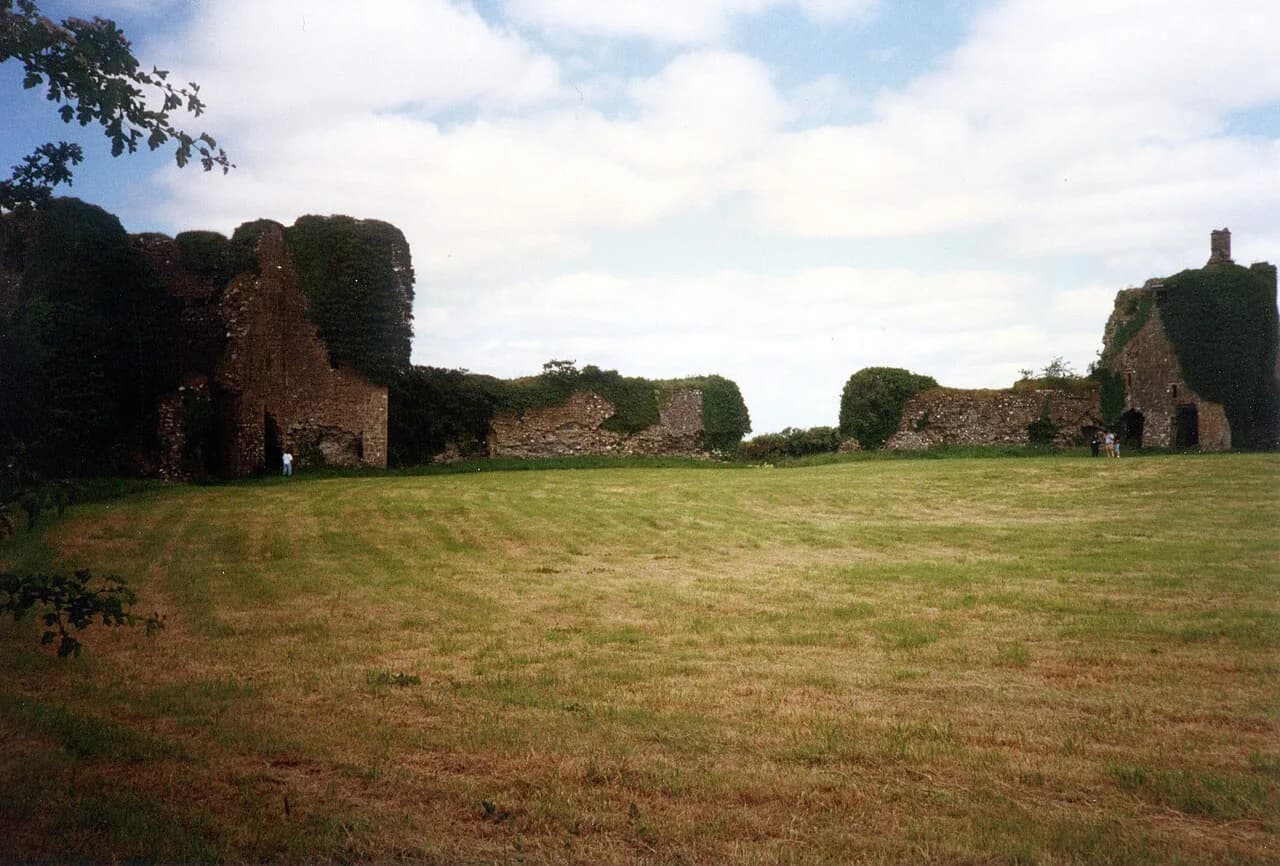
The castle is a ruin, not a restored monument. Standing walls reach up to about 4 m in places, and a ditch remains visible around the outside. The interior is not open: an independent field record states that access to the interior is prohibited without the permission of the owners, the O'Conors of Connacht, who reside at Clonalis House outside Castlerea. Visitors should expect to view the exterior and the surrounding earthworks, and should not assume entry.
Origins: An Anglo-Norman Castle on O'Conor Land
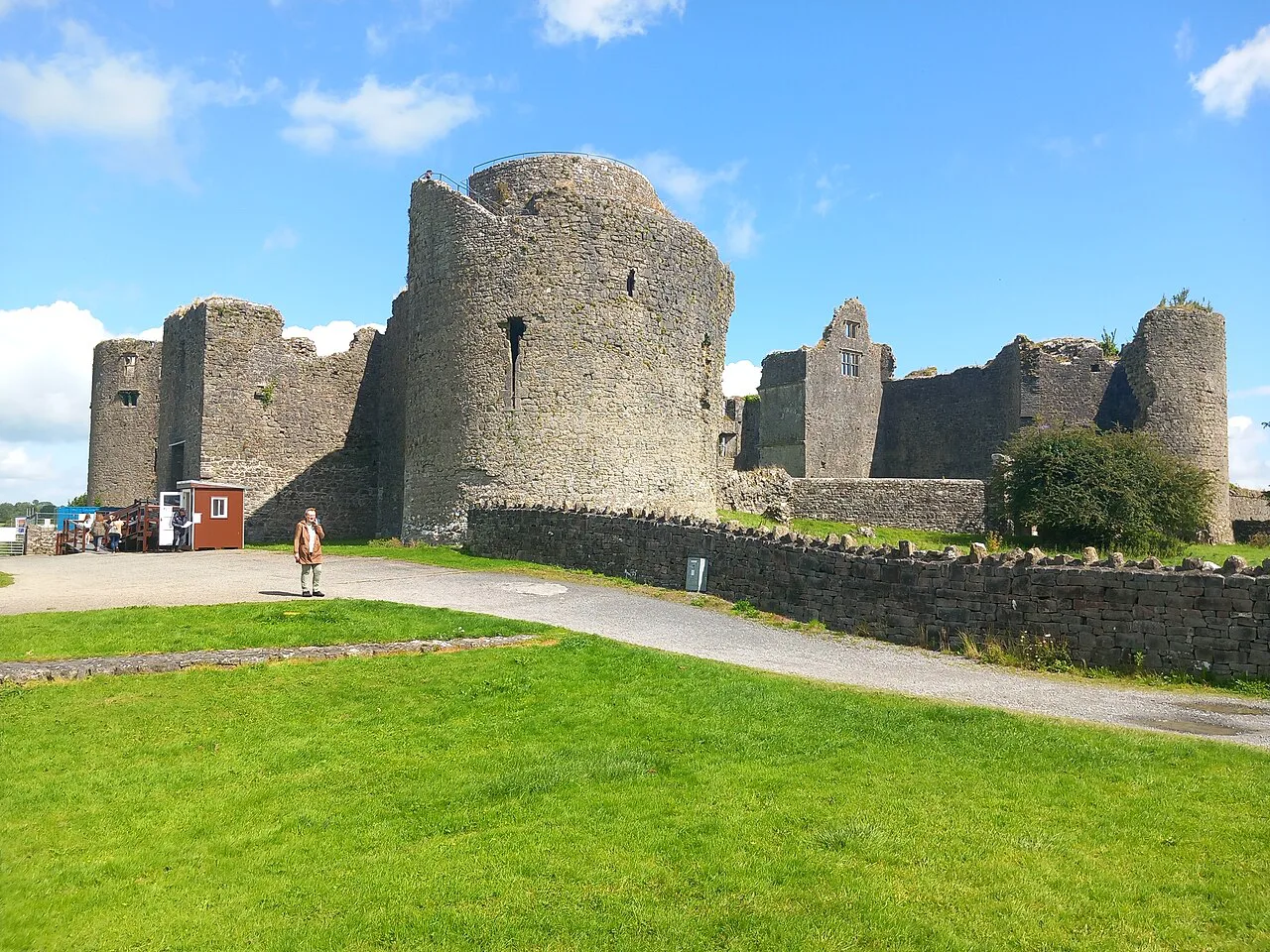
Construction is placed in the early 14th century, sometimes expressed as the late 1200s to early 1300s, and attributed to Richard de Burgh, Earl of Ulster. Sources do not agree on a single precise year, so it is more accurate to describe the castle as an early 14th-century foundation than to give one date. The Castle Studies Trust notes that the polygonal corner towers are thought to emulate Edward I's Caernarfon Castle in Wales, a comparison that signals the ambition of the design rather than its size alone. Ballintober was both a military structure and a residence, and the fireplaces found in the standing remains point to comfortable accommodation.
The castle changed hands in the later 14th century. One source places O'Conor control from 1381, while another records a takeover in 1362; the discrepancy is unresolved, so the safe statement is that the castle passed to the O'Conor family in the later 14th century. After a near-attack in 1642 the castle was abandoned as a residence and gradually fell into ruin, but the O'Conor family still owns it today.
Reading the Standing Remains
The Castle Studies Trust survey gives a rectangular plan measuring 73.8 m by 80.5 m, with a tower at each corner and two further towers flanking the entrance on the east side. An independent field record describes the sides as slightly uneven and gives an average of about 83 m across, so the two measurements should be treated as separate observations rather than blended into one figure. Either way, the scale is large: the Castle Studies Trust notes that the enclosure is more than twice the size of Roscommon Castle, which may have provided the template for Ballintober decades earlier.
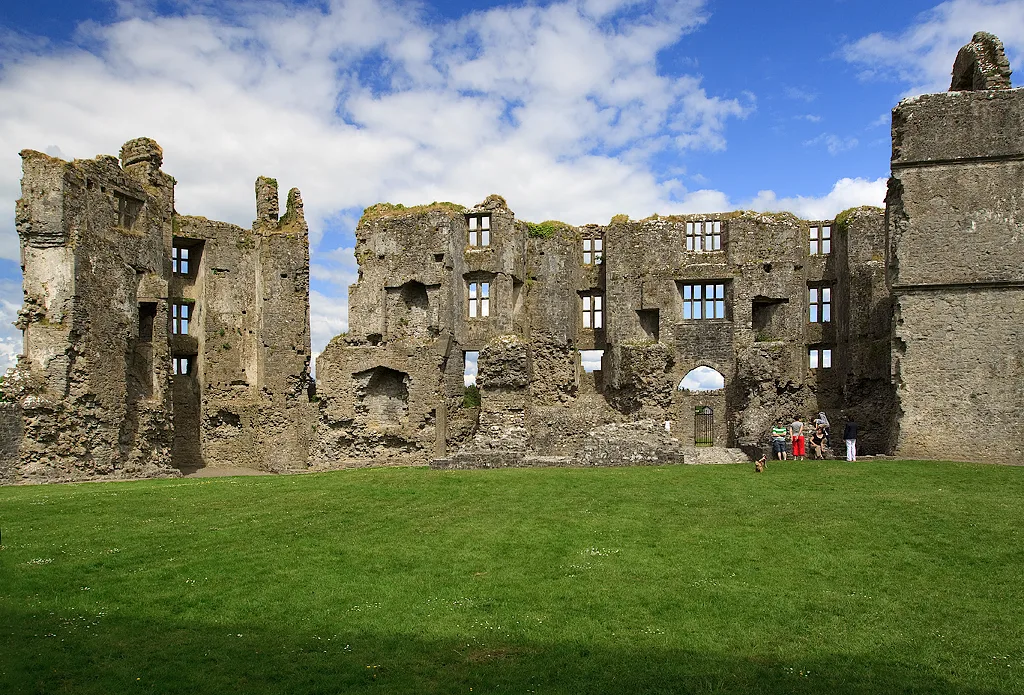
The south-west tower had three storeys, each an apartment with its own rooms, and its narrow windows show that defence was still a consideration; a fireplace on its ground floor and a lost timber vault suggest high-status use. Inside the courtyard there were other buildings, including a hall with chamber and kitchen in the south-west quarter and a church measuring about 12 m by 8 m in the north quarter. These internal structures survive as foundations or buried remains rather than standing buildings, which is one reason the interior is not a walk-through experience even with permission.
What 'Keepless' and 'Palace Castle' Mean
A keepless castle has no great central tower of the kind seen at Trim or Dover. Instead, the living quarters and defences are arranged within the outer walls, and protection comes from the curtain wall and flanking towers rather than a single keep. At Ballintober the design is described as a palace castle because the accommodation was comfortable and high-status, indicated by fireplaces and fine detail, not merely functional. Richard de Burgh also built Ballymote as a keepless castle around the same time, which makes the two sites useful comparisons for anyone following the story of medieval castles in Ireland.
What the 2014 Laser Survey Added
A laser-scanning survey funded by the Castle Studies Trust in 2014 recorded the standing structure and produced a 3D point cloud used to create accurate plans and elevations. The survey identified a fireplace on the ground floor of the south-west tower and evidence that it once had a fine timber vault, suggesting a high-status hall. It also showed that the north-west tower was substantially redesigned in the 17th century, and that the arrow slits are wider than those at Roscommon and Ballymote, possibly reflecting comfort as well as defence. Gun loops were added later to accommodate gunpowder weapons.
One of the more consequential findings is that the castle is asymmetrical, with an entrance set off centre. The survey suggests the design may have changed to enclose a larger area, or that the castle stands on an earlier fortification. These are interpretations rather than settled facts, and they show why the site rewards reading before a visit: the irregularities in the plan are part of the evidence, not construction errors.
The Excavation at the Entrance
The Castles in Communities project, coordinated by ADCO, has focused excavation on the castle entrance. A cutting roughly 30 m long and 6 m wide has exposed a complex drawbridge entrance between the two entrance towers. The project reports two principal construction phases: a later phase from the 17th century and an earlier one associated with the late 13th century, with the castle moat beneath and pre-castle strata still to be reached. This is research in progress, not a finished display, and the excavation area is not presented as visitable by the public.
The field school's work is broader than the entrance trench. Survey teams collect ground-penetrating radar and magnetometry data, conduct field walking and drone survey, and process artefacts and environmental samples in the laboratory. The project describes its approach as combining academic research, field school teaching and intensive community engagement, with a focus on the later medieval period. For visitors, the practical point is that the castle is an active research site whose understanding is still changing.
A Community-Based Research Project
Castles in Communities is directed by Niall Brady of ADCO with colleagues affiliated with Harvard University, Boston College and Las Positas College. The project states that it prioritises collaboration with the Ballintober community to promote tourism and make the castle safe for visitors. That is a stated aim, not evidence that conservation works are complete or that access is currently open. The sources describe the 2026 season as the tenth field season, which makes the project a decade-long investigation rather than a single summer dig.
Visiting with Accurate Expectations
The documented position is that Ballintober Castle is private property and interior access is prohibited without the owners' permission. Visitors should plan on viewing the exterior and the surrounding ditch from public ground, and should not enter the interior or the excavation area without explicit permission. No current official visitor hours, admission arrangements or guided tours are published in the sources consulted, so check with the owners or local heritage and tourism services before travelling rather than relying on assumptions.
Ballintober sits in north Roscommon, and contrasting it with castles that are set up for visitors is the clearest way to understand the access situation. The wider story of Irish tower houses, keeps and hall-and-tower castles is covered in our guide to Medieval Castles in Ireland, while a conserved castle that welcomes visitors shows the other end of the spectrum: a ticketed route through standing buildings rather than a private ruin you view from outside. For a similar exercise in checking what is actually open, our guide to castles in county galway covers four sites with their current access, and the same holds true when weighing early tombs and earthworks against the castles: ancient sites ireland are often likewise private, unstaffed or seasonally limited.
Blarney Castle is presented as a conserved structure with visitor arrangements, whereas Ballintober survives as ivy-clad walls and buried foundations on private land. A trip built around Ballintober depends on patience and, if you want to go beyond the exterior, the owners' permission, rather than a ticket that takes you through the buildings. The same question of present-day access shapes a visit to the castles in county galway, which are covered site by site rather than as a single ticketed stop.
Plan Your Visit
Ballintober Castle rewards preparation more than spontaneity. Read the survey findings before you go so that the off-centre entrance, the corner towers and the surviving ditch make sense as evidence of a changing design. Arrive expecting a ruin in a working rural community, and respect the private ownership that has kept the site in O'Conor hands for centuries. If interior access matters to you, seek permission from the owners in advance rather than turning up and hoping.
Explore more Ireland guides
Frequently Asked Questions
Can you go inside Ballintober Castle?
Not without permission. The castle is private property, and the documented position is that interior access is prohibited unless the owners, the O'Conors of Connacht, grant it. Visitors should plan to view the exterior and the surrounding ditch from public ground. No public opening hours or guided tour arrangements are published in the sources consulted, so check with the owners or local heritage services before travelling.
Why is Ballintober called a keepless castle?
It has no great central tower of the kind found at Trim or Dover. Instead, the living quarters and defences sit within the outer walls, protected by the curtain wall and flanking towers. At Ballintober the comfortable accommodation indicated by fireplaces has led to the additional description 'palace castle'.
Who built Ballintober Castle and when?
It is attributed to Richard de Burgh, Earl of Ulster, and dated to the early 14th century, sometimes expressed as the late 1200s to early 1300s. Sources do not agree on a single precise year. It was built on O'Conor territory and passed to the O'Conor family in the later 14th century.
What did the laser survey of Ballintober Castle reveal?
The 2014 survey produced a 3D record of the standing structure and identified features including a ground-floor fireplace and lost timber vault in the south-west tower, a north-west tower redesigned in the 17th century, wider arrow slits than at comparable castles, later gun loops, and an asymmetrical plan with an off-centre entrance.
What is being excavated at the castle entrance?
A cutting roughly 30 m long and 6 m wide has exposed a complex drawbridge entrance between the two entrance towers. The project reports a 17th-century construction phase over a late 13th-century phase, with the castle moat beneath. Excavation is research work and the trench is not presented as a public attraction.
Who owns Ballintober Castle now?
The O'Conor family still owns the castle. An independent field record identifies the owners as the O'Conors of Connacht, who reside at Clonalis House outside Castlerea. Ownership has remained with the family since the later medieval period, although the castle was abandoned as a residence after a near-attack in 1642.
Sources
- Castles in Communities: Irish Archaeology at Ballintober Castle - Archaeological Fieldwork Opportunities Bulletin (AFOB)
- The Society for Medieval Archaeology | Ballintober Castle
- Ballintober: a palace castle in a border territory – Castle Studies Trust Blog
- The Field School – Castles In Communities
- Ballintober
You might also like



Continue reading
More guides you'll find useful





