
Irish Celtic Art: Where to See It in Dublin
See Irish Celtic art in Dublin: Iron Age gold and early medieval metalwork at the National Museum's Treasury, plus the Book of Kells at Trinity College.
On this page
Irish Celtic art is best understood as an art-historical label rather than the style of one people or one faith. It covers Iron Age ornament in the La Tène tradition and the early medieval Christian metalwork and manuscripts that absorbed and transformed it. Dublin holds both ends of that story: the National Museum of Ireland's Treasury on Kildare Street, which is free, and the separately ticketed Book of Kells Experience at Trinity College.
What "Irish Celtic Art" Actually Covers
The phrase bundles together objects made many centuries apart for very different purposes. A first-century BC gold collar worn as a status object and an eighth-century silver chalice made for the Mass share decorative instincts, but not a religion, an ethnicity or a single symbolic code. Treat interlace, spirals and animal motifs as shared visual vocabulary, not as a dictionary with fixed meanings.
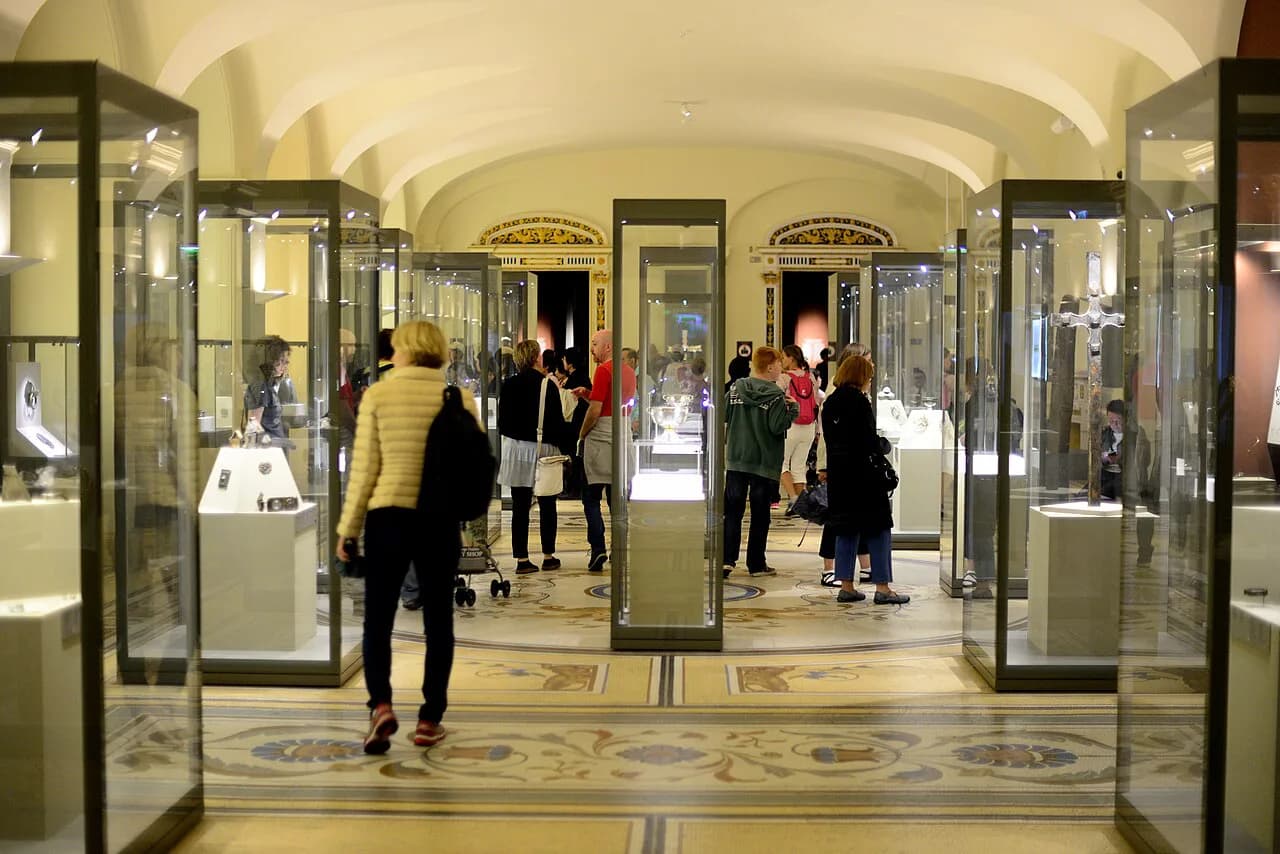
The National Museum's Treasury exhibition is organised to make that chronology legible, running from the Iron Age to the twelfth century across three galleries. The museum traces the shift from paganism to Christianity, the flourishing of native and foreign-influenced craftsmanship between the late seventh and early ninth centuries, and the impact of Viking-era styles from the ninth century onward. Admission is free, which makes the collection the practical starting point for the subject. If you want to place these objects among the city's other landmarks, our Dublin heritage guide sets out the key sites in chronological order.
The Broighter Collar: Iron Age Gold
The Broighter Collar is the most opulent Irish Iron Age gold neck ornament in the museum's care, recovered from a hoard found near the old shoreline of Lough Foyle at Broighter, County Derry. It is a large tubular piece with buffer terminals, its surface worked in raised and incised ornament including stylised bird and horse motifs. The two ends fasten with a mortise-and-tenon device rather than a simple clasp. The findspot is not a visitor site; the object itself is in Dublin.
The museum suggests the collar's associations may connect it to kingship and to the sea god Manannán mac Lir, who was linked with Lough Foyle, noting that the place name Broighter may derive from a term for a god's residence. Read that as informed interpretation rather than settled fact. What the object itself supports is more modest and more useful: exceptional goldworking, animal ornament, and a fastening engineered to be worn and removed repeatedly.
The Tara Brooch: Name, Provenance and Detail
The Tara Brooch was not found at Tara. It was recovered near the seashore at Bettystown, County Meath, in 1850, and its Tara attribution came from a dealer seeking a higher price. The misnomer stuck, which is why the label tells you about nineteenth-century antiquarianism rather than about the Hill of Tara. Knowing this also makes the object a good lesson in reading museum labels critically.
Made of cast and gilt silver and dated by the museum to the eighth century, the brooch is decorated on both faces. The front carries exceptionally fine gold filigree panels with animal and abstract motifs, separated by studs of glass, enamel and amber, while the flatter back is cast with scrolls and triple spirals recalling Iron Age La Tène work. The museum presents it, alongside the Ardagh Chalice and the Derrynaflan Paten, as representing a high point of early medieval Irish metalwork.
The element most visitors nearly miss is the attachment. A silver chain of plaited wire hangs from a swivel, and that swivel is formed of animal heads framing two tiny cast glass human heads. Pause on it before moving on: it shows a maker thinking about a joint as a place for sculpture, not merely as a mechanism. In the National Museum galleries, hand-held cameras are allowed, but flash, video and tripods are not.
The Ardagh Chalice: Liturgical Silver
The Ardagh Chalice came from a hoard unearthed in the nineteenth century by a young man digging for potatoes at Reerasta, Ardagh, County Limerick. The museum describes spun silver for the bowl and foot, with applied gold, silver, glass, amber and enamel ornament on the outside, and a polished rock crystal set at the centre of the decorated underside of the foot. Its overall shape echoes late Roman tableware, but the method of construction is Irish.
Give the inscription band your time. The names of eleven apostles and St Paul are worked below a band of gold filigree and studs encircling the bowl, with the letters set against a stippled ground, and incised animal ornament appears beneath two decorated handle escutcheons. Installed next to the Tara Brooch, the chalice lets you compare sacred function with personal adornment using the same techniques in the same room.
Gallery Two and Gallery Three: Manuscript and Technique
The second gallery is devoted to the Faddan More Psalter, a book of psalms of about AD 800 found by chance in a County Tipperary bog in 2006. Seeing a manuscript recovered from wet ground before you reach the Trinity displays gives the later book rooms a useful context: survival is part of the story, not a footnote. The third gallery then turns to the workshop, using tools and artefacts connected with producing and decorating metalwork.
Interactive glossary kiosks with extreme close-up images reward the kind of looking that case glass normally frustrates. If you want to go beyond this Dublin collection into Irish material culture more broadly, the subject sits naturally within the wider field of irish traditional crafts, from metalwork and wood to textiles and stone.
Manuscripts as Celtic Art: the Book of Durrow
The Book of Durrow, dated to roughly 650 to 700, is the more restrained precursor of the Book of Kells. Trinity College Dublin Library describes a limited palette of red, yellow and green filling whole carpet pages with dense ornamentation, while the evangelist symbols stand isolated against creamy vellum, framed by bands of interlace. Fewer colours and simpler motifs produce a deliberately concise symbolism rather than a lesser version of Kells.
Its symbolic scheme is genuinely different, and worth knowing before you compare the two books. Durrow follows a pre-Vulgate arrangement in which the lion stands for John and the eagle for Mark, whereas the later Kells scheme assigns man, lion, calf and eagle to Matthew, Mark, Luke and John. Carrying the Kells order across to Durrow is a common and easy mistake.
Trinity College Library holds this material as custodian, including the Book of Kells, the Book of Durrow and the Book of Armagh among its medieval codices. Custody is not a display guarantee: pages and volumes rotate, and the relevant exhibition changes, so a manuscript in the collection may not be in a case on the day you arrive. Plan around the confirmed headline item and treat the rest as a bonus.
The Book of Kells Experience at Trinity College
This is a separate venue and operator from the free National Museum Treasury, with timed entry, and online booking is strongly recommended. Tickets start from 25 euros per person and are non-refundable once purchased, so confirm your date before paying. The experience begins in the Old Library with the Book of Kells and the Long Room, then continues to a digital exhibition in the Red Pavilion a minute's walk away.
Allow roughly ninety minutes and adjust expectations about the Long Room. As part of the Old Library redevelopment, all books have been removed except the first four bays as you enter, and photography is forbidden in the Treasury room where the manuscript is housed. Audio guides are offered in a long list of languages, and an optional guided walking tour of the college can be added before your timed slot.
Practical Decisions for One Day
At Kildare Street the ordinary pattern is Tuesday to Saturday 10am to 5pm and Sunday and Monday 1pm to 5pm, with a late opening on the last Thursday of the month and a recommended last entry of 4.30pm. Admission is free, and individuals, families and small groups do not need to book, while groups of eight or more must arrange a booking in advance. Plan your Treasury stop for the morning and your timed Trinity slot for the afternoon, or reverse it if tickets dictate.
One dated exception matters if you are travelling around the end of October: Kildare Street is listed as closed on Sunday 25 and Bank Holiday Monday 26 October 2026 because of industrial action. That notice applies to this branch, not to every National Museum site, and it is not a permanent closure. Check the museum's current notices before locking in a date, and ring ahead if one particular object is your reason for going, since individual galleries can close at short notice.
Where Celtic Art Sits in Irish Making
Metalwork and manuscript illumination are the headline expressions of this tradition, but they belong to a longer continuum of Irish making that includes ceramics, glass, textiles and stone. The collections at the National Museum of Ireland hold comparative material from later periods, and specialist crafts collections elsewhere in the country cover the modern revival.
Whether you come out of the Treasury wanting more on technique or on the wider story of making in Ireland, the craft tradition continues well beyond medieval metalwork. For named potteries, studio ceramics and museum collections covering that later material, browse our guide to Irish pottery.
Plan Your Visit
Build the day around the free Treasury galleries, because they carry the chronological argument from Iron Age gold to Christian metalwork and manuscripts in one sequence. Add the Book of Kells Experience only if you accept it as a separately ticketed, timed visit with a redeveloped Long Room. Between them, they cover the subject without repeating it.
Before travelling, confirm the Kildare Street opening pattern and any current notice, and check Trinity's booking page for the slot you want. If a specific object is the point of the trip, telephone the museum rather than assuming it is on view. That one call is the difference between a good day and a wasted one.
For another heritage guide, read about Irish Weaving.
Explore more Ireland guides
Frequently Asked Questions
What is meant by Irish Celtic art?
It is an art-historical label covering several centuries of Irish decorative work, chiefly Iron Age ornament in the La Tène tradition and the early medieval Christian metalwork and manuscripts that followed. It does not describe a single people, religion or fixed set of symbolic meanings, so read motifs as a shared visual vocabulary rather than a code.
Where can I see Irish Celtic art in Dublin?
Start at the National Museum of Ireland on Kildare Street, where the Treasury exhibition runs from the Iron Age to the twelfth century and holds the Broighter Collar, the Tara Brooch and the Ardagh Chalice. For manuscripts, the Book of Kells Experience at Trinity College is a separate ticketed visit that includes a digital exhibition.
Was the Tara Brooch found at Tara?
No. It was found near the seashore at Bettystown, County Meath, in 1850, and the Tara name came from a dealer's attribution intended to raise its value. The brooch is displayed in Dublin, not at the Hill of Tara.
Is the National Museum's Treasury free to visit?
Yes, admission is free at the Kildare Street museum, and individuals, families and small social groups do not need to book. Groups of eight or more must book in advance through the museum's bookings office, and school or community groups should contact it for tours and workshops.
Do I need to book the Book of Kells Experience separately?
Yes. It is a different venue and operator from the National Museum, entry is timed, and online booking is strongly recommended. Tickets are non-refundable once purchased, so confirm your date before paying.
Can I see the Book of Durrow on display at Trinity College?
Do not assume so. Trinity College Library holds the manuscript, but display rotates and the exhibition changes, so check what is currently on view before building a visit around it. The confirmed headline item of the ticketed experience is the Book of Kells.
How long should I allow for the Book of Kells Experience?
The operator suggests around ninety minutes for the full sequence, from the Book of Kells and the Long Room through to the digital exhibition in the Red Pavilion and the gift shop. Add extra time if you also take the optional guided walking tour of the college beforehand.
Is the Broighter Collar on display in Derry?
No. It was found in a hoard near Lough Foyle at Broighter, County Derry, but that findspot is not a visitor attraction. The collar itself is held and displayed in Dublin at the National Museum of Ireland.
Sources
- The Broighter Collar | National Museum of Ireland
- The 'Tara' Brooch | National Museum of Ireland (https://www.museum.ie/en-IE/Collections-Research/Collection/The-Treasury/Artefact/The-Tara-Brooch/4e7de8cc-9cf5-4352-a20a-34caf1bf4d95)
- The Ardagh Chalice | National Museum of Ireland
- Book of Durrow - Director's Choice Uncut - Trinity College Dublin (https://www.tcd.ie/library/exhibitions/directors-choice/durrow/)
- The Treasury | Archaeology | National Museum of Ireland
- Opening Hours, Location and Facilities | Archaeology | National Museum of Ireland
- Book of Kells Experience | Trinity College Dublin | Official Site
- https://www.tcd.ie/library/research-collections/subject-strengths/medieval/medieval-latin.php
You might also like



Continue reading
More guides you'll find useful



