
Irish Pottery: Museum Ceramics and Working Potteries
Irish pottery explained through the National Museum's ceramics collection and two working potteries you can visit, with clear guidance on what each stop offers.
On this page
The most useful way to approach Irish pottery is to split it into distinct strands: delftware made in Dublin in the 1700s, factory and training-school wares of the 1800s, decorated spongeware, and the studio pottery that continues today. The National Museum of Ireland's ceramics collection documents the historical end of that story, while two working potteries — Nicholas Mosse in Bennettsbridge, County Kilkenny, and Louis Mulcahy at Clogher on the Dingle Peninsula, County Kerry — show the craft in production now. This guide sits within a wider set of irish traditional crafts, so you can place ceramics alongside weaving, glass and metalwork.
This is not an exhaustive survey, and none of these stops claims to be the best of anything. What they offer is range: museum context for the historical wares, and two contrasting workshops where you can see how contemporary Irish ceramics is actually made and sold. Choosing between them depends on whether you want collections or a working floor.
Four Strands of Irish Ceramics, Not One Style
Treating Irish pottery as a single look flattens a complicated record. The museum's ceramics page separates Irish delftware, associated with Henry Delamain and his Dublin pottery, from later commercial ventures such as Frederick Vodrey's Dublin operation and Belleek, and from the teaching work of the Queen's Institute porcelain-painting school. Carrigaline Pottery in County Cork, active from 1928 to 1979, carries the story into the twentieth century with its mottled glazes and animal and bird figures.
A related technique worth knowing before you go is hand sponging: pattern dabbed onto a pot with a cut sponge. Nicholas Mosse describes its own patterns as following an age-old sponge tradition, which it dates to the eighteenth century, and applies them by hand to each piece. Reading the strands separately helps when you visit: a delftware apothecary jar, a sponged jug and a thrown stoneware vase are products of very different workshops and economies.
Dublin Delftware: Henry Delamain and the World's End Pottery
Henry Delamain took over the World's End Pottery at Frenchman's Lane in Dublin in 1752 and produced wall-fountains, dinner services and apothecary jars there. The museum record notes that one of his most celebrated employees was the mid-eighteenth-century landscape painter Peter Shee, and that the manufactory appears to have faded around 1773. For a visitor, this is the key Irish benchmark for tin-glazed earthenware made on Irish soil rather than imported.
Delamain's output sits beside a much larger body of non-Irish tin-glazed ware in the same collection: Italian maiolica from the sixteenth to nineteenth centuries, Hispano-Moresque lustre ware mostly of the sixteenth century, French faience from Rouen, Moustiers and Lyons, and Dutch delft. The Dutch material is directly relevant as context, because its imitation of Chinese decorative motifs was later echoed on Irish delftware in the 1700s. Keep that distinction in mind so you do not read imported pieces as Irish work.
Vodrey, Belleek and the Queen's Institute
Frederick Vodrey ran a Dublin pottery from about 1882 to 1897, with premises on Henry Street, Mary Street and Moore Street, the last apparently serving as the main warehouse and works. Although he was not a trained potter, his employees designed pieces blending Celtic, Arabic, Classical and Art Nouveau influences, and the museum notes successful attempts at the antimony yellow and ruby red glazes associated with Far Eastern ceramics. Vodrey is a good example of Irish ware assembled from borrowed vocabularies.
Belleek's production started in 1863 after W. H. Kerr and Robert Williams Armstrong approached David McBirney of Hibernian House, Aston Quay, for finance, and early output leaned on Staffordshire and Worcester design links. The Queen's Institute for the Training and Employment of Educated Women opened a painting-on-porcelain school on Molesworth Street in 1870, with its impetus coming from Kerr and Herbert Cooper recruited to manage it the year before. These are historical reference points in the museum record, not visitor attractions to slot into a pottery itinerary.
Carrigaline, founded in County Cork in 1928 by H. W. B. (Hodder) Roberts, closes the historical sequence with art direction initially from the Stoke-on-Trent potter Louis T. Keeling. Its mottled glazes and ornamental animal and bird figures are distinctive enough to look for deliberately. If your interest runs to how Irish makers adapted outside influences, the museum's account of these four enterprises is more instructive than a wall of unlabelled display.
What the What's In Store? Ceramics Gallery Actually Is
The ceramics display sits within a gallery explicitly designed to show collections normally kept in storage, which sets expectations correctly: you are seeing a selection of stored material, not a comprehensive permanent ceramics survey. The page describes the gallery's contents at that level, and it is the place to check current opening arrangements before you build a day around it. Do not assume that any individual object named in the collection record is on view when you arrive.
Tiles from Islamic lands, Spain, Italy and Holland are shown together for comparison, illustrating different forms of tin-glazed earthenware alongside Irish material. The same gallery covers Asian porcelain — Satsuma, Kutani and a Chinese selection in which blanc-de-chine from Fujian dominates — plus German and Flemish stoneware and Wedgwood, the most important of which came from the Museum of Irish Industry. All of that is international context, useful for comparison but not evidence of Irish production. Verifying the museum's current opening arrangements before travelling is the sensible step.
Contemporary Makers in the Museum Record
The museum's ceramics page names a long roll of late twentieth-century and current Irish makers, among them Cormac Boydell, Peter Brennan, Pat Connor, Sara Flynn, Vivienne Foley, Sonja Landweer, Deirdre McLoughlin, Stephen Pearce and Louis Mulcahy, and identifies the sculptor Kathleen Cox (1904–1972) as a pioneer of modern ceramic art in Ireland. Read that list as a starting point for further reading, not a canon or a ranking; it is a museum record of activity rather than a directory of visitor sites.
Nicholas Mosse in Bennettsbridge, County Kilkenny
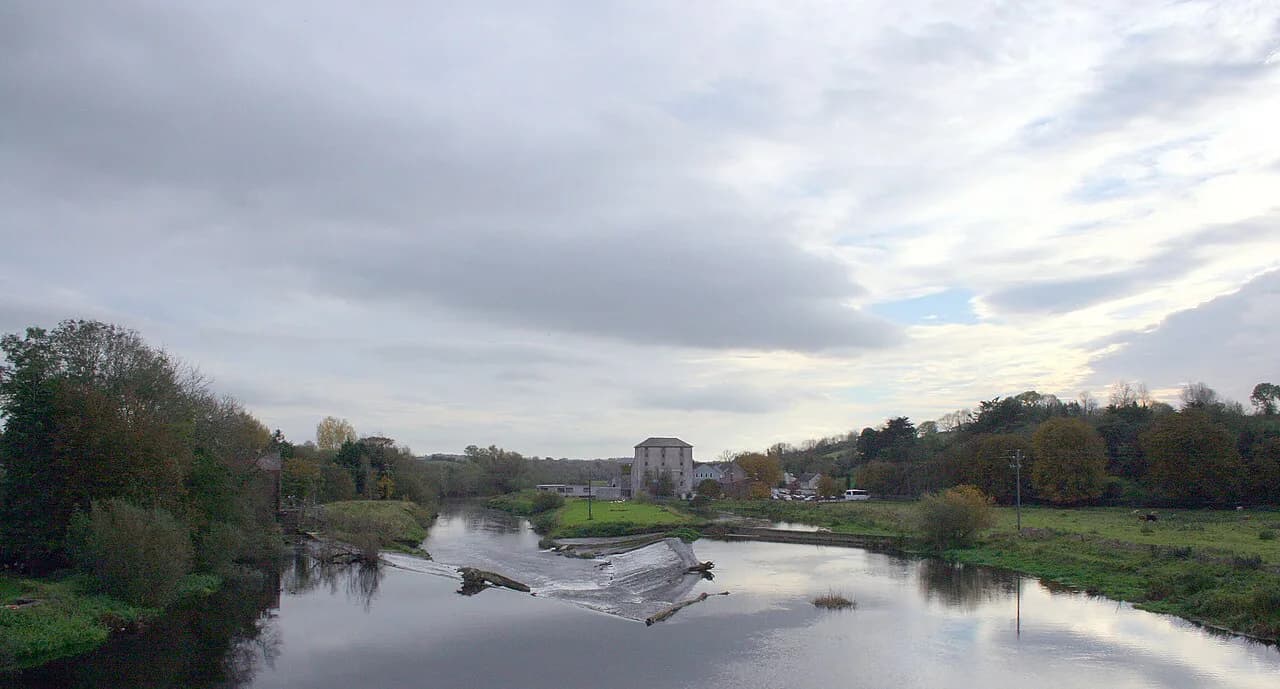
Nick and Susan Mosse founded Nicholas Mosse Pottery in 1976 in a small shed on family land at Bennettsbridge, County Kilkenny; Nick had honed his craft under potters in Harrow, England, and Susan is the botanical artist behind the patterns. Every piece is made by hand, patterns are adapted across more than sixty shapes, and each item passes through a twenty-step process. The old family mill was restored with hydro-electric power to fire the pottery after burning to the ground in 1985.
Design decisions here are slow by intention: Susan Mosse develops roughly one new pattern a year from hedgerow and wildflower sources, and early designs are tested on customers in the seconds shop. Patterns are applied with cut sponges, a technique the company describes as an eighteenth-century tradition. That is the operator's own framing of its method rather than a scholarly history of spongeware, but it explains what you will see on the ware: dense, repeated motifs rather than painted scenes.
Visiting the Bennettsbridge Mill: Shop, Café and Viewing Windows
A general visit means the shop, the café and viewing windows into the pottery when the team is working; no booking is required for the shop and café. The shop carries the full range of shapes and patterns alongside textiles, glassware and Irish-made homeware, and the riverside café serves scones, light lunches and coffee with gluten-free options. Free parking is available on site.
The operator publishes shop hours of Monday to Saturday 10am to 6pm and Sunday 1.30pm to 5pm, with the café open Monday to Saturday 11am to 5pm and Sunday 1.30pm to 4pm. Hours may vary over Christmas, bank holidays and other seasonal periods, so check the notice on the operator's page before travelling. The address is Bennettsbridge, County Kilkenny, Eircode R95 CK71.
Be clear about the trade-off: the viewing windows depend on staff being at work, and the page does not promise a guided factory tour or a scheduled demonstration. If watching production is the point of your trip, treat it as a chance rather than a guarantee and plan around the shop and café instead. If you are also following other craft stops, our guide to cushendale woollen mills covers a County Kilkenny maker in the same region.
Louis Mulcahy at Clogher, Dingle Peninsula, County Kerry
Louis Mulcahy founded his workshop with his wife Lisbeth in 1975 at Clogher near Clogher beach on the Dingle Peninsula, County Kerry, and has been making pots there since. Glazes and forms draw on the Kerry coast — sea blues, hillside browns and sunset reds — and production is hand-thrown, from posy jars and dinner sets to ovenware and large urns. Lisbeth Mulcahy, a Danish-born weaver, runs her own shop in Dingle town.
The workshop describes a wide operation, with more than thirty people working alongside Louis and his son Lasse; treat that figure as the operator's own account rather than an independently verified number. The site is on the scenic Slea Head Drive, and the operator states that its showroom is open seven days a week. Confirm that before you build a peninsula drive around it, since no independent schedule is published.
Two Ways to Visit Louis Mulcahy: Showroom or Wheel
Browsing is the simpler option: the showroom and shop display the full range of pottery and hand-painted lampshades, and a visit brings you into a working workshop where pieces are made by hand. That alone justifies the detour on a Slea Head Drive day. If you only have time for one stop on the peninsula, this combines retail, production context and coastal scenery in a single halt.
The more active option is the wheel experience, in which an experienced potter helps you throw a small pot or vase that is later fired, glazed and delivered, with delivery options available. Workshop tours covering techniques and craft are also described. No schedule, duration or price is published on the operator's page, so contact the pottery directly to arrange a session rather than assuming you can walk in and throw.
Choosing Between the Three Stops
The museum gives you chronology and comparison: Delamain's Dublin delftware, Vodrey's eclectic wares, Belleek, the Queen's Institute, Carrigaline and a list of contemporary makers, with international ceramics shown for contrast. Nicholas Mosse gives you a single workshop with a long family history, a strong decorative identity and easy facilities including a café and parking. Louis Mulcahy gives you a remote coastal workshop where you can potentially handle clay yourself.
Pair them by geography rather than trying to see everything. Bennettsbridge sits in County Kilkenny and pairs naturally with a Kilkenny day, while Clogher belongs to a Dingle Peninsula drive. If your wider interest is in how Irish craft traditions are documented and displayed, our irish folk art guide makes a useful companion to the ceramics.
Plan Your Visit
Decide first what you want: historical range, a working pottery that is easy to reach, or hands-on making. The National Museum display suits the first, Bennettsbridge the second, and Clogher the third. Confirm the museum's current opening arrangements on the institution's own site before travelling, and for Louis Mulcahy ring ahead or check the operator's page rather than relying on the published seven-day claim. If you are weighing a museum stop, our Dublin heritage guide covers the city's key historical sites. For either pottery, contact the operator directly about activities, and check published seasonal notices before you travel.
Build the trip around one county at a time, since these stops are far apart. A Kilkenny day can absorb Bennettsbridge comfortably, while the Kerry workshop belongs to a Slea Head Drive itinerary; the museum stands apart as a collection visit rather than a workshop. That separation keeps expectations honest and your driving reasonable. For a broader view of visual culture, read our introduction to Irish artists. For another heritage guide, read about Allihies Copper Mine Museum.
Explore more Ireland guides
Frequently Asked Questions
Where can I see historic Irish pottery in a museum?
The National Museum of Ireland's ceramics collection covers Irish delftware associated with Henry Delamain, Frederick Vodrey's Dublin pottery, Belleek, the Queen's Institute porcelain-painting school and Carrigaline Pottery. A gallery there is described as showing collections normally kept in storage, alongside international wares. The museum's own page is the place to confirm current opening arrangements, since individual objects are not guaranteed to be on view.
What is the difference between Irish delftware and later studio pottery?
Delftware is tin-glazed earthenware; Henry Delamain made it at the World's End Pottery in Dublin from 1752, producing wall-fountains, dinner services and apothecary jars before the works faded around 1773. Studio pottery is the later workshop-based tradition of individual makers, including those the museum names among contemporary Irish ceramicists. They belong to different periods, workshop scales and markets, so a museum display of one does not explain the other.
Can you visit a working pottery in Ireland?
Yes. Nicholas Mosse in Bennettsbridge, County Kilkenny, welcomes visitors to its shop and café with viewing windows into the pottery when the team is working, and no booking is needed for a general shop and café visit. Louis Mulcahy Pottery at Clogher on the Dingle Peninsula has a showroom and shop and offers workshop tours and a wheel experience. Neither promises a scheduled guided factory tour on demand.
Do you need to book a visit to Nicholas Mosse in Bennettsbridge?
No booking is required for a general visit to the shop and café, and free parking is available on site. If seeing production matters, note that the viewing windows depend on staff being at work, so the workshop is not a guaranteed demonstration. Check the operator's page for seasonal variations in hours before setting out.
Can you try throwing a pot at Louis Mulcahy Pottery?
The pottery describes a wheel experience in which an experienced potter helps you make a small pot or vase, which is then fired, glazed and delivered, with delivery options available. No schedule, duration or price is published on its site, so contact the pottery directly to arrange a session rather than assuming availability on the day you arrive.
Is the National Museum ceramics collection fully on display?
No. The relevant gallery is described as showing collections normally kept in storage, which means a selection rather than the whole collection. International material such as Italian maiolica, Dutch delft, French faience, Chinese porcelain and Wedgwood appears there as comparative context, not as Irish production. Check the museum's current opening arrangements before travelling.
Sources
You might also like



Continue reading
More guides you'll find useful



