
Irish Silver: How Hallmarks and Makers Tell Ireland's Story
Irish silver records Ireland's story through makers' marks, owners' arms and hallmarks. See where to view it and how to read one cup with two dates.
On this page
Irish silver is tableware, ceremonial plate, jewellery and trophies made on the island over roughly a millennium, and its survival makes it one of the most closely documented of the metalworking crafts. The Irish Silver Museum in Waterford is the collection described here that is open to visitors, while the National Museum of Ireland's Irish Silver Gallery at Collins Barracks in Dublin is temporarily closed for maintenance and has not published a reopening date. Plan a silver-focused visit around Waterford and leave the Dublin gallery out until it reopens; for the wider craft context, see the guide to irish traditional crafts.
Why hallmarked silver doubles as a historical record
Silver was worked in Ireland as both a valuable material and a means of exchange from the Viking period onward, which is why surviving pieces carry more than aesthetic interest. A spoon, cup or brooch records the taste of a period, the wealth of a household and the trade that supplied the metal. Because so many pieces were inscribed or stamped, they also carry names, dates and official marks that can be checked against institutional records.
The discipline of hallmarking is what turns a handsome object into a document. A maker's mark identifies the workshop, a fineness mark states metal quality, and a date letter pins the piece to a year, so a researcher can place an object in time even when its early ownership is unknown. This is also why silver rewards close looking: the smallest set of stamps on the underside of a cup often holds more hard information than the decoration on its bowl.
The visitable anchor: the Irish Silver Museum in Waterford
The Irish Silver Museum occupies The Deanery on Cathedral Square in Waterford, a building that stands above a medieval wine vault dating to the 1440s. That setting matters for reading the collection, because the house originally belonged to James Rice, a wealthy wine merchant and eleven-times Mayor of Waterford, who gifted it to Dean John Collyn of Christ Church Cathedral in 1468. The museum is part of the Waterford Treasures group of museums clustered in the city's Viking Triangle, which makes it practical to combine with other collections on foot.
The museum presents Irish silver across a long arc, running from the Viking era to modern Ireland, and it groups objects by what they reveal about the people who owned and used them rather than as a simple sequence of styles. Its own framing is that it is home to one of the largest collections of Irish silver in the world, with many pieces repatriated from overseas. Visitors should read that description as the institution's own account of its holdings rather than an independent ranking.
What the Waterford collection shows: makers, owners and named highlights
Much of the museum's silver carries the initials of the silversmith who made it and the coat of arms of the family that owned it, so the displays work as a portrait of both craft and status. Named highlights include the Waterford kite brooch, a sword granted to the city by Edward IV and silver that belonged to Dean Jonathan Swift. A famous owner's name can attach to an everyday object and pull it into wider history, which is part of what makes such pieces worth pausing over.
The collection also demonstrates how widely silversmithing was practised, with work attributed to workshops in Dublin, Waterford, Cork, Limerick, Galway, Youghal, Clonmel and Carrick-on-Suir during the eighteenth century. It includes pieces by Ireland's rare female silversmiths, showing that women did work within the trade. Read together, these regional pieces show that Irish silver was a network of local workshops, because silversmiths in cities such as Cork, Galway, Limerick, Kinsale and Waterford used their own official town marks rather than relying on Dublin alone.
European style, Irish hands
The National Museum of Ireland's Irish Silver Gallery is temporarily closed for maintenance, so it cannot currently be visited, but its published interpretation remains a helpful framework for looking at silver anywhere. The gallery traces silversmithing from the early seventeenth century to the present and groups objects under design labels including Baroque, Rococo, Neo-Classical, Victorian and Celtic Revival. The museum's own framing is that Irish smiths followed European fashions of the day and interpreted them in a distinctly local way. While that gallery is shut, a Dublin heritage guide can help you plan other historic sites in the capital instead.
That framework is worth carrying into a Waterford visit. A rococo teapot and a Celtic Revival trophy are not simply different objects; they show Irish workshops responding to wider European taste while serving a local market. Learning to spot the shift in ornament, proportion and surface finish lets a visitor date a display piece approximately before reading its label, which turns a case of gleaming objects into a sequence of decisions made by designers and patrons.
How hallmarking worked: Dublin control and local town marks
The Dublin Assay Office was established in 1637 to test and mark gold and silver made throughout Ireland, and its early marks were the maker's mark, a fineness mark and a crowned harp for sterling silver and 22-carat gold. A date letter system was introduced in 1638 and denotes the year a piece was made or hallmarked. The Hibernia mark arrived on 25 March 1730 to show that duty had been paid, and it later became the office's own identifying mark. The system continued largely unchanged after 1922, when Irish law on hallmarking was made in Dublin.
Dublin's control did not mean every piece was made there. Silversmiths in cities such as Cork, Galway, Limerick, Kinsale and Waterford used their own official town marks, the source explains, because sending precious metal to Dublin carried a fear of loss in transit. For a visitor, a town mark is often the most legible clue to a regional workshop, and it explains why silver from those centres can be identified even when the maker's name is obscure.
How a hallmark is applied today
Modern hallmarking still follows a sequence a visitor can picture: a sample is taken or tested, the metal's fineness is confirmed, and the marks are struck. Silver is usually tested by dissolving a small portion of alloy and analysing the solution to establish how many parts per thousand are pure silver. Gold is handled differently, by fire assay, which is one reason the two metals are described separately in the office's technical guidance.
Marking itself can be done by hand punch, by press or by laser, including deep laser marks intended to survive polishing. Since 2002 the marks used for Irish-made and imported goods have been the same, which is useful context when a piece in a display case carries unfamiliar stamps. The Dublin Assay Office is a working professional body, not a visitor attraction, so its value here is explanatory: it shows why the marks on an old cup can be trusted as a record of testing.
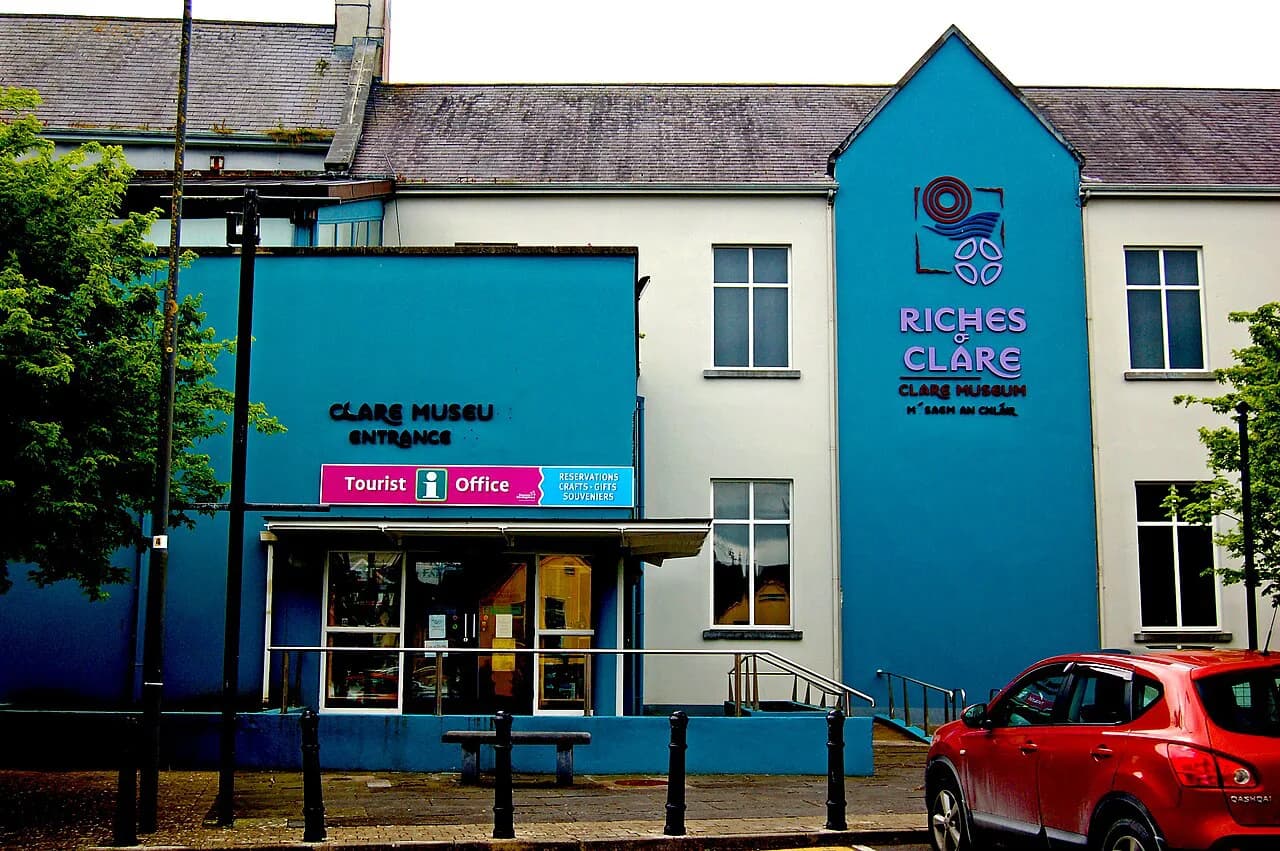
One object, two dates: the Colpois Cup at Clare Museum
A silver cup held in the Hugh and Grania Weir collection at Clare Museum shows why hallmarks need careful reading. Its Dublin hallmarks are for 1808, and the maker's mark DE is assigned to Daniel Egan. Many visitors would assume the cup was awarded in that year, but the engraving records a different occasion: it was won by Patrick Walsh for Anthony Colpois and given by the Newmarket-on-Fergus Farming Society for the best gentleman's plough, with an award date of 9 April 1832.
The twenty-four-year gap between mark and inscription is not a contradiction. A date letter records when a piece was made or hallmarked, while an engraving records what happened to it later, whether an award, a presentation or a family event. The cup was later donated by Grania O'Brien Weir, as it shows a connection to Dromoland, where she was born, adding a third layer of meaning. Museum custody of an object does not by itself confirm that it is on display, so check with Clare Museum before travelling to see it.

What silver can and cannot tell you
Silver reliably documents craft technique, metal quality, the payment of duty and, often, who owned a piece and when it changed hands. It can also be ambiguous: a maker's mark may belong to a workshop rather than an individual, an inscription may record a presentation rather than a purchase, and an heirloom can travel far from where it was made. Museums are cautious about these gaps because interpretation has to rest on documented evidence rather than on the appearance of the object.
What a museum label cannot do is settle an object's market value or confirm that a similar piece offered elsewhere is authentic, and it is worth keeping that limit in mind. The Dublin Assay Office describes testing and marking, not valuation or buying advice, and its processes are not a substitute for expert appraisal. For an heirloom, an independent qualified valuer or the relevant museum's collections team is the appropriate starting point rather than a hallmark guide.
Planning the visit: Waterford practicalities
The Irish Silver Museum publishes daily opening times, running longer hours on weekdays than on Sundays and bank holidays, and Waterford Treasures lists closures on Christmas Day, St Stephen's Day and New Year's Day. Standard admission prices are not stated here because the figures published at the museum's opening are no longer a reliable guide; check the current rate when booking. Waterford Treasures also notes that booking is not required and advertises a saving for booking online, so the trade-off is flexibility versus a discount.
Allow roughly one to two hours for a Waterford Treasures museum, with guided tours of about 45 minutes per museum and free time afterward. The museums sit within about five minutes' walk of one another, which makes a half-day pass through the Viking Triangle easy without a car. Bolton Street public car park is the closest option for drivers, and blue-badge spaces are available on Greyfriar's Street and The Mall.
Start With Waterford, Read Every Mark
Irish silver is best approached as a set of readable objects rather than a single treasure. Waterford's Irish Silver Museum gives the fullest current view of that story, from Viking-era exchange to eighteenth-century regional workshops and named owners such as Swift. If you are building a wider craft itinerary, the National Museum of Ireland's other collections and the country's surviving mill and workshop sites extend the same theme of skilled making.
Before travelling, confirm opening hours and any seasonal closures with Waterford Treasures, and leave the Dublin silver gallery out of this trip while its maintenance closure remains in place. When you stand in front of a case, look first for the small stamps, then for the inscription, and keep the two dates separate in your mind. That habit turns a display of polished metal into a record of who made it, who paid for it and who used it. For a wider choice of collection-based visits, compare museums in Ireland.
For another heritage guide, read about Irish Pottery.
Explore more Ireland guides
Frequently Asked Questions
Where can I see Irish silver in Ireland now?
The Irish Silver Museum at The Deanery, Cathedral Square, Waterford is the collection to plan around, and it is part of the Waterford Treasures group in the Viking Triangle. The National Museum of Ireland's Irish Silver Gallery at Collins Barracks in Dublin is temporarily closed for maintenance and has not published a reopening date, so do not build a visit around it. Clare Museum holds the Colpois Cup, but check with the museum before travelling to see a specific object.
What does a hallmark actually tell you about an Irish silver piece?
A hallmark set can identify the workshop through a maker's mark, indicate the metal's fineness, and through a date letter place the piece in the year it was made or hallmarked. Dublin has controlled hallmarking since the Assay Office was established in 1637, and silversmiths in Cork, Galway, Limerick, Kinsale and Waterford used their own official town marks for regional pieces. Hallmarks record manufacture and testing, not the later history of the object.
Why does one silver cup carry an 1808 hallmark but an 1832 award date?
The dates answer different questions. The Dublin hallmark of 1808 with maker Daniel Egan records when the cup was made or hallmarked, while the engraving records its award by the Newmarket-on-Fergus Farming Society to Patrick Walsh for Anthony Colpois on 9 April 1832. A cup could be made, held, and only later engraved and presented, so the gap is normal rather than suspicious.
Is the Irish Silver Gallery in Dublin open?
No. The National Museum of Ireland states that the Irish Silver Gallery at Collins Barracks is temporarily closed for maintenance and invites visitors to subscribe for news of reopening, without giving a date. Admission is free when it operates and no booking is required, but confirm the gallery's status with the museum before planning a trip around it.
How long does a visit to the Irish Silver Museum in Waterford take?
Waterford Treasures suggests roughly one to two hours for a museum visit, with guided tours of about 45 minutes and time to explore afterward. Because the Waterford museums sit within about five minutes' walk of each other, most visitors combine the silver collection with another site in the same outing. Check published opening times and the Christmas and New Year closures before setting out.
Can I visit the Dublin Assay Office or get a valuation there?
No. The Dublin Assay Office is a working institution that tests and marks gold and silver; it is not presented as a visitor attraction and does not offer valuation or authentication advice. Its published material explains how sampling, testing and marking work, including that since 2002 the marks have been the same for Irish-made and imported goods. For an appraisal, consult an independent qualified valuer.
How can I tell where an old piece of Irish silver was made?
Look for a town mark alongside the maker's mark and date letter. Dublin controlled hallmarking from 1637, but silversmiths in Cork, Galway, Limerick, Kinsale and Waterford used their own official town marks because sending metal to Dublin risked loss. A town mark points to a regional workshop, while the maker's mark identifies the maker, and both are best read together with any inscription.
Sources
- Irish Silver Museum | Waterford Treasures
- Official Opening of the Irish Silver Museum by Minister for Finance Paschal Donohoe | Waterford Treasures
- Plan your visit | Waterford Treasures
- Irish Silver Gallery | Decorative Arts & History | National Museum of Ireland
- The History of The Assay Office | About
- Hallmarking Process | Hallmarking
You might also like



Continue reading
More guides you'll find useful




