
Allihies Copper Mine Museum: A Visitor's Guide to the Beara Site
Plan a visit to Allihies Copper Mine Museum in West Cork: the 1845 chapel setting, mine collections, engine houses and trail, plus access and seasonal details.
On this page
The Allihies Copper Mine Museum is a small, community-run museum in Allihies village on the Beara Peninsula in West Cork. It tells the story of the copper mines worked in the surrounding hills during the 19th century and doubles as the interpretive gateway to the ruined engine houses and mine sites that visitors can see in the landscape. Expect a focused indoor exhibition rather than a large national institution, and plan the museum and the outdoor trail as two halves of one visit.
This guide sets out what the museum building is, what its collection covers, how the operator presents the mining story, and what to look for in the surrounding mine landscape. It also covers the seasonal opening pattern, admission categories, accessibility and the facilities the museum describes, so you can decide how much time to give the site and what to confirm before travelling.
The Building and Its Origins
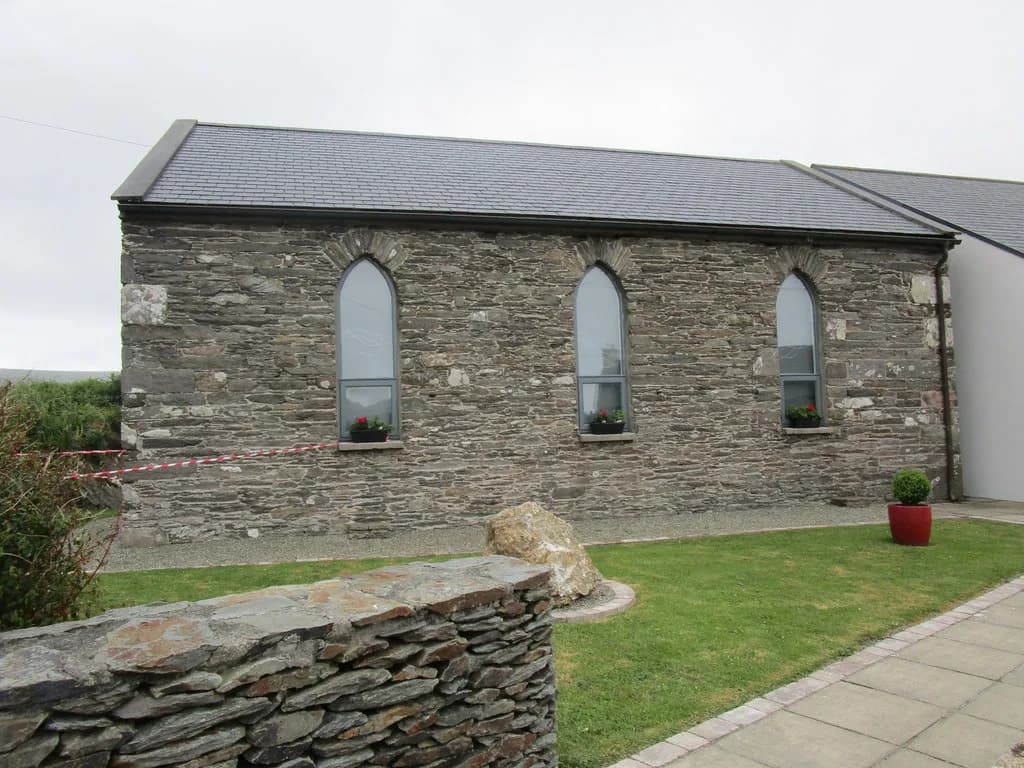
The museum occupies the former Methodist chapel built in 1845 for the Cornish miners who came to work the Allihies mines, according to the museum's own About Us page. The building's original purpose is part of the story: Cornish engineers and mine captains brought not only steam technology but their own religious and community life to this remote corner of West Cork. Knowing that the exhibition sits inside a chapel built for that migrant workforce gives the visit a useful frame before you look at the objects.
The museum as an institution is much younger than the building. Local residents began meeting in the mid-1990s to discuss how to preserve and present the area's mining heritage, and the museum opened in May 2007 after that community effort, with the operator noting it was attended by then-president Mary McAleese. It is a registered charity, and the museum states that all income supports its day-to-day operation and its role as a social and cultural hub. That background helps explain the museum's character: modest in scale, locally driven, and closely tied to the village rather than to a national collection.
What the Collection Covers
The museum's stated objective is to recognise, research, preserve and celebrate the mining heritage of Allihies, and it does so through artefacts, photographs, illustrations, original drawings and documents, diagrams, maps, text panels and several large-scale models. The emphasis is on the 19th-century workings, from the 1812 discovery through continuous working until 1885, with the later 1920s and 1960s phases also covered. If you have an interest in industrial machinery or in how a mining company organised labour and transport, the models and documents are likely to hold your attention longer than the panels.
The operator widens the story beyond copper. Displays set the local geology in a global context, place the mines within Bronze Age mining in West Cork, and include a stone implement found near the shore locally that the museum describes as the most southerly find in Ireland of such an implement. The human strand runs through the sociology of the 19th-century mining enterprise, the engineering itself, and the emigration that followed the closure of the mines, including movement to copper mines in the United States. This breadth is worth knowing in advance: the museum is not only a machinery display but an attempt to explain a whole mining community.
Because the collection is a work in progress rather than a fixed display, the museum says new material is added as it comes to light, and it has been assembling a library of books and documents for anyone researching further. If your visit is research-driven, ask at the desk what is currently available rather than assuming the library or any particular document is accessible on the day. The same applies to the genealogical service the operator advertises, which is handled through the museum office.
The Mining Story in Brief
The museum's account begins in 1812, when John Puxley, a local landlord, identified copper at Dooneen from the bright malachite staining on the quartz. The enterprise that followed was run by the Puxley family, and by 1842 the operator's chronology records 1,600 employees, a reminder of how many people the workings drew in at their peak. This is the core narrative the exhibition sets out: a rich local ore body, Cornish technology and capital, a large migrant workforce, and a landscape transformed by shafts, engine houses, reservoirs and dressing floors.
The museum's published chronology, credited to Dan Tietzsch-Tailor, traces the rise and decline of the workings. Employment figures fluctuate sharply, strikes over pay and conditions occur at Kealogue in the 1860s, and the mines change hands when Henry Puxley sells to the Berehaven Mining Company in 1868. The chronology records the Berehaven company wound up in 1884, the plant auctioned the following year, and minor production continuing until 1962. Treat that chronology as the museum's framework for the story rather than as a substitute for academic history.
Engine Houses as Off-Site Exhibits
The museum treats the surviving engine houses and mine buildings in the surrounding landscape as key off-site exhibits, and it has developed a mining trail with a published information map to help visitors read them. This is the single most useful thing to understand before arriving: the building in the village is the interpretation centre, while much of what the mines actually left behind stands outdoors. If you only have time for one or the other, the museum will make the outdoor remains far more legible.
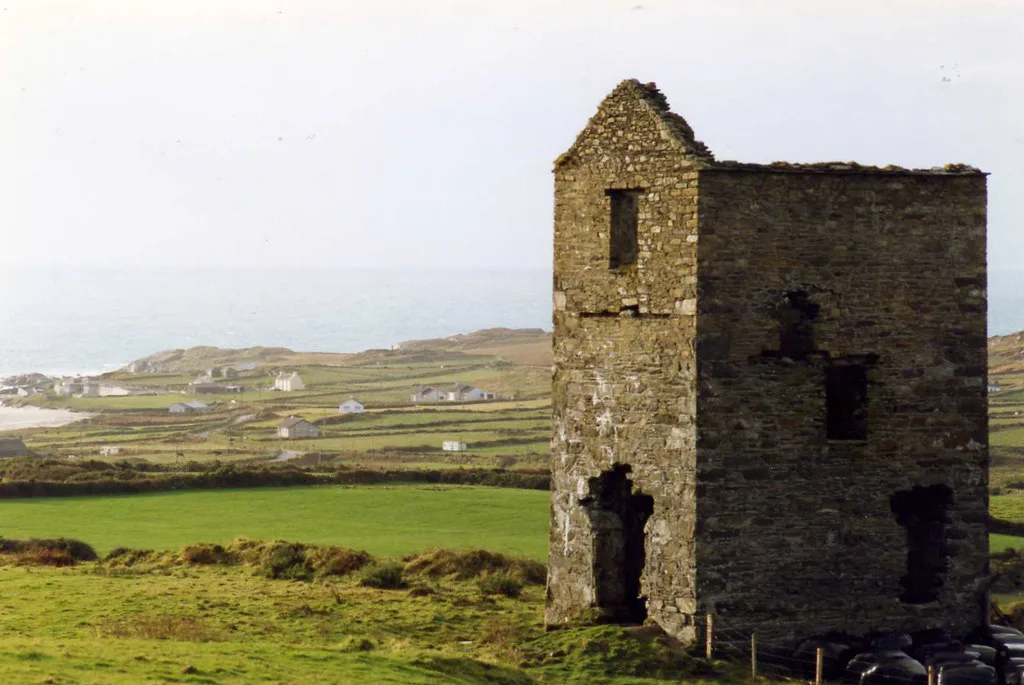
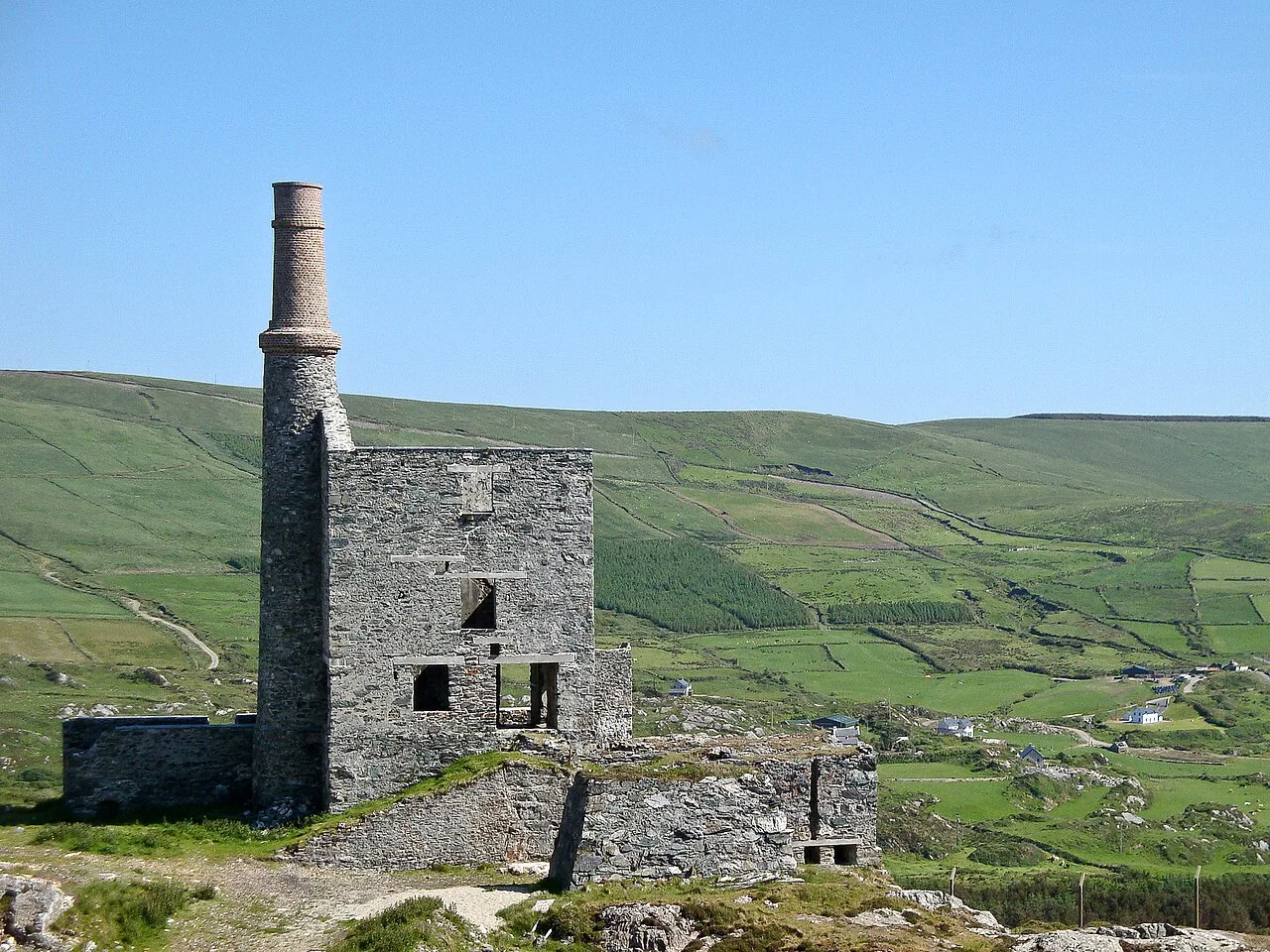
The engine houses are the most conspicuous remains, and the museum explains their function: they housed steam engines that pumped water from the workings, drove winding gear and lowered miners far below sea level. Discover Ireland's listing for the Allihies area describes disused mines, a gun powder house, dressing floors, man-made reservoirs and engine houses spread across the landscape. It also notes the viewing and trail context around the village. Use these descriptions to decide which structures you want to seek out on foot, and treat all of them as outdoor features exposed to Atlantic weather.
Weather matters here more than in a town-based visit. The museum sits in a landscape of open hillside and coastal exposure, and the structures are ruins rather than maintained attractions with shelters. Dress for rain and rough ground, and be realistic about how much ground you can cover in the time you have. The operator does not publish maintained paths, opening times or guided entry for the individual mine buildings, so plan around what you can see from public ground and do not assume access to private land or into adits.
Mountain Mine and the Man Engine House
Mountain Mine is the site the museum singles out for the most productive working in Allihies, in continuous production from its opening in 1813 until 1882 and reaching a depth of 421 metres below the surface. The operator notes that the vein was first worked as an open cast, with the gaping holes still visible, before underground mining took over. Its scale explains why it repays a proper look rather than a passing glance.
The man engine house at Mountain Mine is the structure to seek out. Erected in 1862 to operate the newly invented system for lowering and lifting miners, the museum describes it as the only man engine house in Ireland and one of only a few surviving worldwide, and notes that the Mining Heritage Trust of Ireland carried out conservation work on it in 2004. It is a specific engineering claim rather than a general superlative, which is what makes it worth understanding before you stand in front of it.
Other Named Mine Sites Worth Knowing
The museum's detailed page names several productive mines in the Allihies area, and the names help you make sense of the landscape. Dooneen, where mining began, was worked from an adit off the beach and later by shafts, with an engine house erected in 1823 to house a steam engine brought from Cornwall. Its remains, including the chimney base, are still to be seen, along with dressing floors and a high dam that stored water for the engines.
Caminches opened in 1818 and worked a long quartz vein, with two water-driven stamping mills and two engine houses recorded, though little now remains beyond shafts and ruined walls. Its reservoir was the largest in the area, and the museum records that in March 1833 its dam burst and flooded the mine, trapping four men and a boy. Kealogue, opened in 1842, was worked along a very long vein with over eighteen shafts and at least four engine houses, only one of which survives. Coom, the last to open in 1870, proved unproductive and closed in 1882.
One detail explains the beach: the museum states that quartz sand left over after the copper ore was extracted was washed down to Ballydonegan, where it made the beach now seen below the hillside. That connection between industrial waste and present-day landscape is one of the most striking things the museum explains. Knowing it changes the way the coastline reads from the village.
The Human Story
The museum does not present the mines as a purely technical triumph. Its chronology records hardships and disputes, including strikes by Kealogue miners over pay and conditions between 1861 and 1868, episodes when the company bought in provisions during famine years, and accidents recorded by mine captains. These accounts are sobering, and they are most useful read alongside the exhibition's treatment of housing, migration and community life. If you want the social history rather than the machinery, start with the panels on the workforce.
The museum states that after the closure of the mines many miners emigrated, particularly to the Butte, Montana copper mines, and that the exhibition covers this follow-on migration. That context matters in a region where emigration shaped nearly every community, and it gives the visit a wider frame than the industrial remains alone. There is also a genealogy service advertised through the museum office, useful if you are tracing Allihies mining families.
Practical Access and Seasonality
The museum publishes its opening pattern as 10.30am to 5.00pm from Easter to mid-October. For the off-peak period from November to March, the operator advises visitors to phone ahead on 027 73218 to check that the office is staffed for admission, rather than guaranteeing the museum is open on any given day. That single phone call is the practical decision point for anyone visiting outside the main season.
Admission is published by category: adult, student, child, family and guided group rates. The same page notes that art exhibitions can be viewed daily from 10.30am, which is a statement about the gallery rather than an indication that museum entry is free: check the current table on the operator's page before you go. If you are visiting with a group and want a guided format, confirm the arrangement and the applicable rate directly with the museum.
The operator states that the museum is wheelchair accessible and that accessible toilets are available on site. Beyond the building, there is a sensory garden at the rear offering a calm space, and the Copper Café has indoor and outdoor seating with a lunch menu for eating in or taking away. These are encouraging facts for visitors with mobility needs, though they concern the museum site rather than the wider mine trail.
Facilities and Interpretation
Multilingual audio guides are available to help visitors explore the exhibitions, and the museum also provides Irish Sign Language provision for visitors with hearing impairments. If you have specific access requirements or questions, the operator invites you to contact the museum in advance by phone or email so that particular needs can be discussed. That is worth doing if you need the audio guide in a particular language.
The café and gallery have developed alongside the museum, with indoor and outdoor seating and a shop counter, and the operator describes the café as welcoming and accessible to all visitors. It is described as an amenity attached to a community museum rather than a destination in itself, so check on the day rather than assuming a fixed café schedule. A museum built around local stone, machinery and oral memory also sits comfortably within the wider story of irish traditional crafts, and our guide to irish pottery covers another making tradition with its own working sites around the country.
How to Plan the Visit
The most sensible approach is to treat the museum as the first stop and the landscape as the second. Spend time with the models, maps and panels to understand the engine houses, then walk out to read the remains with that context in mind. Allow longer if you are interested in the engineering, because the collection is denser than its scale suggests. If you enjoy industrial archaeology, our guide to museums in Cork covers the city and county collections that broaden the same heritage story.
Before setting out in the off-peak months, confirm staffing and check the operator's website and social channels for changes to opening times. Within the site, ask what is currently available rather than assuming the library or any research material is accessible. Outside the museum, remember that the mine buildings and engine houses are outdoor landscape features and the operator does not publish safe paths, opening times or guided entry for them: apply normal care on rough and exposed ground.
Plan Your Visit
Allihies Copper Mine Museum is the right starting point for understanding this corner of the Beara Peninsula, and a worthwhile visit in its own right for anyone interested in industrial archaeology, Cornish migration or West Cork communities. Go expecting a compact, locally run exhibition with a rich set of documents and models, and pair it with time outdoors among the engine houses it interprets.
Confirm the seasonal opening pattern and admission categories before you travel, phone ahead in the November to March period, and factor in the weather for the outdoor trail. With that preparation the museum and the mining landscape together give a fuller picture than either offers alone.
Explore more Ireland guides
Frequently Asked Questions
Is the Allihies Copper Mine Museum the same as the mine itself?
No. The museum occupies the former Methodist chapel in Allihies village and presents the mining story indoors through documents, models and panels. The mines, engine houses and dressing floors are separate outdoor remains in the surrounding landscape, which the museum treats as off-site exhibits and interprets with a developed trail and information map. Plan for both if you want the full picture, and keep in mind that the outdoor structures are exposed ruins rather than maintained attractions.
Do you need to book tickets for the museum?
The operator publishes admission by category—adult, student, child, family and guided group rates. Groups wanting a guided format should contact the museum directly to confirm the arrangement and the applicable rate. For opening times, check the published seasonal pattern and, in the November to March period, phone ahead to confirm the office is staffed before you travel.
Is the museum wheelchair accessible?
The operator states that the museum is wheelchair accessible and that accessible toilets are available on site, with a sensory garden at the rear of the building. These provisions relate to the museum site itself. The surrounding mine buildings and engine houses are outdoor landscape features, and the museum does not publish information about paths, surfaces or access for them, so assess the ground yourself or ask staff before setting out.
What can you see on the mine trail around Allihies?
The landscape holds named mine sites including Dooneen, Caminches, Coom, Kealogue and Mountain Mine, with surviving engine houses, shafts, dressing floors and reservoirs. Discover Ireland's listing describes disused mines, a gun powder house, dressing floors and man-made reservoirs across the area. Treat these as outdoor ruins exposed to Atlantic weather, and do not assume marked paths or permission to enter private ground or mine openings.
Why is the man engine house at Mountain Mine significant?
The museum states that the man engine house was erected in 1862 to operate a newly invented system for lowering and lifting miners, and describes it as the only man engine house in Ireland and one of only a few surviving worldwide. The Mining Heritage Trust of Ireland carried out conservation work on the building in 2004. It is a precise engineering distinction, which is why the museum singles it out from the other engine houses in the area.
When did copper mining begin and end at Allihies?
According to the museum's account, John Puxley identified copper at Dooneen in 1812, and mine workings continued through the 19th century, with the museum's chronology recording the Berehaven Mining Company wound up in 1884 and the plant auctioned the following year, and minor production continuing until 1962. Treat these dates as the museum's own published chronology rather than as an independent academic history, and read the exhibition panels for the sequence in detail.
Can you visit the mines in winter?
The museum publishes 10.30am to 5.00pm from Easter to mid-October, and for November to March advises visitors to phone 027 73218 to check that the office is staffed for admission. The outdoor mine remains are landscape features without published opening times or guided entry, so winter visits depend on daylight and weather rather than a schedule. Confirm by phone before making a special journey outside the main season.
Sources
You might also like



Continue reading
More guides you'll find useful




