
Irish Folk Art: Vernacular Objects at Turlough Park
Irish folk art is best read through everyday objects. See painted dressers, regional chairs, straw work and St Brigid's crosses at Turlough Park, Castlebar.
On this page
There is no single official Irish folk art style. What survives from rural Ireland is a body of everyday objects, from dressers and chairs to rush crosses and straw bedding, shaped by household need, local materials and the habits of the people who used them.
The most practical place to study that tradition is the National Museum of Ireland – Country Life at Turlough Park, Castlebar, Co. Mayo. Its exhibitions are free to enter, and the museum is just off the N5, roughly half an hour from the Mayo section of the Wild Atlantic Way.
Why Turlough Park Works as the Visitor Anchor
Turlough Park suits this subject because it treats furniture, tools and decorative customs as one connected account of rural life. The permanent galleries sit in a single complex with a café, gift shop, picnic areas and a greenway on site, so a focused visit does not need to be split across town.
Admission to the exhibitions is free, and the museum is well signposted off the N5 in both directions. Drive about five minutes from the junction and the entrance appears on your left, marked by iron gates between flag poles.
Opening hours are Tuesday to Saturday 10am to 5pm and Sunday and Monday 1pm to 5pm, with a short Christmas Eve window. The museum closes on Christmas Day, St Stephen's Day and Good Friday, so check the operator page before setting out on a holiday period.
Set Expectations Before You Go
Exhibition status changes, and the museum's own index is the authority on what is open. Hearth and Home is currently listed as closed temporarily, and no reopening date has been announced; check the index before relying on any single gallery.
Trades and Crafts and The Year in Ireland are listed as permanent, and both address the core themes of this guide. Build the visit around them rather than around a single gallery, and you can still cover painted furniture, crafts and seasonal custom in one afternoon.
The Hearth-Centred Home
Almost all daily activity in a traditional Irish home was centred on the hearth. It had to be kept in working order for cooking, cleaning and drying clothes, and for handwork done by firelight, which explains why house building and furnishing were arranged around it.
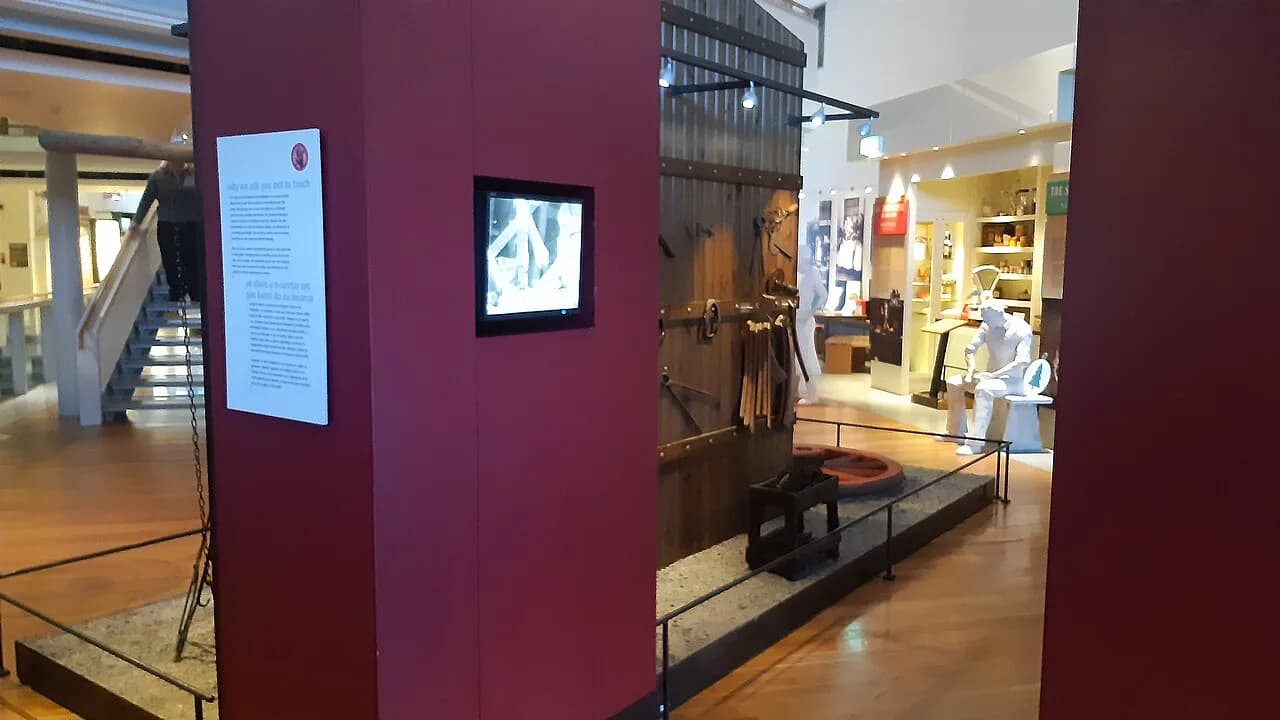
That exhibition covers building, maintaining and furnishing a house as well as feeding and clothing the family, with the craftsmen and craftswomen who supplied those needs. It is listed as temporarily closed, so treat that material as context while you plan rather than a room you can currently walk through.
The Dresser and Painted Furniture
The dresser was the most valued piece of furniture in an Irish country home because it displayed the household's standing. Shelves and racks above held ceramic ware, while the base stored food, pots and butter-making utensils, making it a storage unit and a statement at once.
Paint was practical before it was decorative. Most rural furniture was painted to guard timber against damp and to make cleaning easier, and dressers and presses could be repainted periodically, so old pieces often carry several layers that trace changing fashions in colour.
Local makers also imitated expensive grained woods using paint and a technique called scumbling, in which a stain is applied over a light base coat and drawn off with a graining comb. Look for that effect on case furniture, then compare it with plain painted surfaces nearby.
Seats and Regional Variation
Chairs show how regional variation worked in practice. The creepie, a roughly made stool often little more than a raised log, is among the earliest rural seating types, and the tradition moved through súgán chairs with rope seats and straw armchairs to ladder-back and Windsor forms.
Some chairs are named after the counties that developed them, such as Sligo and Leitrim forms. A heavy three-legged seat in oak and ash made in County Mayo in the mid nineteenth century is a type recorded only in Connacht, and curators suggest it arrived with Scottish settlers, a good reminder that styles were not invented in isolation.
Northern dressers tend toward simpler designs and restrained decoration, possibly reflecting Scottish influence, while the wider tradition drew heavily on English and Welsh furniture already established before it. The same regional thinking explains the named castle types and local building styles you meet on the road, as a look at the castles in county galway shows. For an older layer of the same regional story, compare these county-named forms with the surviving ancient sites ireland preserves in the landscape. Judge a piece by what it was made from, who made it and where it sat, not by prettiness alone.
Small Carved and Turned Work
Spoons were the commonest utensil, carved from whatever hard material was at hand, including horn, bone and wood, often with intricate patterns. Ladles were turned from wood by local craftsmen, and these small objects reward the same attention as a chair: grain, wear and the marks of use record how often a tool was handled.
Basketmakers also produced furniture such as chairs and cradles from wicker rods into the early twentieth century, and householders plaited straw into chairs, stools, mats and mattresses into the mid twentieth. Clay vessels belong to the same household world, and for that line of craft, see the Irish pottery guide to compare potting traditions with the straw and woodwork here.
Craft as Skill, Not Decoration
Before mass production, most household objects were made by hand from locally available materials, by householders themselves or by carpenters, joiners, wheelwrights and basketmakers. Similar objects differed by region in material and design, sometimes visibly so in chairs, butter churns and thatched roofs.
Traditional craft workers rarely used written measurements or patterns. They relied on accuracy built through rigorous apprenticeship, often passing skills and valued tools down within a family, which is why forms stayed recognisable across generations.
Function generally outranked aesthetics. Mass-produced goods, new transport networks and factory furniture using materials such as plywood displaced that work, reducing demand for blacksmiths, harness makers and basketmakers, though some rural makers continued producing vernacular furniture.
Straw, Rush and Seasonal Custom
The St Brigid's Cross is the most familiar piece of Irish folk art and still appears above front doors and in kitchens. Styles and materials varied considerably: straw, rushes and reeds were common, but grass, hay, wood, goose quills, wire and fabric were also used, in diamond, interlaced and wheel shapes with two, three or four arms.
The four-armed cross is the most recognisable today largely because it became an emblem for RTÉ television from 1961, which is a modern reason for its prominence rather than evidence that other forms were rare. The Irish Folklife Collection at Turlough Park holds examples of most regional styles.
Other customs attached to the feast included the Crios Bríde, a large straw belt passed over people in parts of Connacht, and the Brat Bríde, a cloth left out overnight and kept for the year. Both were understood as protection against illness and pain, which is a matter of traditional belief rather than an effect to expect.
The Quarter Days
The Year in Ireland exhibition frames the farming year through quarter days: St Brigid's Day on 1 February for spring, Bealtaine on 1 May for summer, Lúnasa on 1 August for autumn and Samhain on 1 November for winter. Many associated ceremonies took place on the eve rather than the day itself.
These festivals tied the passage of time to work and to the safety of the family and farmstead, and elements reach back to antiquity. Read the crosses and straw objects in this light: decoration and protection were part of the same practice, not separate categories.
A Living Tradition
Folklore keeps adapting, and the museum has commissioned contemporary responses to its collections. In 2020, artist Maria McKinney created Straw Sister for the OnSight project, a sculptural work exploring the Strawboys tradition alongside artificial insemination in cattle breeding.
That project is a dated record from 2020, not a standing installation, so do not plan a visit around seeing it. It does show the argument this collection makes: masking and straw work were never fixed, and new practices take their place in the same tradition.
Plan Your Visit
Allow two to three hours for the permanent galleries and check the exhibitions index on the day of your visit, since Hearth and Home is listed as temporarily closed. The museum is fully wheelchair accessible, with lifts to all floors in the exhibition galleries and designated parking spaces on site.
By car, approach from the N5; from Westport the museum is about 25km away. Mayo Local Link route 454 runs a daily bus linking the museum with Castlebar and Ballina, and Castlebar Train Station can advise on rail connections.
For the wider craft landscape, including woollen mills and glass studios, the Irish traditional crafts pillar sets these objects in a national context. Pair that background reading with time in front of the dressers and chairs themselves, because the detail only registers at close range.
Explore more Ireland guides
Frequently Asked Questions
What is Irish folk art?
It is the body of everyday objects made and decorated by country people and local craftsmen: painted dressers, regional chairs, carved spoons, straw and wicker work, and rush crosses. The value lies in use and local variation rather than a single uniform national style.
Where can I see Irish folk art in Ireland?
The National Museum of Ireland – Country Life at Turlough Park, Castlebar, Co. Mayo, holds the Irish Folklife Collection and permanent galleries covering trades, crafts and the seasonal year. Check the museum's exhibitions page before travelling, as individual galleries change status.
What objects should I look for in the collection?
Start with a dresser, a súgán or locality-named chair, a settlebed and the carved spoons. Then look at the St Brigid's crosses, where regional styles and materials differ widely and show how varied the tradition is.
Why do Irish country chairs differ by region?
Makers used locally available materials and worked within inherited patterns, so forms developed differently in different places. Some chairs carry county names, and at least one Connacht type is linked by curators to Scottish settlers, showing outside influence as well as local habit.
What were painted dressers for?
A dresser displayed ceramic ware on its upper shelves and stored food, pots and butter-making utensils below, so it signalled household standing while doing real work. Paint protected the timber from damp, made cleaning easier and was refreshed as fashions in colour changed.
How do I get to the National Museum of Ireland at Turlough Park?
The museum is just off the N5 outside Castlebar and is signposted in both directions. Mayo Local Link route 454 runs daily between the museum, Castlebar and Ballina, and the site has a free car park with disability spaces and a set-down area near the house.
Is the Hearth and Home exhibition open?
The museum currently lists Hearth and Home as temporarily closed and gives no reopening date. Trades and Crafts and The Year in Ireland are listed as permanent, so plan around those and confirm on the day.
Sources
- Irish County Furniture FAQs | National Museum of Ireland
- St Brigid's Day | National Museum of Ireland
- Trades and Crafts | Country Life | National Museum of Ireland
- The Year in Ireland | Country Life | National Museum of Ireland
- Hearth and Home | Country Life | National Museum of Ireland
- OnSight 2020: 'Straw Sister' by Maria McKinney | Country Life | National Museum of Ireland
- Exhibitions | Country Life | National Museum of Ireland
- Opening Hours, Location and Facilities | Country Life | National Museum of Ireland
You might also like



Continue reading
More guides you'll find useful




