
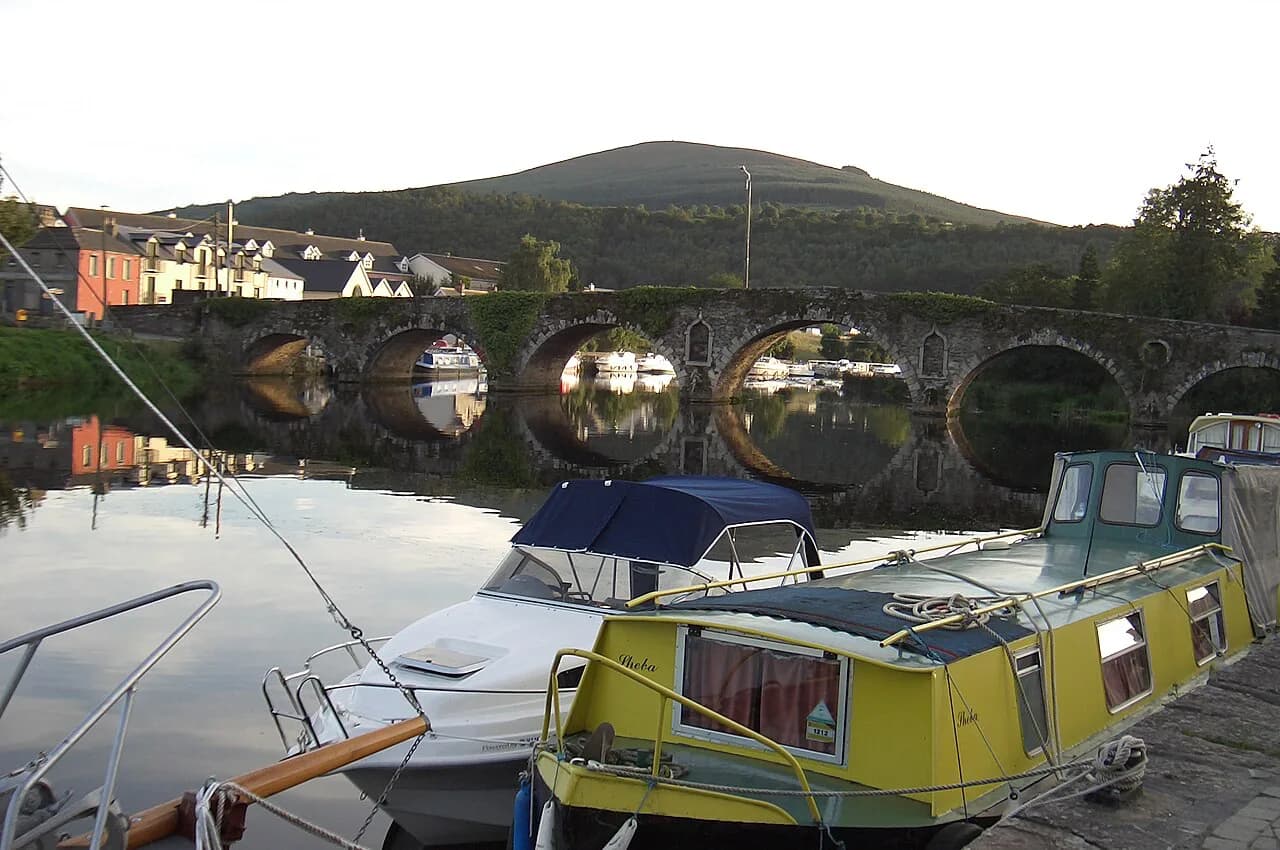
Cushendale Woollen Mills: A Working Mill in Graiguenamanagh
Plan a visit to Cushendale Woollen Mills in Graiguenamanagh, County Kilkenny, with showroom hours, appointment-only tours and the site's layered history.
On this page
Cushendale Woollen Mills is a working family mill at Mill Road, Graiguenamanagh, County Kilkenny, R95 PP83. Visitors can browse the showroom during published hours, but the working mill is seen on tours booked in advance, so the two experiences should be planned as separate choices.
The temptation is to treat the place as a single historical attraction. In practice it holds several distinct stories: a monastic mill site on the Duiske River, a Cushen family weaving business, and a modern design-led textile studio. Keeping those threads apart makes a visit more legible, and it gives you sensible questions to ask on a tour.
Where the Mill Actually Is
Graiguenamanagh sits in County Kilkenny, and the mill stands on Mill Road beside the Duiske River. That matters for planning: a break in Kilkenny city will not put you at the door. The mill's own site gives the full address and postcode, which is the reliable thing to enter into a navigation app before setting out.
The town's Irish name, Gráig na Manach, is glossed by the mill as the Village of the Monks, a reference to the monastic foundation that shaped the settlement. Treat that as the mill's own account rather than an independent scholarly statement. It is still a useful frame: the river, the religious house and the textile trade belong to the same small place.
For readers building a wider craft itinerary, this is one stop within a broader field of Irish making rather than a standalone theme park. A background read on Irish traditional crafts helps place a working mill alongside other collection and studio stories.
Two Histories, Deliberately Kept Apart
The mill's account of its site begins in 1204, when Cistercian monks and the Anglo-Norman knight William Marshall founded an abbey at Graiguenamanagh. The same account says a woollen mill has operated there since that foundation, and that monks worked wool, yarns and cloth for export to European textile centres including Lucca. These are the operator's historical claims, presented on its own pages.
The family history is a separate chronology. Six generations of the Cushen family have worked in textiles in Graiguenamanagh since the 1700s, beginning with the weaver Sylvester Cushon; the Cushendale name was established in the 1920s under Philip. Philip and his daughter Miriam run the business today. Nothing here implies the present company, building or machinery dates from the medieval period.
A visit is more interesting if you hold both timelines in view at once. The site carries a long institutional memory, while the business you encounter is a documented family enterprise of more recent centuries. The mill's own pages set out both the monastic foundation story and the Cushen family succession, so the distinction between them is easy to trace before you arrive.
The Mill Race and the Water
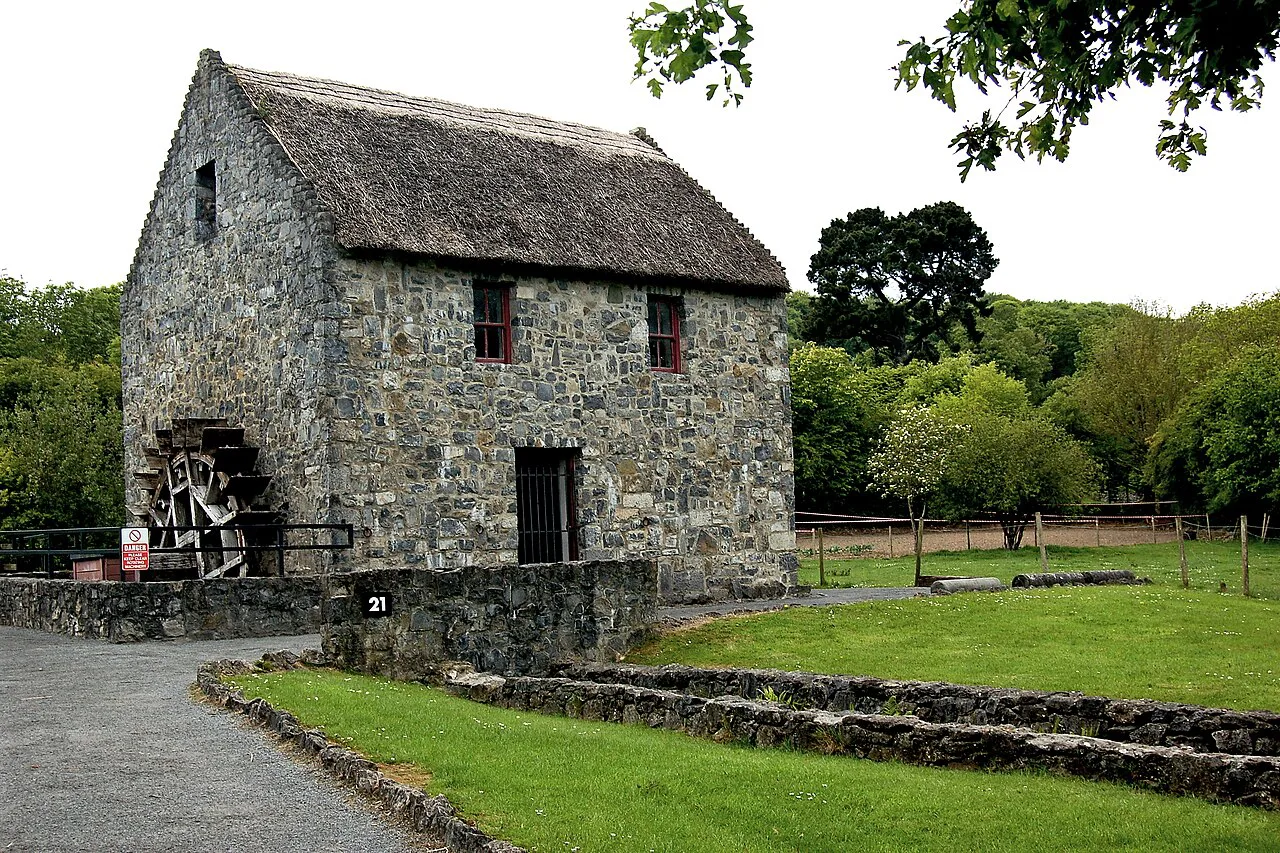
The Mill Race, described by the mill as an artificial channel built in 1204 and fed from the Duiske River, still flows past the site. The operator calls it one of Ireland's oldest surviving mill races, maintained across centuries by successive mill owners. That continuity is the point of interest, not any claim that the channel still turns machinery.
The mill is explicit that the race no longer generates power. Water is still described as important to production, with its quality linked to the colour, texture and character of the cloth. Visitors should therefore read the race as working heritage and a live part of the process, not as a Victorian-style waterwheel demonstration.
This is where the site's geography rewards attention. The Duiske River, the channel and the mill buildings form a compact landscape that explains why cloth-making settled here at all. If you walk the town before or after your visit, the watercourse is the feature that ties the abbey ruins, the streets and the mill together.
Inside a Vertical Mill
Cushendale describes itself as one of Ireland's last vertical mills, meaning the main stages of production happen on one site rather than being contracted out. The published sequence runs from fleece through yarn-making, designing and weaving, wet and dry finishing, and finally hand finishing, with each piece checked and labelled by hand.
That structure is why a guided tour can be more informative than a shop visit alone. Vertical production keeps dyeing, weaving and finishing decisions close together, and the mill frames its design process as a conversation between designer and maker. On a tour, the useful questions concern how a colour is settled, how a finish changes the handle of a cloth, and where a given yarn was spun.
Blankets, scarves and throws are the finished forms the mill names, and the showroom is where those pieces can be handled and compared. Loom or finishing demonstrations during a tour are not promised on the operator pages, so treat any such moment as a bonus rather than a scheduled feature.
Fibres and Sourcing
Not every product is Irish wool. The mill works with three named fibres: Irish wool from the Galway sheep, a native breed sourced from partner farmers around Ireland; mohair from the Angora goat, with Oeko-Tex certification for its mohair yarns; and merino lambswool certified under the Responsible Wool Standard. Blanket descriptions that assume an all-Irish fleece are therefore too simple.
The sourcing story also has a calendar. The mill says it visits each partner farm during June and July to collect fleece, naming farmers in Kilkenny, Kildare, Wexford, Sligo, Galway and Mayo. That detail gives you something concrete to ask about: which of the fibres in a given throw came from which breed, and how that affects warmth and texture.
Irish wool has its own craft lineage beyond this one mill, including weaving traditions documented in public collections. A wider read on Irish weaving is a useful companion if you want to compare how different makers handle fleece, loom work and finishing.
Design and the Kilkenny Design Workshops
A significant design episode in the mill's history is its participation in the Kilkenny Design Workshops, which the mill says the Irish government established in 1963 to strengthen design in Irish craft. European designers were brought together with Irish makers in weaving, ceramics, furniture and silversmithing. For Cushendale, this is a design-development chapter, not a founding date.
The mill's current collections are described as resting on design, colour and new fibres, and its palette is said to draw on the surrounding landscape. When you look at a throw in the showroom, those ideas are the interpretive key: pattern and colour come from a deliberate studio process rather than a fixed heritage template.
Ceramics was one of the disciplines the workshops touched, which makes Kilkenny's craft landscape a natural wider context. Irish pottery offers a parallel route through studio-made work in the same county and beyond.
Planning a Visit: Showroom and Hours
As published by the mill in October 2026, the showroom opens Monday to Friday from 9am to 5.30pm and Saturday from 10.30am to 5.30pm. It closes daily from 12.30pm to 1.30pm and is shut on Sundays and bank holidays. Those gaps matter more than the broad hours, so aim to arrive with a clear margin on either side of lunch.
Opening is not the same as access to the working floors. The showroom is the browsing space, while the mill itself is seen on tours. Plan a showroom stop if you want to look at blankets, compare colours and buy without committing to a time slot; that is the lower-commitment option.
Hours can change around holidays, so confirm the day before travelling, especially outside the summer months. This is the one current-details check worth building into the trip.
Tours, Prices and the Capacity Caveat
Tours are by appointment only and are subject to operational capacity at the mill. Booking is handled by email, and the mill asks for your preferred date, group size and any special requirements. Since availability depends on the working schedule, a request sent at short notice may not be met; enquiring well ahead is the safer approach.
The mill publishes two tour prices: a private tour at €40 per person and a group tour at €20 per person. Do not expect discounts beyond these published rates, and note that the private format is suited to a small party while the group rate is framed around coach groups, clubs and educational visits.
The trade-off is straightforward. A tour costs money and depends on scheduling, but it is the only route to the production side; the free showroom visit is easy and flexible but stops at the shop floor. Deciding which you want first prevents a wasted journey.
What a Visit Does Not Guarantee
Some details are simply not published, and it is better to know that in advance. The operator pages do not state a tour duration, a maximum group size, or facilities such as a café or parking. They also do not promise that a particular member of staff will be available, so build your questions around the mill rather than a named guide. If you plan to combine the mill with time in the county town, a Kilkenny heritage guide covers what else rewards a stop in the city.
Accessibility information is likewise absent from the published visitor material. If mobility, seating or step-free movement through an old mill building matters to your party, raise it in the booking email so the team can answer for your specific needs rather than leaving you to guess.
One useful frame is to think of the mill as part of Ireland's broader craft landscape, where studios and working sites vary widely in how much they open to the public. An overview of Irish folk art helps calibrate expectations for that kind of small-site visit.
Plan Your Visit
Cushendale rewards a two-part plan: a showroom stop within the published hours, and an emailed tour request for the production side. If a tour is not possible on your dates, the showroom still gives you the textiles and a conversation, which is a reasonable second best.
Before travelling, check the mill's visitor page for current hours and tour availability, then confirm your booking in writing. Treat the 1204 monastic story and the Cushen family history as separate chapters, and ask which applies to what you are looking at. For another heritage guide, read about Jerpoint Glass Ireland.
Explore more Ireland guides
Frequently Asked Questions
Where is Cushendale Woollen Mills?
It is on Mill Road in Graiguenamanagh, County Kilkenny, with the postcode R95 PP83. That is the town of Graiguenamanagh, not Kilkenny city, so allow for the difference when planning a route from Kilkenny or from elsewhere in the south-east.
Can you visit without booking a tour?
Yes. The showroom is open to visitors during the mill's published hours, and you can browse without a tour. The working mill itself is only seen on tours booked in advance, so showroom opening should not be read as open access to the production floors.
How much does a mill tour cost?
The mill publishes separate private and group tour rates on its own visitor page; both formats are by appointment only and subject to operational capacity. Check that official price list or your booking email for the current rate before you commit.
What are the showroom opening hours?
As published in October 2026, the showroom opens Monday to Friday from 9am to 5.30pm and Saturday from 10.30am to 5.30pm. It closes for lunch daily from 12.30pm to 1.30pm and is shut on Sundays and bank holidays. Hours can change, so check before travelling.
Does the Mill Race still power the mill?
No. The mill describes the Mill Race as a 1204 channel fed from the Duiske River that no longer generates power, although water is still linked to the quality and character of the cloth. Read the channel as surviving working heritage, not as live machinery.
Is all the wool Irish?
No. The mill works with Irish wool from the Galway sheep, along with mohair from the Angora goat and merino lambswool. It also notes certification for its mohair and merino yarns, so an item is not necessarily made from Irish fleece.
What connects the mill to the Kilkenny Design Workshops?
The mill participated in the Kilkenny Design Workshops, which the operator says the Irish government established in 1963 to strengthen design in Irish craft. That experience shaped its emphasis on design, colour and new fibres; it is not the mill's founding date.
How far back does the mill site's history go?
The mill's own account traces a mill on the site to 1204, when Cistercian monks and William Marshall founded an abbey at Graiguenamanagh. The Cushen family business dates from the 1700s, so the site's history and the present company are distinct stories.
Sources
- Medieval History - Throws and Blankets - Cushendale – Cushendale Woollen Mills
- About Our Wool - blankets and throws - Cushendale – Cushendale Woollen Mills
- Visit Us | Artisan Irish Woollen Mill, Kilkenny – Cushendale Woollen Mills
- Our Team | Six Generations of Cushendale – Cushendale Woollen Mills
- Made Slower, Made for a Lifetime – Cushendale Woollen Mills
- Design Ethos – Cushendale Woollen Mills
You might also like



Continue reading
More guides you'll find useful





