
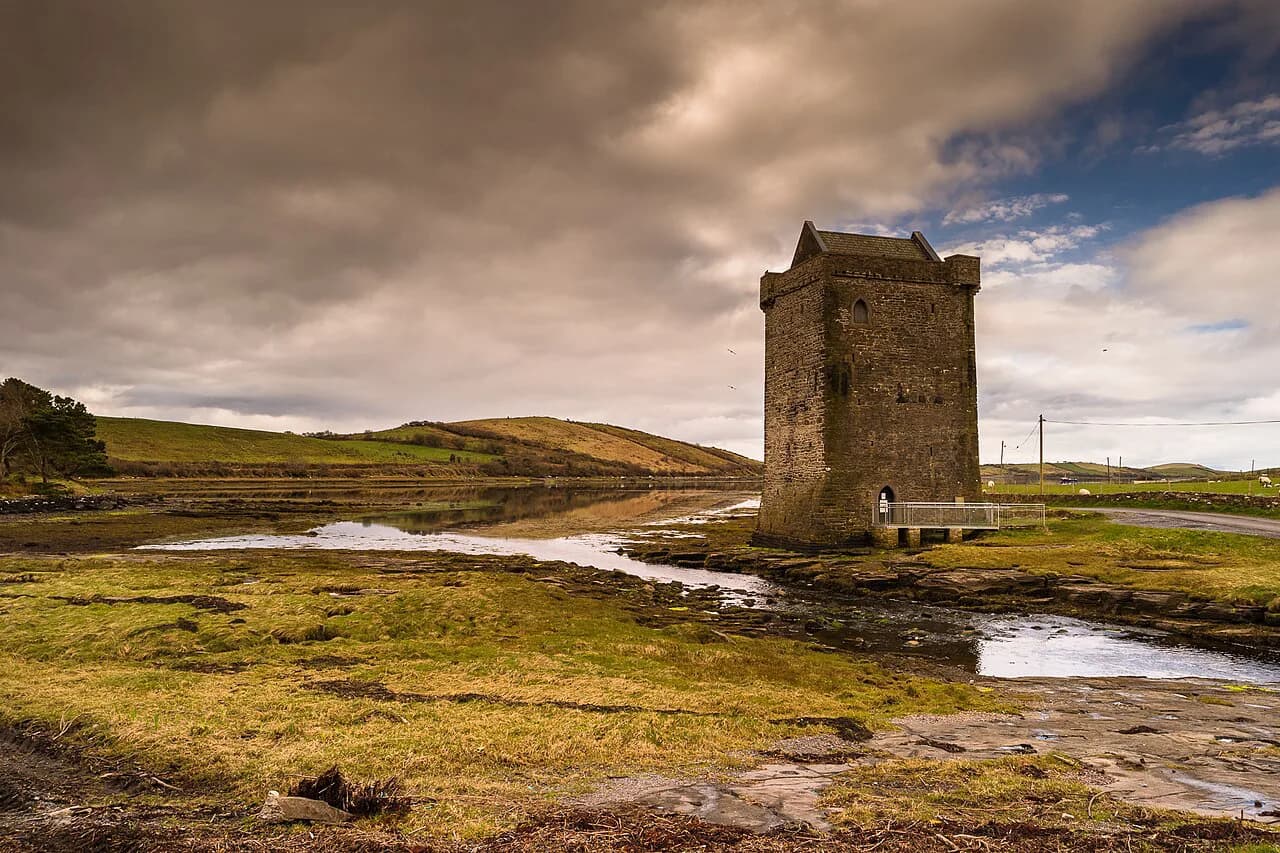
Rockfleet Castle: Grace O'Malley's Tower House in Clew Bay
Rockfleet Castle is a four-storey tower house on a Clew Bay inlet, tied to Grace O'Malley. Access is not permitted while conservation works are underway.
On this page
Rockfleet Castle stands on an inlet of Clew Bay in County Mayo, a four-storey tower house in state guardianship and best known through its association with Grace O'Malley. The governing fact for any trip is the current notice: access is not permitted as conservation works are underway at the site.
That means this is not a normal visitor guide. The OPW describes the property as unguided and asks the public to take care around such sites, but no reopening date, hours or ticketing information accompanies the access restriction. Read the castle as a Clew Bay landscape subject and a documented piece of O'Malley history, not as an interior to explore.
Current Access Status: What the Official Notice Says
Heritage Ireland, the OPW's public heritage service, lists Rockfleet Castle as a National Monument in state guardianship and states that access is not permitted because conservation works are underway. The notice gives no completion target, no temporary viewing arrangement and no ticketing detail, so nothing should be assumed about partial entry.
The same page frames the wider class of unguided sites as places where visitors must exercise care and caution, while noting that the OPW accepts no liability for injuries or losses. That general caution describes unguided heritage sites at large; it does not create an invitation to cross onto a works site.
Because the restriction is the only practical statement the official page makes, the sensible decision is to check the page again shortly before any journey west and to treat an unchanged notice as unchanged closure. Do not rely on third-party listings or map aggregators for opening status, since they carry no authority to reopen an OPW works site.
Names, Setting and Architecture
The Irish name is Carraig a Chabhlaigh, rendered as Rock of the Fleet, a name that ties the building to its maritime setting. A map-based aggregator lists the alternative English form Carrickahowley Castle, useful mainly for matching older sources and signposts.
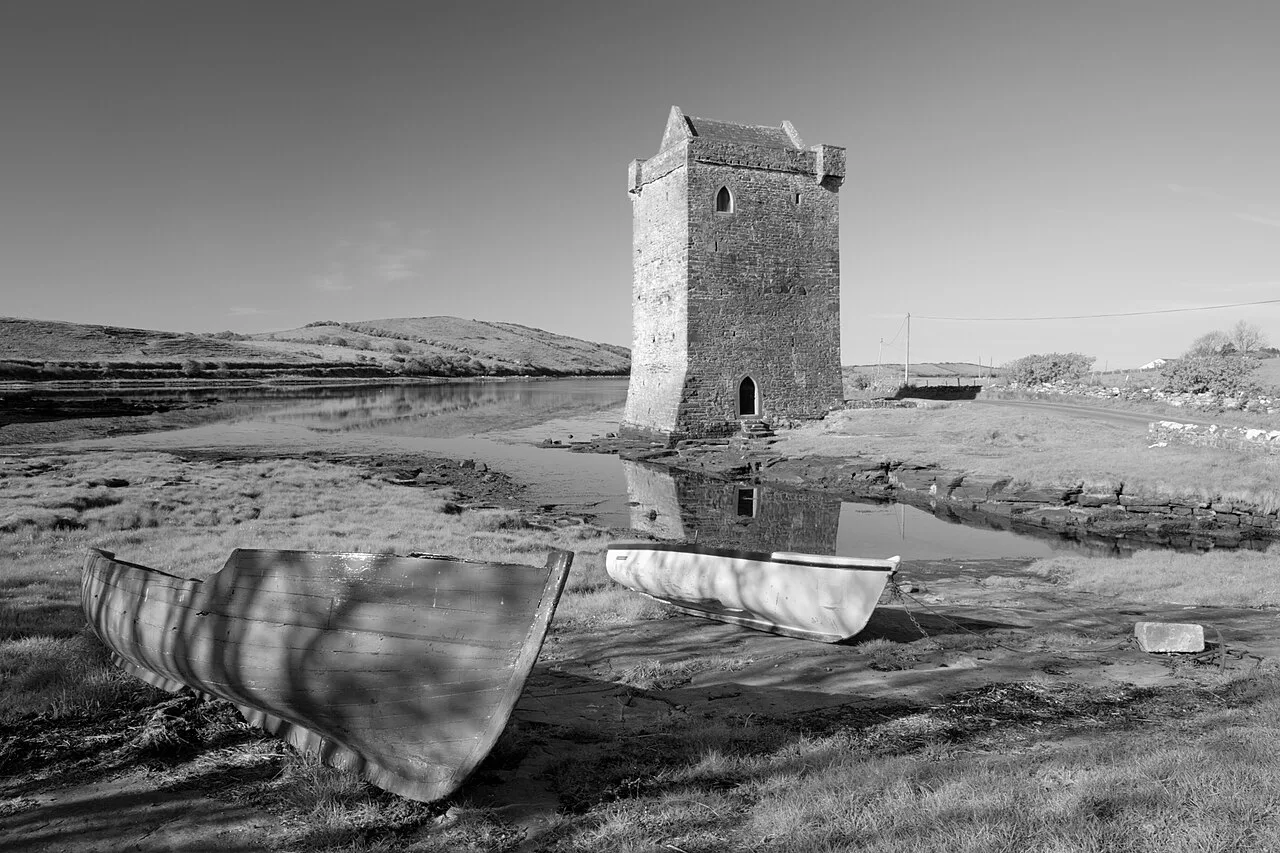
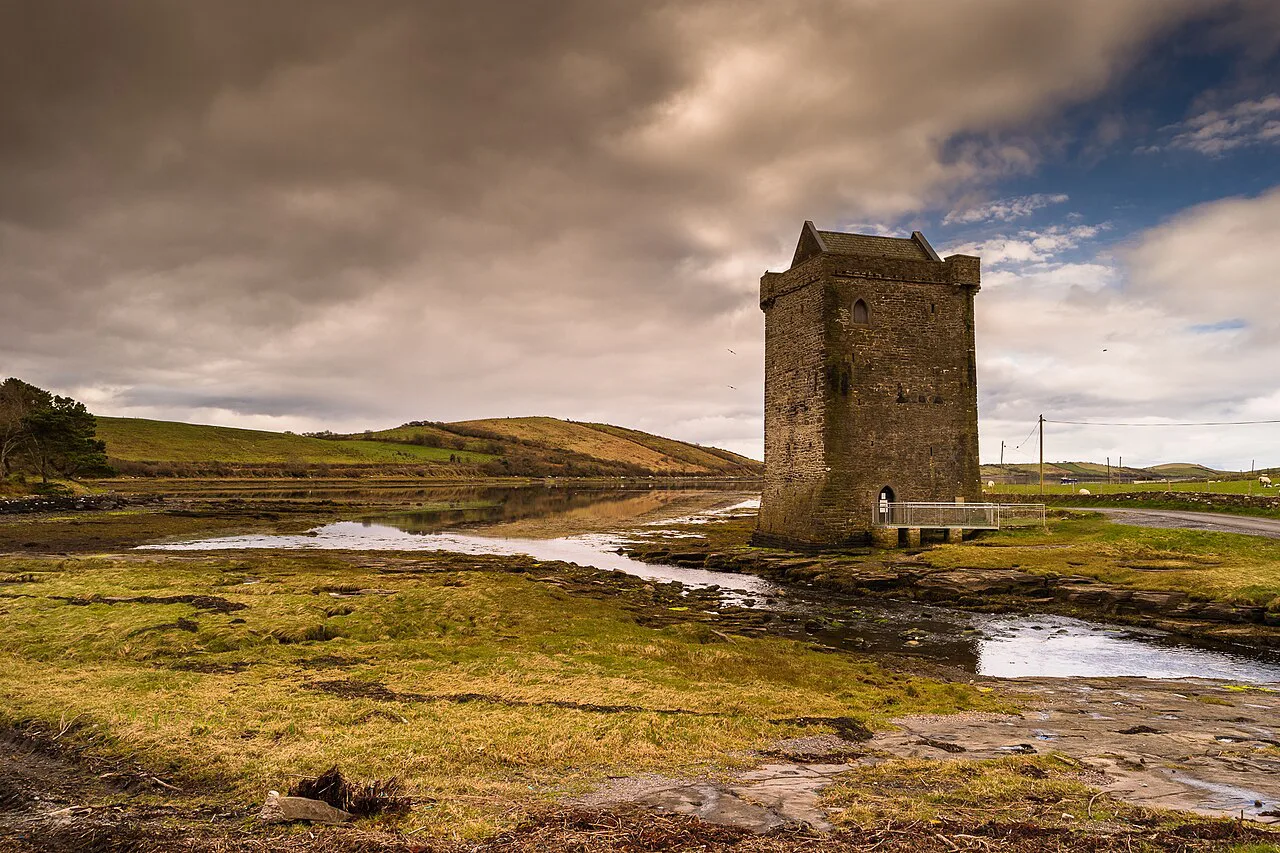
The castle stands near Newport in County Mayo, at roughly 53.8967, -9.6324, on an inlet of Clew Bay, per the same aggregator. Heritage Ireland describes it as four storeys tall and notes that at high tide the water brushes against the castle walls, which is the detail that explains why the structure reads as a sea-edge tower rather than an inland stronghold.
For readers learning to read this building type, the tower's compact vertical plan, thick walls and tidal siting place it within the broad story of [irish tower houses](/irish-tower-houses), a form repeated across the west with local variations in scale and setting.
MacWilliam Burke Ownership and the Reported Build Date
Heritage Ireland records that Rockfleet was under the ownership of the MacWilliam Burkes, the family network whose name recurs across late medieval Connacht. The official page does not supply a construction date, so the castle's origins are best described through its documented owners rather than an assumed building campaign.
The mid-fifteenth-century date that circulates online comes from a map aggregator, which classifies the castle as a tower house and a National Monument and gives that period as the build. Treat this as reported rather than established: it is a secondary compilation, not a primary record, and the official page is silent on the point.
The distinction matters to anyone tracing a family or a lordship through masonry. A tower house can be attributed on stylistic grounds long before any document fixes a date, and a labelled attribution lets you weigh it against archaeological or archival evidence rather than repeating it as settled fact.
Grace O'Malley at Rockfleet: Marriage and the Move
The castle's fame rests on Grace O'Malley, the chieftain remembered as the pirate queen of the O'Malley lordship. According to Heritage Ireland she married her second husband, Richard an Iarainn Burke, in 1566 and moved into Rockfleet a year later, making the place her married base in Clew Bay.
The official account adds that she is said to have continued her lifestyle of piracy from this base. Such statements carry the qualifier the source itself applies, and they are worth keeping in view whenever later retellings of her career at Rockfleet grow more definite than the record allows.
The Galway Fleet Siege and Its Failure
Her activities provoked a response from Galway City, whose fleet sailed to Rockfleet in an attempt to besiege the castle. Heritage Ireland records the attempt as unsuccessful, without further tactical detail. For the later urban side of that same contest, see these museums in Galway City.
That single sentence is more useful than it looks. It shows rival commercial and political interests on the Connacht coast taking a woman's maritime power seriously enough to mount an expedition, and it grounds the castle's reputation in a documented event rather than in legend alone.
1580 to 1593: Lough Mask, Widowhood and the Queen
Grace and her husband moved to Lough Mask in 1580; after his death in 1584 she returned to Rockfleet. The same year, Sir Richard Bingham was appointed Governor of Connaught, and Heritage Ireland notes that the change created difficulties for her: her fleet was destroyed and her properties confiscated.
Those losses led her to seek an audience with Queen Elizabeth I, which was eventually granted in 1593 and ended in a deal allowing her to resume her former life. A short sequence of dates does a lot of work here: it compresses a decade of hostile administration, maritime loss and personal diplomacy into a story tied directly to the building on the bay.
Later History, Restoration and State Guardianship
Heritage Ireland records partial restoration of the castle in the twentieth century by Sir Owen O'Malley, a direct descendant of Grace, while noting that the OPW is today carrying out further conservation works. The O'Malley name in the restoration record makes the later life of the castle a family as well as a departmental story.
As a National Monument in state guardianship, the castle is protected under the National Monuments Acts 1930 to 2014, and it is the OPW that is carrying out conservation works there today. The protection and the restriction are two faces of the same status; it is not a private ruin that has fallen unexpectedly out of use.
The 1603 Death Tradition
It is believed that Grace O'Malley died at Rockfleet in 1603. Heritage Ireland presents this as a belief rather than a recorded fact, and readers should carry that qualifier when repeating it.
A death tradition attached to a family seat is common in Irish lordship histories, where it is often preserved through tradition as much as through documents. Labelling it as a tradition keeps the castle's story accurate while still explaining why the building carries such weight in O'Malley memory.
Reading the Castle as a Closed Landscape Site
With access barred, the most honest way to approach Rockfleet is as a landscape subject: a four-storey mass set where the tide reaches its walls on a Clew Bay inlet. That tidal relationship is documented by the OPW and is the detail to look for when studying photographs or mapping the bay from a distance.
Readers who want to see comparable towers at closer range can start from the other sites Heritage Ireland lists on the Rockfleet page, each of which needs its own check on current opening arrangements — a sounder approach than seeking a way around a closure. Elsewhere in the [ancient sites](/ancient-sites-ireland) landscape of Ireland, similar monuments show how builders worked with coast, river and stone over centuries.
Other OPW Sites Listed Alongside Rockfleet
Heritage Ireland's Rockfleet page lists nearby sites to visit, including Céide Fields, Pearse's Cottage, Aughnanure Castle, Carrowmore Megalithic Cemetery, Dún Aonghasa and Sligo Abbey. Each appears because it is part of the same official network, not because of any ranking, and each deserves its own check on current opening arrangements before a trip.
Aughnanure Castle belongs to the western tower-house tradition and anchors a wider survey of [castles in county galway](/castles-in-county-galway) for travellers already heading east from Clew Bay. Dún Aonghasa and Carrowmore sit within the stone-fort and megalithic landscape covered by Heritage Ireland's own listing rather than by any commercial itinerary.
A Broader Tower House Trail
Travellers following the tower-house story beyond Mayo can extend the theme to Adare Castle in County Limerick, a separate visitor site with its own history and access arrangements to check before travelling.
The comparison holds because both are documented structures with named owners and later preservation histories, not because they are ranked against one another. Bring the same habit of separating primary notices from secondary retellings to each site you add to a route west.
Plan Around the Closure
Rockfleet Castle is worth understanding as the four-storey MacWilliam Burke tower on a Clew Bay inlet that became Grace O'Malley's base and, by tradition, her death place in 1603. Its present status is simple: a National Monument in state guardianship, closed to access while conservation works are underway.
Check the official Heritage Ireland page before any journey, and build the day around the OPW alternatives listed there rather than around a hoped-for interior visit. Treat the mid-fifteenth-century build date as reported and the 1603 death as a tradition, and the castle's story remains both accurate and compelling.
Explore more Ireland guides
Frequently Asked Questions
Is Rockfleet Castle open to visitors?
No. The Office of Public Works states on its Heritage Ireland page that access is not permitted at Rockfleet Castle while conservation works are underway. No reopening date is published, so check that page before planning a stop.
Can you go inside Rockfleet Castle?
Not at present. The official notice restricts access during conservation works, and nothing on the page indicates partial entry or a temporary arrangement. The castle remains a National Monument in state guardianship.
Who built Rockfleet Castle?
The official page records the castle as under the ownership of the MacWilliam Burkes but gives no construction date. A secondary map aggregator reports a mid-fifteenth-century build, which is best treated as reported rather than established.
Why is Rockfleet Castle associated with Grace O'Malley?
Grace O'Malley married Richard an Iarainn Burke in 1566 and moved into the castle the following year. It served as her base, survived an unsuccessful siege by a fleet from Galway City, and she returned to it after her husband's death in 1584.
When did Grace O'Malley die at Rockfleet?
Heritage Ireland states it is believed she died at Rockfleet in 1603. That phrasing presents the death as a tradition rather than a documented certainty.
What other OPW sites are listed near Rockfleet Castle?
The same Heritage Ireland page lists Céide Fields, Pearse's Cottage, Aughnanure Castle, Carrowmore Megalithic Cemetery, Dún Aonghasa and Sligo Abbey as nearby sites to visit. Check each site's own page for current opening arrangements.
Sources
You might also like



Continue reading
More guides you'll find useful





