
Dublin Literary Walking Tour: A Self-Guided Route
Plan a self-guided Dublin literary walking tour linking Joyce, Wilde, Stoker and Yeats places, with weekday and weekend access notes for each stop.
On this page
You can walk a Dublin literary route without booking anything. The streets between the city's writers' places are public, and the museums, libraries and houses along them are separate stops you enter when they are open and when you choose to pay. The Museum of Literature Ireland frames Dublin as a UNESCO City of Literature and presents Irish writing across three floors, which makes it a workable first stop for orientation before you head out on foot.
The catch is that no single day covers every interior comfortably. The National Library's Kildare Street buildings, including the Yeats exhibition, have been closed on Saturdays since 3 October 2026, while Oscar Wilde House currently opens at weekends only. Plan the walk around one weekday outing and one weekend outing rather than forcing everything into a single circuit.
Building the Route Around Opening Days
Treat the walk as two layers. The outer layer is the streetscape: Georgian terraces, the streets around St Patrick's Cathedral, the width of Merrion Square and the spine of Kildare Street and Westmoreland Street. That layer costs nothing and needs no timetable. The inner layer is the buildings, each run by a different institution with its own hours, tickets and closures.
A practical split is a weekday for Marsh's Library and the National Library of Ireland, then a weekend for Oscar Wilde House. MoLI and the Heaney exhibition at Westmoreland Street have their own published hours and can be fitted in on whichever day suits; for the James Joyce Centre, check its programme and opening details before you set out. If you want broader historical context for the streets you cross, the city's wider dublin history is a useful companion to this literary route.
Keep the walking element honest: this is not a packaged tour with a fixed length, a meeting point or a guide's schedule. Set your own order, check each venue's page the week you travel, and accept that you may leave one interior for a return visit.
Stop 1: James Joyce Centre, North Great George's Street
Start north of the river at 35 North Great George's Street, a Georgian townhouse built in 1784 for Valentine Brown, the first Earl of Kenmare. The James Joyce Centre is an educational charity, museum and cultural institution housed there, and it opened to the public in June 1996 after the building was saved from demolition and renovated. Joyce himself never lived in this house, so read it as a museum of his life and legacy rather than a former home.
Inside, displays include the door of No. 7 Eccles Street, the address associated with Ulysses, alongside art exhibitions and items tied to the author and his work. The Centre also runs walking tours of Joyce's Dublin, exhibitions and lectures, so check its programme if you want a guided layer on top of your own route.
The building's own history is part of the visit: this stretch of street was fashionable in the eighteenth century and later declined, and No. 35 was rescued from demolition in the late twentieth century. That story sits naturally alongside the city's broader dublin history if the terraces themselves interest you.
Stop 2: Marsh's Library, St Patrick's Close
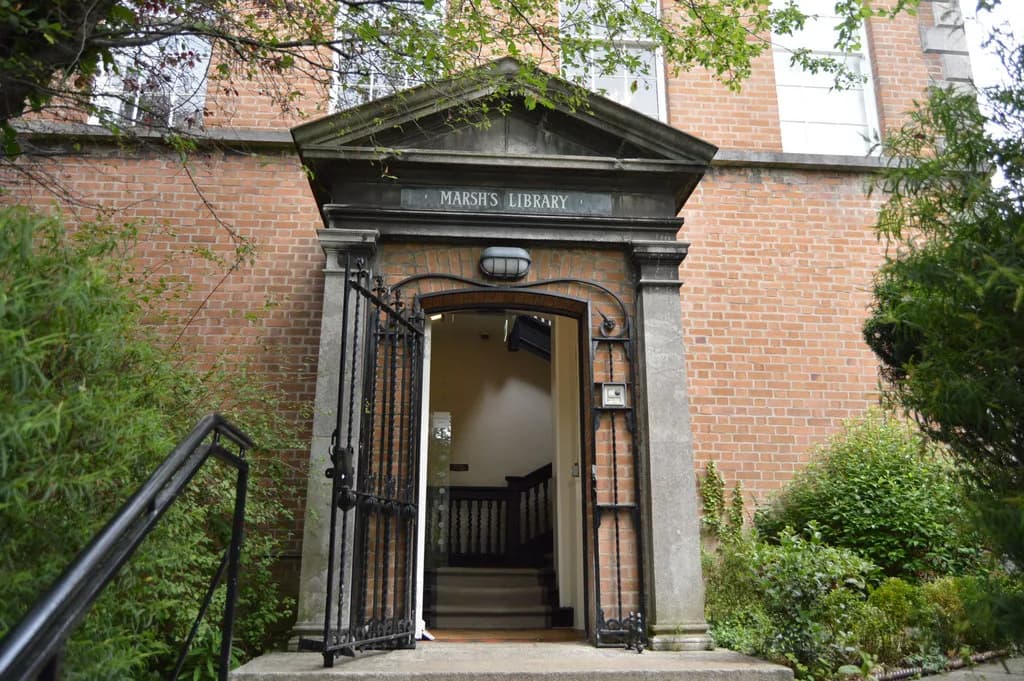
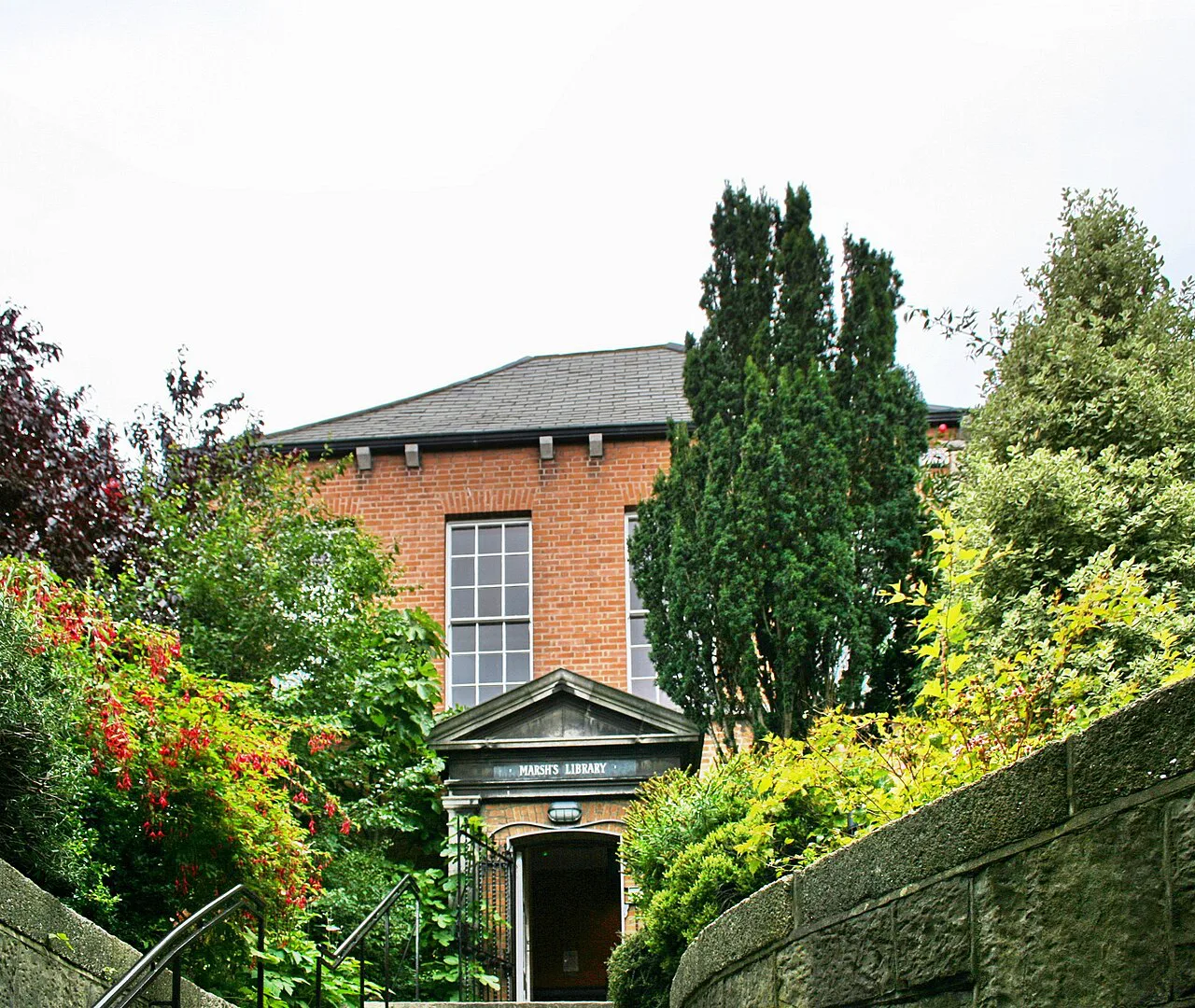
Marsh's Library was founded in the early eighteenth century by Archbishop Narcissus Marsh as the first public library in Ireland, intended for anyone who could read rather than only university or church members. An Act of the Irish parliament in October 1707 established it as a public library, and it still operates under that Act with amendments. Jonathan Swift, then Dean of St Patrick's Cathedral, was among its early Governors and attended annual meetings.
The library's records document writers reading on site: Bram Stoker came in 1866 as a Trinity student recommended by his tutor, and James Joyce signed the visitors' book in 1902. What survives is the record of their reading, not evidence that either was locked in the famous cages. Those wired alcoves were a later anti-theft measure imposed after more than a thousand books went missing by the mid-1760s.
Visiting hours are Tuesday to Friday 9.30 to 5.00 and Saturday 10.00 to 5.00, with the library closed on Sundays and bank holidays. It also closes for a seasonal break, shutting at 1pm on 23 December 2026 and reopening at 10.30am on 5 January 2027. Self-guided adult tickets cost €8 and concession tickets €6, bookable online through the library's own visit page.
Accessibility is limited by the historic building: the galleries are not wheelchair accessible, though ground-floor facilities, the shop and the garden can be arranged on request, and the reading room is on the ground floor. If stairs are a barrier, plan the visit around the ground floor and ask staff in advance.

Stop 3: National Library of Ireland, Kildare Street
The National Library of Ireland's Yeats exhibition draws on its Yeats Collection, described by the library as the largest assembly of books, manuscripts and personal items relating to W.B. Yeats anywhere. Highlights include manuscripts of well-known poems, his Nobel Prize medal and personal artefacts. Opening days currently require forward planning, so confirm them before building the stop into a fixed route.
The Kildare Street buildings, including the Yeats exhibition, have been closed on Saturdays since 3 October 2026 and will stay closed on Saturdays until further notice. They are also closed on Monday 26 October 2026. The exhibition remains open on Sundays, so a Sunday or a weekday is the reliable choice while these arrangements last.
While industrial action continues, only material held on site can be consulted in the reading rooms, and offsite items cannot be ordered. That matters if you hope to combine a visit with family or local history research rather than just the exhibition.
Stop 3b: Seamus Heaney Exhibition, Westmoreland Street
The Seamus Heaney exhibition, Listen Now Again, is not at Kildare Street. It sits in the Bank of Ireland Cultural and Heritage Centre on Westmoreland Street and is presented by the National Library of Ireland with partners, curated by Professor Geraldine Higgins. Its centrepiece is Heaney's own writing desk, surrounded by manuscripts, letters, photographs and recordings drawn from the archive he and his family donated to the library in 2011.
Entry is free without booking, and the exhibition runs until 2027. It opens 10am to 4pm Monday to Saturday with last admission at 3.30pm and is closed on bank holidays, so the Saturday closure affecting Kildare Street does not apply here. A guided tour runs daily at 2pm for visitors who want interpretation rather than a self-guided look.
Stop 4: Oscar Wilde House, Merrion Square
Oscar Wilde's parents, William and Jane, moved the family to Number One Merrion Square North in 1855, a few months after Oscar was born, and the house was the family's home for roughly two decades. It is his childhood home, not his birthplace. It now houses the American College Dublin, with part of the building open to visitors as Oscar Wilde House.
Jane Wilde, who wrote as Speranza, ran a weekly salon on the first floor that drew artists, poets, politicians and thinkers. That salon, rather than any single exhibit, is the reason the house repays a visit for readers interested in the literary culture surrounding the young Wilde.
Access is currently weekend-only until the end of April 2027, with walk-in visits from 11am to 6pm and last entry at 5pm. General admission is €12, with concession tickets at €10 and a separately booked guided tour at €25 on selected weekends. Book the guided tour online in advance, since there are no discounts on it.
Weekday Versus Weekend: Choosing Your Day
A weekday gives you Marsh's Library and the National Library's Yeats exhibition in one run, with the Heaney show on Westmoreland Street on the way back toward the river. A Saturday still works for Marsh's Library and the Heaney exhibition, but not for the Kildare Street buildings. A Sunday strips out Marsh's Library, which closes on Sundays, so the Yeats exhibition and Wilde House become the pair that fits.
If you only have one day, choose either the weekday set or the weekend set and treat the rest as a second visit. Trying to squeeze every interior into a single day means rushing the galleries, and Marsh's Library in particular rewards time in the old reading room and the first gallery rather than a quick pass.
What to Skip and How to Read the Streetscape
Distinguish three kinds of literary place. There are true former residences, such as Oscar Wilde's childhood home at Merrion Square; museums in buildings the writer never occupied, such as the James Joyce Centre; and institutions holding the papers and objects, such as the National Library and Marsh's Library. Each tells you something different, and none should be described as the others. If your interests run to the medieval and fortified rather than the literary, the city's Dublin Castles are a separate strand of the same old town.
Resist filling gaps with legend. The cages at Marsh's Library were a later anti-theft measure, not a literary ritual, and the library's own account places Stoker and Joyce at the reading tables rather than behind bars. Similarly, a fictional address in a novel is not a historical home.
If theatre and staging are part of your interest in these writers, the city's dublin theatres are a natural extension of the walk, since several of the figures here wrote for or about the stage. Pair that with a browse of the city's bookshops in dublin if you want to carry the reading list home.
Practical Notes Before You Set Out
Two checks cover most of the risk. First, confirm the National Library's Kildare Street opening days, since the Saturday closure is stated as continuing until further notice and short-notice changes are possible. Second, confirm Wilde House's weekend opening ahead of a late-April 2027 visit, as its current arrangement is described as running only to the end of that month.
For MoLI, all-day museum access runs from 10am to 5pm with last admission at 4pm, and the ticket includes all exhibitions, the Readers Garden, the café and the bookshop. That makes it a sensible rainy-day anchor or a half-day stop in its own right rather than a quick add-on.
Plan Your Visit
The most reliable version of this Dublin literary walking tour is a weekday loop through Marsh's Library and the National Library, a separate weekend stop at Oscar Wilde House, and the free Heaney exhibition fitted in whenever it suits. Book only the interiors you intend to enter, and leave the streets to do the rest.
Check the two live constraints before you travel: the Kildare Street Saturday closure and Wilde House's weekend-only arrangement until the end of April 2027. Everything else, including MoLI and the James Joyce Centre, can be arranged around them.
Explore more Ireland guides
Frequently Asked Questions
Can you do a Dublin literary walking tour without booking a guide?
Yes. The streets between the writers' places are public, and several interiors, including the National Library's Heaney exhibition, admit visitors free without booking. Others, such as Marsh's Library and Oscar Wilde House, sell tickets separately, and the James Joyce Centre runs its own guided walks if you later want one.
Which Dublin literary stops are open at weekends only?
Oscar Wilde House at 1 Merrion Square is currently open at weekends only until the end of April 2027, with walk-in visits from 11am to 6pm and last entry at 5pm. Check its events page before travelling, since the guided tour runs on selected weekends and must be booked online.
Is the WB Yeats exhibition at the National Library open on Saturdays?
Not at present. The Kildare Street buildings, including the Yeats exhibition, have been closed on Saturdays since 3 October 2026 until further notice, and are also closed on Monday 26 October 2026. The exhibition remains open on Sundays, with weekday hours applying the rest of the week.
Where is the Seamus Heaney exhibition in Dublin and is it free?
It is at the Bank of Ireland Cultural and Heritage Centre on Westmoreland Street, not at the National Library's Kildare Street building. Entry is free and booking is not required. It opens 10am to 4pm Monday to Saturday, with last admission at 3.30pm, closed on bank holidays, and a guided tour daily at 2pm.
Is 1 Merrion Square Oscar Wilde's birthplace?
No. The Wilde family moved to Number One Merrion Square North in 1855, a few months after Oscar was born, so the house is his childhood home rather than his birthplace. It now also houses the American College Dublin, with part of the building open to visitors as Oscar Wilde House.
Why is the James Joyce Centre not Joyce's house?
The Centre occupies a Georgian townhouse built in 1784 for the Earl of Kenmare and opened as a museum in 1996. Joyce never lived there. It holds displays including the door of No. 7 Eccles Street and exhibitions on his life and work.
Is Marsh's Library accessible for wheelchair users?
The galleries are not wheelchair accessible because of the historic building. Ground-floor facilities, the shop and the garden can be made available on request, and the reading room is on the ground floor. Contact the library in advance to arrange access.
How long does a self-guided literary walk in central Dublin take?
There is no fixed length, because the walk is yours to set. No standard duration applies to a self-guided route, and the time depends on how many interiors you enter. Allow extra time for Marsh's Library and the National Library, and split the route across a weekday and a weekend if you want to cover both.
Sources
- Home - James Joyce Centre, Dublin, Ireland
- Visit - James Joyce Centre, Dublin, Ireland
- Discover the Vibrant History of Marsh's Library (https://marshlibrary.ie/about/history/)
- https://marshlibrary.ie/visit/
- Oscar Wilde House: about
- Exhibition | Yeats: The Life and Works of William Butler Yeats | National Library of Ireland
- Opening Hours and Service Updates | National Library of Ireland
- Seamus Heaney: Listen Now Again
- Admission to MoLI | MoLI – Museum of Literature Ireland
You might also like



Continue reading
More guides you'll find useful





